
Imagine waking up to a flat tire, a broken refrigerator, or a sudden medical bill. For millions of Americans, these aren’t just small bumps in the road—they can be full-blown financial crises. Recent surveys show that about one in three adults in the United States would struggle to cover an unexpected $400 expense without borrowing, selling something, or going into debt.
The U.S. Federal Reserve’s annual report, based on responses from more than 12,000 adults, found that 63% of people could handle a $400 surprise with cash, savings, or a credit card paid off quickly. That still leaves 37% who would need outside help—or who simply couldn’t pay at all.
Roughly 13% said they wouldn’t be able to cover the cost under any circumstances. And when the expense grows, the situation worsens. Only about 55% of Americans have enough money saved to cover three months of expenses if they lost their income, while 30% have nothing close to that cushion.
Other research paints a similar picture. A U.S. News & World Report survey found that 42% of Americans don’t have any emergency savings at all. Men were more likely than women to have emergency funds, and when they did, men tended to have larger amounts saved.
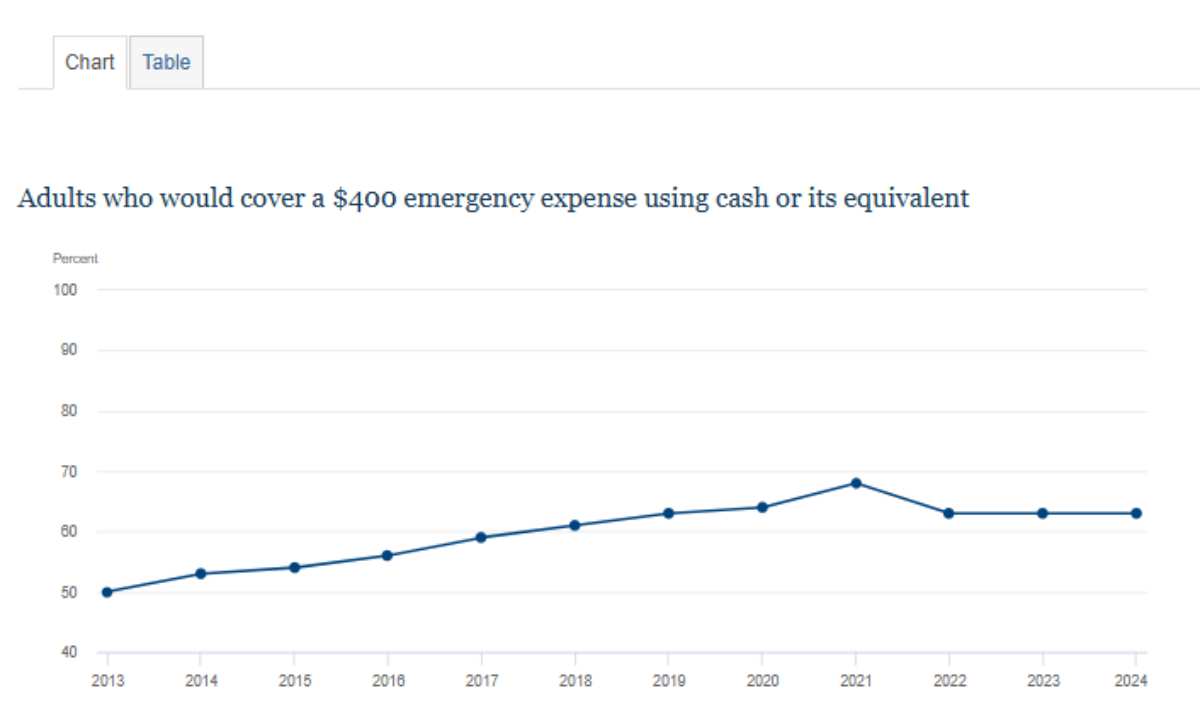
A review by JPMorgan Chase of almost 6 million households showed that just 8% of their customers couldn’t cover a $400 bill—but those numbers reflect banked households, meaning the unbanked and underbanked, who are often more vulnerable, weren’t counted. Even among low-income households that could handle a $400 hit, many would still need to lean on disposable income or credit cards instead of savings.
The challenge isn’t just about sudden expenses—it’s about the rising cost of everyday life. Bankrate’s 2025 report found that 59% of Americans don’t have enough savings to cover a $1,000 emergency, such as a bigger car repair or a medical procedure. Inflation is a major factor.
Grocery prices peaked at a 13.5% annual increase in 2022, and while inflation has cooled to 2.9% as of December, many essentials—food, rent, utilities—remain expensive. Some products have also quietly shrunk in size, a practice known as “shrinkflation,” which makes consumers feel their dollars stretch even less.
The financial strain is felt across all generations, but younger Americans are especially anxious. About 80% of Gen Zers worry about being able to pay for immediate needs if they lose their income, compared with 72% of Millennials and Gen Xers. Even 58% of Baby Boomers, many of whom are retired, say they regularly worry about having enough savings.
When faced with an emergency, borrowing is a common fallback. Only 41% of people told Bankrate they could cover a $1,000 expense with savings alone. About 25% would reach for a credit card, 13% would borrow from family, and 5% would take out a personal loan. In total, 43% would have to borrow in some form.
This is troubling given that Americans now carry a record $1.14 trillion in credit card debt, with average interest rates hovering around 24%. High rates make it easy for short-term fixes to spiral into long-term debt.
The data also shows a mixed picture of preparedness. While 36% of adults say their credit card debt exceeds their emergency savings, 55% actually have more saved than they owe—an encouraging sign and the highest level since 2018.
When asked about the size of their emergency funds, 28% said they had at least six months of expenses saved, 16% had three to five months, 29% had less than three months, and 27% had none at all.
Experts say that building a safety net is possible, even for those starting from zero. The general rule of thumb is to save three to six months’ worth of expenses. That means if your bills total $2,000 a month, you’d need $6,000 to $12,000 for a comfortable buffer.
Opening a dedicated emergency savings account, automating transfers from checking to savings, and sticking to a realistic budget can help make it happen. Even small, consistent deposits can grow over time and make the next $400—or $1,000—surprise much less frightening.
For now, though, the reality is clear: while zombies and AI may fill headlines, the financial fear keeping many Americans up at night is far more ordinary—a single unexpected bill.