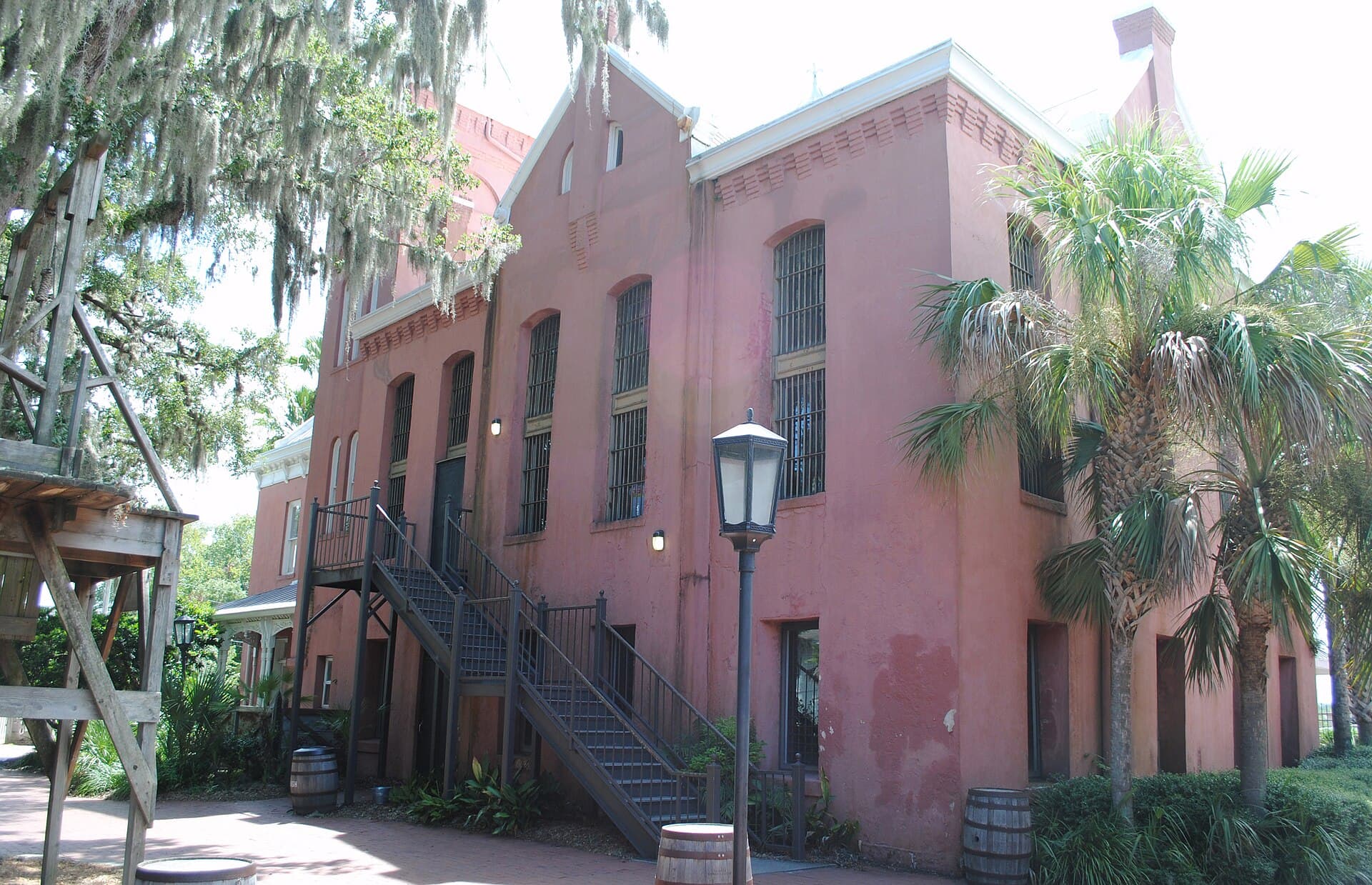
The Old Jail in St. Augustine looks almost welcoming, until you learn what happened behind its walls.
Its pink exterior and broad porch suggest a grand old house. Inside, iron cells tell a different story. This building held county prisoners from 1891 to 1953, and the museum records eight executions on its grounds.
Today, costumed guides lead visitors through the former jail. After midnight, smaller groups arrive with ghost-hunting equipment. Stories describe footsteps, shadow figures and a sheriff who supposedly never stopped making his rounds.
The place raises questions beyond whether ghosts exist. Why did a wealthy hotel developer help finance a jail? How did family life fit beside the cells? And how much of today’s haunted reputation rests on evidence? The answers reveal a disturbing piece of St. Augustine history beneath an inviting facade.
Creep Factor Score: 7/10
Rating: Seriously Spooky
| Historical Darkness | 8/10 |
|---|---|
| Paranormal Reputation | 6/10 |
| Atmosphere | 7/10 |
| Horror Fame | 6/10 |
| Visitor Experience | 8/10 |
How We Calculated This Score
This editorial score is the equal-weight average of five category ratings. It is not a visitor vote or a measure of paranormal evidence.
The execution history and preserved cells drive Historical Darkness. Recurring ghost stories support Paranormal Reputation, but limited independently verified accounts restrain that rating. The house-like exterior and confined interiors shape Atmosphere. Paranormal television supports Horror Fame. Daytime tours and midnight investigations strengthen Visitor Experience, although stairs limit access.
Why Is the Old Jail Famous?
The Old Jail combines preserved prison spaces, an execution history and a busy ghost-tour business. Visitors can enter the cells and see how closely the sheriff’s household lived beside the people confined there.
Paranormal television carried those stories beyond Florida. Ghost Hunters featured the location, and Kindred Spirits investigated it in the 2020 episode “Dead Men Tell Tales.” These programs helped turn a historic attraction into a destination for ghost hunters.
Its appeal comes from that overlap. History visitors see an unusual county jail. Paranormal enthusiasts enter a building already familiar from television and local ghost stories.
View this post on InstagramA post shared by Old Jail Museum St.Augustine (@oldjailmuseumstaugustine)
The Story Behind the Legend
A jail moved away from luxury
Henry Flagler helped reshape St. Augustine into a winter retreat for wealthy travelers. But the earlier county jail stood opposite his Ponce de Leon Hotel on Cordova Street.
The National Register nomination documents what followed. Flagler offered funding for a replacement in 1889. County commissioners accepted his proposal in 1890, and construction began that August.
The Pauly Jail Company completed the new building in early 1891. Flagler contributed $10,000 toward construction and bought the previous jail property for $2,500. He then had the old building demolished.
The replacement’s Romanesque Revival design gave it an unexpectedly domestic appearance. Its tower and porch softened the view from outside. The cells inside served a very different purpose.
Family quarters beside confinement
The sheriff and his family occupied living quarters within the same building. Today’s tour includes those spaces alongside the men’s and women’s cells and maximum-security area.
Sheriff Joe Perry remains central to the museum’s interpretation. He served from 1889 to 1897 and again from 1901 to 1919. The operator describes his involvement in a system that leased prisoners to local farmers.
That proximity makes the building unsettling without any ghost story. Domestic routines continued beside confinement, punishment and the threat of execution.
Executions and a second life
The museum counts eight men executed on the grounds. A historical article in the Florida Sheriffs Association’s magazine also documents St. Augustine hangings, including a triple execution on May 31, 1912.
The jail stopped holding prisoners in 1953. H.L. McDaniel acquired the building and developed the tourist attraction. Its later inclusion in the National Register of Historic Places in 1987 recognized its historical and architectural importance.
Why People Think It’s Haunted
The operator’s account of paranormal reports describes footsteps, unexplained voices, cold spots and figures in the cells. These are published haunting claims, not independently established events.
One recurring story identifies a figure as Sheriff Perry. Visitors and staff reportedly hear heavy footsteps or sense someone watching them. The account does not provide dated, named witnesses for these particular encounters.
Another story centers on the kitchen. A supposed former cook appears near the stove, while other accounts describe clattering cookware or food smells. Stories about solitary confinement involve moving shadows and the feeling of an unseen touch.
These tales gain force from their setting. Knowing that people suffered here can make a sound or shape feel especially significant. Darkness also leaves visitors with less information about what they are seeing.
Possible explanations deserve attention alongside the stories. Other visitors, outside sounds and shifting light should be checked before assigning a supernatural cause. Those possibilities do not settle every account, but uncertainty alone does not establish a haunting.
Fact Vs Fiction
The building’s history as a working jail is well established. Its haunted reputation rests on a different kind of material: tour narratives, personal accounts and paranormal entertainment.
A television appearance confirms that investigators visited. It does not confirm their interpretation of a sound or image. Likewise, National Register recognition concerns historical significance, not supernatural activity.
The distinction leaves room to enjoy the stories while treating the people who lived and died here as more than ghost-tour characters.
Fact Vs Fiction
The Old Jail has a documented history and a rich collection of ghost stories. Here, “Fiction” identifies unsupported claims, not proof that someone invented an experience.
Fact: The Old Jail held county prisoners from 1891 to 1953.
Fiction: Claims that Sheriff Joe Perry’s ghost still patrols the jail remain unverified.
Fact: Henry Flagler contributed funding to move the county jail away from his Ponce de Leon Hotel.
Fiction: National Register listing does not certify a haunting; it recognizes historical significance.
Fact: The sheriff’s family lived in quarters within the same building as the prisoners.
Can You Visit Today?
Yes. The Old Jail operates as a ticketed museum at 167 San Marco Ave., St. Augustine, Florida. Choose your experience carefully, because the daytime visit and midnight investigation differ considerably.
Daytime history tours
The operator lists roughly 30-minute guided tours, normally departing every 15 minutes from 9 a.m. through 4:30 p.m. Costumed performers lead the experience. Children of all ages may attend.
Free parking is available for patrons. The official visitor information explains that wheelchair access covers the first floor only. A visual presentation covers the upstairs spaces for guests unable to use the stairs. Tour scripts are available on request for visitors with hearing impairments.
Old Jail After Dark
The separate Old Jail After Dark investigation runs about 2½ hours, with a listed schedule of midnight to 2:30 a.m. Reservations are required, and participants must be at least 13.
The experience includes ghost-hunting equipment, and the operator encourages phone photography and audio recording. It is a late-night activity, not overnight accommodation.
Check the booking calendar for current prices, availability and holiday changes. Confirm the date carefully when reserving a midnight departure.
Is It Worth Visiting?
The Old Jail suits travelers who enjoy historic buildings and theatrical storytelling. History lovers should choose the daytime tour. Paranormal enthusiasts may prefer the longer investigation.
Visitors seeking a quiet, self-guided museum should expect a more performative experience. Families should also consider how children might respond to confinement and execution stories.
The strongest reason to visit is visible without special equipment: a pleasant-looking building that placed family life, imprisonment and death within the same small world.
Frequently Asked Questions
It has a well-known haunted reputation. Published accounts and television investigations do not establish that ghosts caused the reported experiences.
It held county prisoners from 1891 to 1953. The museum records eight executions on the property.
No horror feature-film connection was verified for this article. Its confirmed screen connections include paranormal television programs.
Yes, through ticketed guided visits. Daytime tours and the separately booked After Dark investigation offer different experiences.
The first floor is accessible. Reaching the second floor requires stairs; the operator offers a visual alternative for daytime visitors.