St. Augustine Lighthouse carries a haunting story of children who died before its famous beacon ever shone.
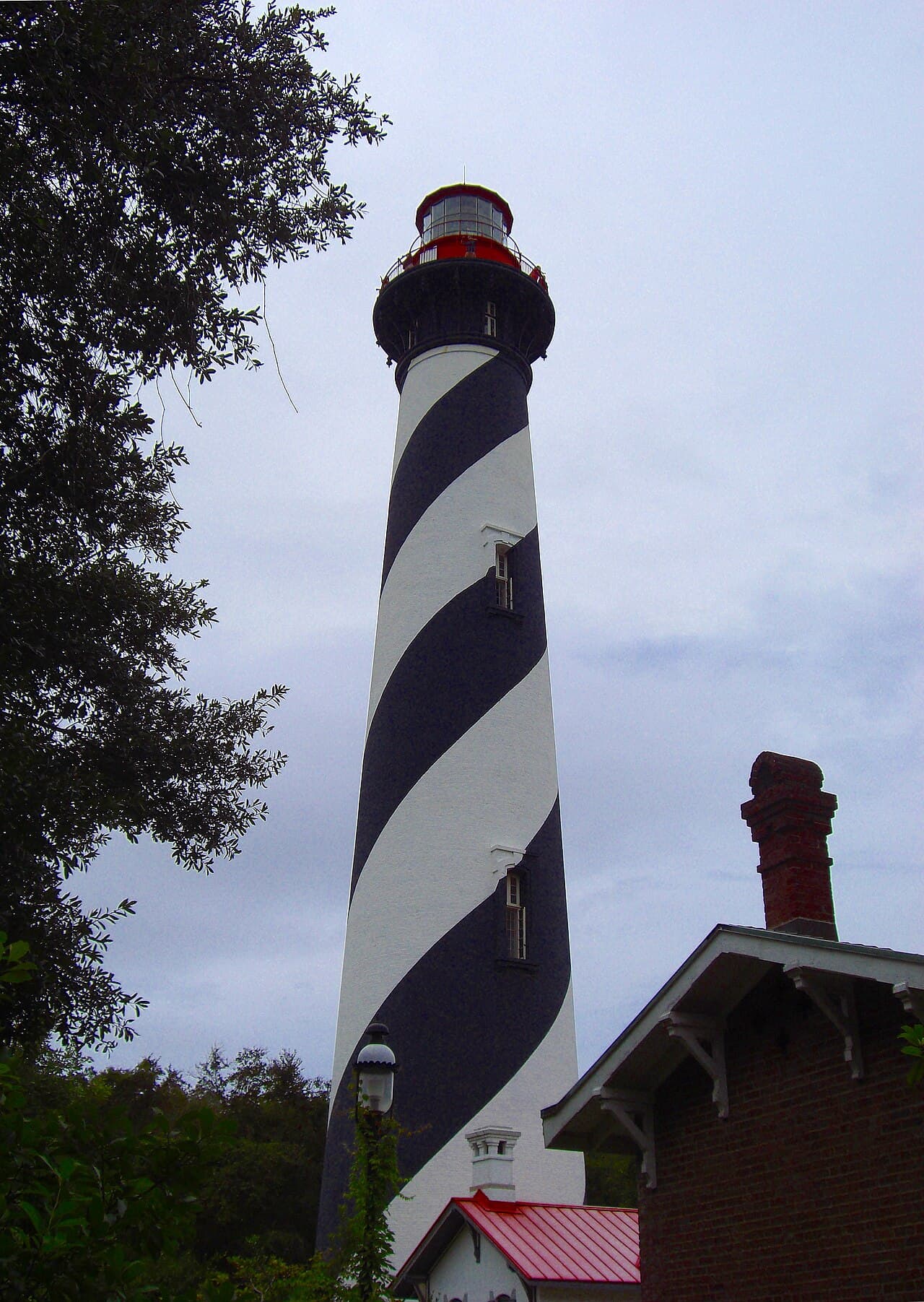
From outside, the black-and-white tower looks like a Florida postcard. Its spiral stripes rise above Anastasia Island, topped by a red lantern room. Inside, 219 steps lead toward the view. For ghost hunters, the climb carries another attraction: stories of figures watching from the railings above.
This St. Augustine landmark brings together maritime history, a fatal construction accident, and a memorable television investigation. Some events have strong historical support. Others survive through museum storytelling, visitor reports, and disputed recordings.
Knowing the difference makes the place more interesting. Behind the ghost stories are families who worked here, children who played beside the water, and people who saved the station from decay. Their history gives an evening visit weight long before anyone hears an unexplained sound.
Creep Factor Score: 7/10
Rating: Seriously Spooky
| Historical Darkness | 6/10 |
|---|---|
| Paranormal Reputation | 8/10 |
| Atmosphere | 7/10 |
| Horror Fame | 6/10 |
| Visitor Experience | 8/10 |
How We Calculated This Score
This editorial score is the equal-weight average of the five categories. It is not a visitor vote or a measurement of paranormal activity.
Documented accidents give the history emotional weight. Ghost stories and television investigations strengthen its paranormal reputation. The tall staircase and evening access add atmosphere, while museum exhibits broaden its appeal. Stair-only tower access limits the visitor experience for some travelers. The reputation score reflects the prominence of the claims, not proof of ghosts.
Why Is St. Augustine Lighthouse Famous?
St. Augustine Lighthouse is both a working coastal landmark and a destination for paranormal tourism. The present tower began operating in 1874. Today, the St. Augustine Lighthouse & Maritime Museum preserves the station and interprets the area’s maritime past.
Its national ghost-hunting profile grew through Ghost Hunters, including a 2006 episode. Investigators reported voices and a dark figure near the tower’s upper railings. The setting made those claims especially memorable: a tall staircase, dark landings, and something apparently moving beyond reach.
The museum now offers after-dark experiences that let visitors explore this reputation themselves. Its appeal combines a recognizable landmark with a question television could not settle: what caused those encounters?
The Story Behind the Legend
A Keeper’s Death at the Earlier Tower
The current lighthouse has an older predecessor. In 1824, the United States put a converted Spanish watchtower into service as a lighthouse.
In 1859, keeper Joseph Andreu died while whitewashing that earlier structure. His scaffolding failed, and he fell. His wife, Maria, took over the keeper’s duties.
This distinction matters when reading ghost stories. Andreu’s fatal accident happened before the striped tower standing today existed. Retellings that place his death on the present lighthouse blur two different buildings.
Coastal erosion eventually threatened the old station. A replacement farther inland offered a safer position, but its construction brought another tragedy.
The Children and the Supply Cart
Construction superintendent Hezekiah Pittee brought his family from Maine to St. Augustine. A rail cart carried building supplies from Salt Run to the worksite. The children also rode it for fun.
According to the museum’s account of the Pittee girls, disaster struck on July 10, 1873. The cart overturned into the water and trapped its riders underneath.
Mary Pittee, 15, Eliza Pittee, 13, and an unnamed Black girl, about 10, drowned. Worker Dan Sessions lifted the cart, and four-year-old Carrie Pittee survived.
The third victim deserves recognition alongside the sisters. The museum’s published account does not establish her name. Names suggested through psychic claims remain unverified.
In 2023, Carrie’s descendants visited the museum and donated family photographs. That connection reaches beyond the haunting narrative: a surviving child grew up, raised a family, and left descendants who still preserve her story.
A Light Worth Saving
The new tower first shone on October 15, 1874. Its French-made Fresnel lens concentrated lamplight into a beam that helped vessels navigate the coast.
The station later faced serious damage. Fire gutted the keepers’ house in 1970. Volunteers from the Junior Service League of St. Augustine undertook its restoration, helping turn the endangered property into a museum.
The lighthouse’s preservation history includes another remarkable rescue. Gunfire damaged the original lens in 1986. After repairs, it returned to service in 1993.
The place visitors explore today reflects decades of work to protect both the buildings and their stories.
Why People Think It’s Haunted
The children’s story anchors much of the folklore. The museum recounts a staff member hearing giggles from an apparently empty tower. Other stories describe a girl appearing near a visitor’s bed or a guest discovering a shoelace tied to the stairs.
These are reported experiences, not independently verified supernatural events. Several accounts lack named witnesses or precise dates, which limits what anyone can check.
The television investigation provides a more identifiable record. In Syfy’s episode recap, Jason Hawes and Grant Wilson describe voices, moving shadows, and a figure leaning over a railing. The team interpreted recorded audio as a woman asking for help.
They also found an ordinary explanation for one supposed phenomenon. A nearby window made a sound resembling a falling bucket.
That finding leaves a useful distinction. The program documents an investigation and the team’s conclusions. It does not establish that a ghost caused the remaining sounds or images.
View this post on Instagram
Fact Vs Fiction
The historical deaths and the ghost claims require different evidence. Records can establish an accident without establishing that its victims haunt a building.
Investigator Joe Nickell offered alternative explanations for the lighthouse reports after visiting and reviewing the television footage. He discussed wind, temperature-related metal noises, sleep-related experiences, and shadows cast by investigators themselves.
Those possibilities do not explain every individual account. They show why an unidentified sound or shape cannot, by itself, prove a haunting. The lighthouse has a well-established paranormal reputation; its supernatural explanation remains unverified.
Fact Vs Fiction
St. Augustine Lighthouse combines documented tragedy with ghost stories. Here, “Fiction” identifies an unsupported claim, not a judgment about a witness’s sincerity.
Fact: The current lighthouse first shone on October 15, 1874.
Fact: Two Pittee daughters died in the 1873 accident. Their younger sister Carrie survived.
Fiction: Joseph Andreu died falling from today’s tower. His fatal 1859 accident happened at its predecessor.
Fiction: Television investigators proved the lighthouse is haunted. Their recordings and interpretations do not establish a supernatural cause.
Can You Visit Today?
Yes. Use the GPS address 100 Red Cox Drive, St. Augustine, Florida 32080. The museum opens at 9 a.m.; closing times vary by season and special events.
General admission includes exhibits and the tower climb. There is no elevator. Children must be at least 44 inches tall and climb independently; carrying children in the tower is prohibited. Accessible museum spaces offer alternatives to climbing.
The Dark of the Moon Ghost Experience combines stories, investigation time, and a weather-dependent tower climb. The museum also lists separate Investigation-Only and family-oriented Ghost Tales options. Check the official visitor information for schedules, accessibility, and booking links.
Confirm ticket prices for your chosen visit before booking. Personal photography is generally permitted, but equipment restrictions apply. Commercial photography requires advance arrangements. Drones cannot operate over the property during opening hours or evening tours.
Is It Worth Visiting?
For history lovers, the surviving lens and restored station provide plenty to explore. Casual visitors can enjoy the coastal views and museum exhibits without joining a ghost tour.
Paranormal enthusiasts gain something different: access to the setting behind a famous investigation. An evening visit suits travelers who enjoy uncertainty, historic buildings, and stories told after dark.
Expect a preserved museum with a haunting reputation. The strongest reason to visit is the chance to encounter the real place behind the stories, including the lives those stories sometimes overshadow.
Frequently Asked Questions
Visitors and investigators report unusual experiences, but no independently verified evidence establishes that ghosts cause them.
Two Pittee sisters and another girl drowned in a supply-cart accident in 1873. Their younger sister Carrie survived.
Ghost Hunters featured the lighthouse, including a 2006 investigation associated with disputed shadow footage and recorded voices.
Yes, when the tower is open. The climb has 219 steps, height restrictions, and no elevator. Weather can interrupt access.