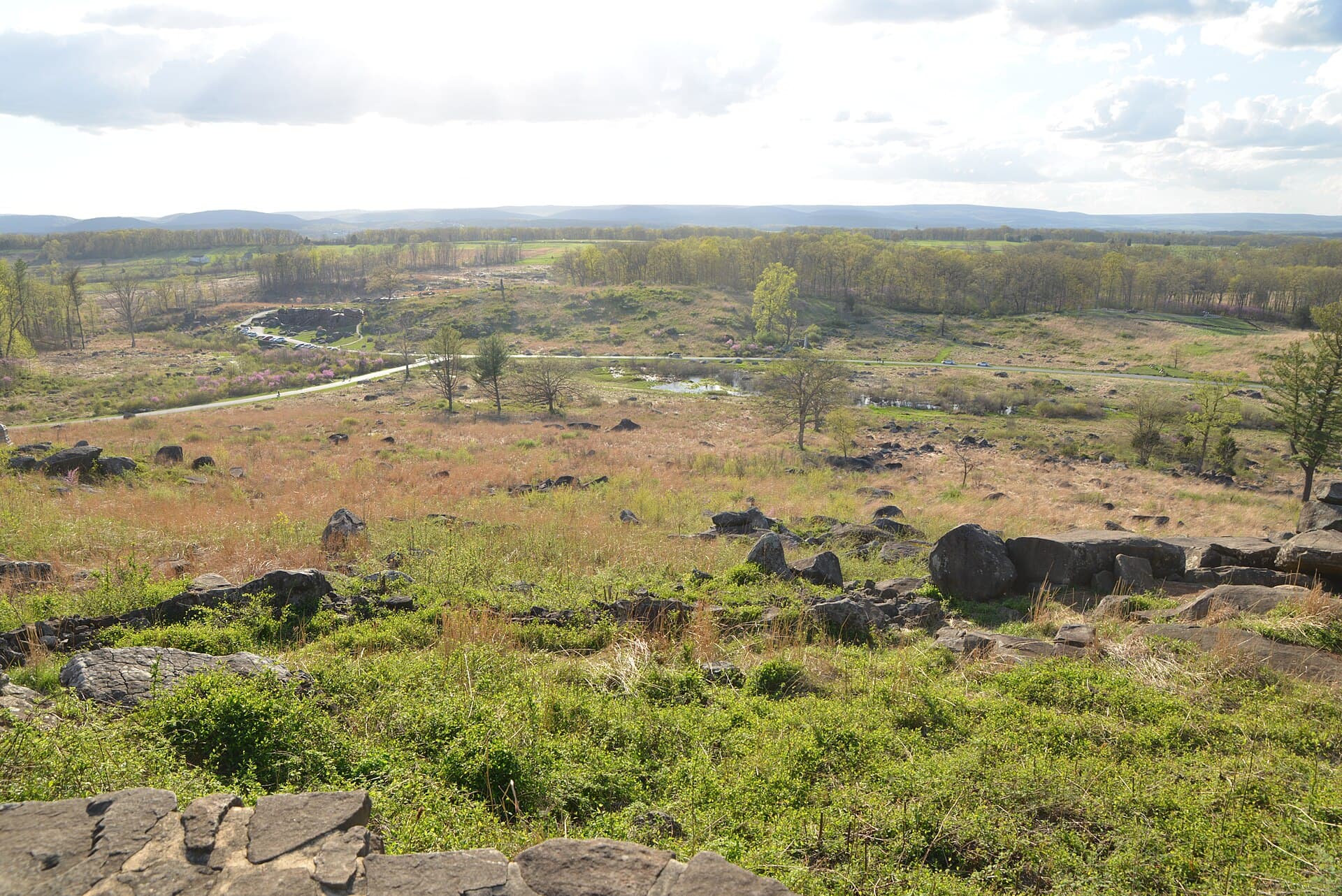
Stand among the boulders at Devil’s Den, and the landscape can feel strangely untouched. Stone walls cross open fields. Cannons point toward distant ridges. More than 1,300 monuments mark positions where soldiers fought, fell, and waited for attacks they knew were coming.
The documented history is disturbing enough. Roughly 51,000 soldiers were killed, wounded, captured, or reported missing during the Battle of Gettysburg. Afterward, residents faced thousands of bodies, overwhelmed field hospitals, and farms damaged by combat.
That history later produced stories of phantom gunfire, vanishing soldiers, and cameras that fail without explanation. Some accounts have circulated for generations. Others appeared through ghost tours, television programs, and online retellings. Here is what happened at Gettysburg, why people call it haunted, and what visitors can experience today.
Creep Factor Score: 9/10
Rating: Nightmare Fuel
| Historical Darkness | 10/10 |
| Paranormal Reputation | 8/10 |
| Atmosphere | 9/10 |
| Horror Fame | 8/10 |
| Visitor Experience | 9/10 |
How We Calculated This Score
This editorial score reflects Gettysburg’s documented casualties, enduring ghost stories, preserved battlefield atmosphere, cultural fame, and strong visitor access. The paranormal claims remain unverified, but the location’s real history and physical landscape create an unusually powerful experience.
Why Is Gettysburg Battlefield Famous?
Gettysburg Battlefield preserves the site of the Civil War’s largest and bloodiest battle. Union and Confederate forces fought around Gettysburg, Pennsylvania, from July 1 to July 3, 1863.
Confederate Gen. Robert E. Lee brought the Army of Northern Virginia into Pennsylvania during his second invasion of the North. Union Maj. Gen. George G. Meade moved the Army of the Potomac to stop him.
According to the National Park Service battle history, about 158,000 troops participated. Estimated casualties reached 23,000 for the Union and 28,000 for the Confederacy.
The Union victory ended Lee’s advance and forced his army back toward Virginia. Gettysburg became a symbol of the war’s human cost and the struggle over the country’s future.
The Story Behind The Legend
The battle began west and north of Gettysburg on July 1. Confederate forces pushed Union defenders through town, but Union troops regrouped on Cemetery Hill. Reinforcements arrived for both armies overnight.
Lee attacked both ends of the Union line on July 2. Fighting swept across the Wheatfield, Peach Orchard, Culp’s Hill, Little Round Top, and Devil’s Den. The rocky ground around Devil’s Den gave soldiers cover, but it also trapped men inside a confusing maze of boulders and gunfire.
On July 3, Lee ordered a massive assault against the Union center on Cemetery Ridge. The attack known as Pickett’s Charge crossed exposed fields under artillery and rifle fire. Confederate troops briefly reached the Union line before being driven back.
The fighting ended, but the suffering continued. Homes, barns, schools, and churches became hospitals. Bodies remained scattered across farms and fields. Some received hurried burials in shallow graves marked with wooden boards.
Reburial of Union soldiers began in October 1863. The Soldiers’ National Cemetery became the final resting place for more than 3,500 Union troops killed at Gettysburg. Confederate organizations later moved about 3,200 Confederate remains to Southern cemeteries.
President Abraham Lincoln visited the unfinished cemetery for its dedication on Nov. 19, 1863. His Gettysburg Address lasted about two minutes, but it transformed the battlefield into a national symbol of sacrifice and renewed freedom.
Why People Think Gettysburg Battlefield Is Haunted
Visitors and tour guides have reported apparitions, footsteps, drumbeats, distant gunfire, and unexplained cries. Stories concentrate around Devil’s Den, the Triangular Field, Little Round Top, the Wheatfield, and former field-hospital locations.
The best-known Devil’s Den legend describes a barefoot, poorly dressed soldier. Witnesses say he gestures toward the rocks, says, “What you’re looking for is over there,” and disappears. The tale is famous, but published versions rarely provide a named witness, a date, or contemporary documentation.
Other visitors claim their cameras stop working near Devil’s Den or produce strange figures. Reports also describe the smell of smoke or gunpowder when no fire is present. These experiences form an important part of Gettysburg folklore, but they do not establish that supernatural activity occurred.
Historian and former park ranger Mark Nesbitt helped popularize many accounts through his Ghosts of Gettysburg books and walking tours. A history of Gettysburg’s ghost stories traces one reported supernatural incident to the battle itself, when soldiers described a mysterious Revolutionary War-era horseman.
Natural conditions offer possible explanations for some modern experiences. Fog, wildlife, distant traffic, reenactors, shifting light, and expectation can alter how people interpret an unfamiliar landscape. Electronic failures and unusual photographs can also result from batteries, moisture, exposure, reflections, or motion.
Fact Vs Fiction
Gettysburg’s casualty figures, battlefield burials, military movements, and hospital conditions are supported by official records. The ghost accounts depend mainly on personal testimony and later retellings.
Even some famous Civil War images require caution. Photographers moved at least one dead soldier and placed a rifle beside him to create the dramatic Devil’s Den image known as “Home of a Rebel Sharpshooter.” The Library of Congress examination of the moved body shows that mythmaking began within days of the battle.
The battlefield’s real history supports its unsettling atmosphere. It does not prove that phantom soldiers walk among the monuments. Gettysburg can be both a place of documented horror and a landscape shaped by folklore.
Fact Vs Fiction
Gettysburg Battlefield combines documented history with enduring folklore. Here, “Fiction” identifies unsupported claims, not proof that every reported experience was invented.
Fact: Gettysburg’s estimated 51,000 casualties include soldiers killed, wounded, captured or missing.
Fact: Photographers moved a dead soldier before creating the famous “Home of a Rebel Sharpshooter” image.
Fiction: Claims that a barefoot ghost guides visitors at Devil’s Den remain unverified.
Fiction: The ghost-cartridge story is not securely documented as an encounter on the Gettysburg movie set.
Can You Visit Gettysburg Battlefield Today?
Gettysburg National Military Park remains open to visitors. The battlefield, roads, visitor center, and national cemetery are free. Park grounds generally open 30 minutes before sunrise and close 30 minutes after sunset, weather permitting.
The museum, Cyclorama painting, and film experience require paid tickets. Licensed battlefield guides also offer private car and bus tours. Prices and schedules can change, so review the park’s official visitor and ticket information before traveling.
Commercial ghost tours operate primarily in Gettysburg’s town streets and historic buildings. Visitors should not enter battlefield property after closing or climb restricted monuments and formations. Metal detecting, relic hunting, and removing artifacts are prohibited.
Is Gettysburg Battlefield Worth Visiting?
Gettysburg is essential for travelers interested in American history. The preserved terrain makes the battle easier to understand than a museum display alone ever could.
Paranormal enthusiasts will recognize locations connected to famous legends, especially Devil’s Den. Still, the best visit begins with the history. Knowing what happened in the fields gives the silence, monuments, and ghost stories their power.
Gettysburg does not need a proven apparition to feel haunted. Its unsettling quality comes from realizing that the peaceful landscape was once filled with smoke, confusion, and tens of thousands of wounded men.
Frequently Asked Questions
No scientific evidence proves that Gettysburg is haunted. Apparitions, phantom sounds, and equipment failures remain witness reports and folklore.
Devil’s Den has the strongest paranormal reputation. Visitors also report experiences around the Triangular Field, Wheatfield, Little Round Top, and former hospitals.
Yes. The 1993 war film Gettysburg filmed limited scenes on the actual battlefield. Most combat scenes were created on nearby Adams County land.
No. Park grounds close 30 minutes after sunset. Evening ghost tours generally visit authorized locations in town or operate on private property.