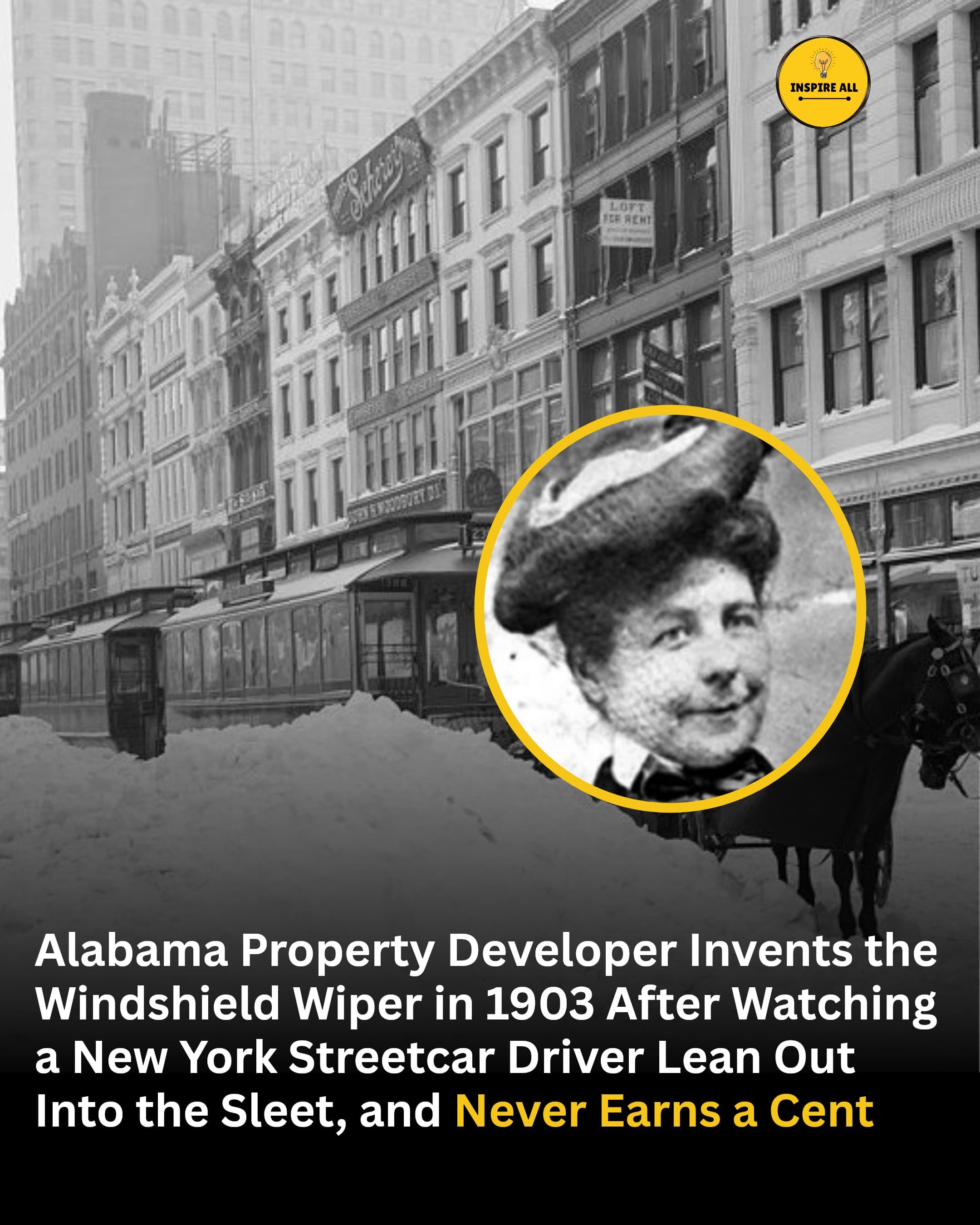
A Birmingham entrepreneur saw a problem on a New York streetcar and designed a way for drivers to clear the glass from inside.
Mary Anderson’s windshield wiper began with an ordinary frustration: a driver could not see through snow and sleet.
During a visit to New York in the early 1900s, the Alabama property developer watched a streetcar driver interrupt the journey to clear the front window. Back in Birmingham, she developed a mechanical answer. On November 10, 1903, she received U.S. Patent No. 743,801 for a window-cleaning device. The Encyclopedia of Alabama documents the invention and its unsuccessful attempt at commercialization.
A blade controlled from the driver’s seat
Anderson’s design connected an interior lever to an arm outside the window. A rubber blade swept the glass, while a counterweight helped maintain contact.
The useful change was where the work happened. A driver could operate the mechanism from inside rather than stopping to clean the pane by hand. The National Inventors Hall of Fame describes the working arrangement.
Anderson already had experience taking on unfamiliar work. She had managed property in Birmingham and operated a California ranch and vineyard. Her invention grew from observation rather than a career in automotive engineering.
A patent did not produce a market
In 1905, Anderson approached a Canadian firm about selling the patent. It declined, finding insufficient commercial value in the device.
Her version never entered production, according to the Alabama encyclopedia. That is the clearest documented outcome; the familiar claim that she “never earned a cent” compresses the commercial history into a stronger slogan.
The Hall of Fame’s historical account dates the patent’s expiration to 1920. Cadillac made windshield wipers standard equipment in 1922.
Recognition arrived much later
Anderson died in 1953. Her induction into the National Inventors Hall of Fame came in 2011.
Her story preserves a useful distinction between seeing a need, making a workable invention, and persuading someone to manufacture it. She completed the first two steps, even though the commercial reward did not follow.
Related stories: the Wright brothers’ wind-tunnel experiments and John Harrison’s sea clock.