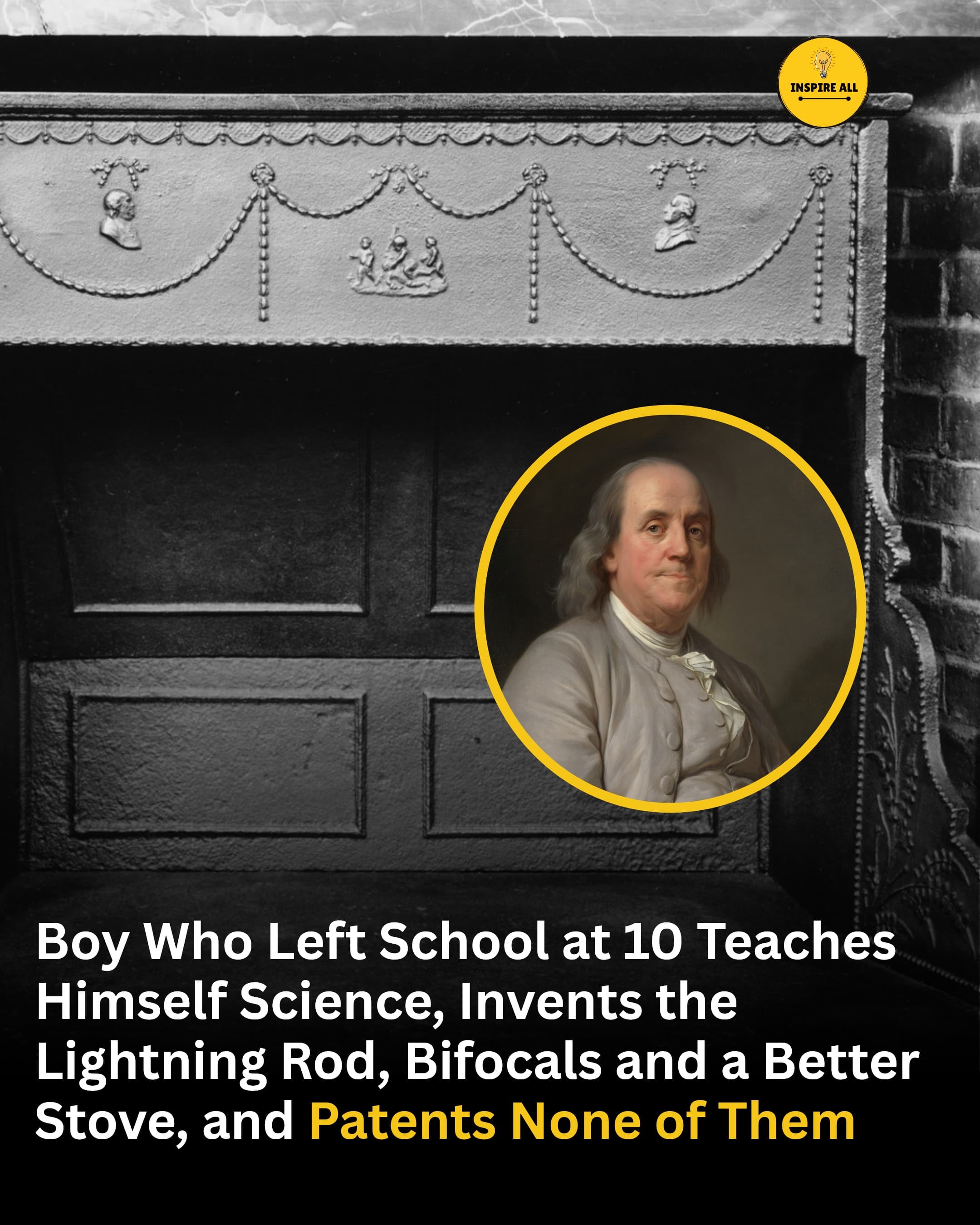
The printer and experimenter approached everyday problems with curiosity, then chose to make his inventions freely available.
Benjamin Franklin’s formal schooling ended when he was ten, but his education continued through reading, work, and experimentation. He later developed inventions associated with safer buildings, warmer rooms, and clearer vision.
His early departure from school appears in historical accounts preserved by the Library of Congress. In 1718, at twelve, he began an apprenticeship with his brother James, a printer, as the library’s Franklin chronology records.
The story is less about having no education than about continuing to learn beyond a classroom.
Inventions that began with practical questions
The Franklin Institute’s account of his inventions describes a lifelong interest in improving familiar things.
At eleven, he made wooden swimming aids held in his hands. The experiment helped him move through the water, although it tired his wrists. The childhood design was an early example of trying an idea, noticing its limits, and learning from the result.
In 1742, he designed the heating arrangement that became known as the Franklin stove. It aimed to get more useful warmth from a fire while reducing smoke.
His “double spectacles,” now called bifocals, put lenses for distance and close work into one frame. Instead of changing glasses, the wearer could look through different portions of the same pair.
Turning electrical research into protection
Franklin’s work on electricity also produced the lightning rod. His interest extended beyond explaining a natural phenomenon to protecting buildings and the people inside them.
That practical purpose connects the inventions. A fireplace, a pair of glasses, and protection against lightning addressed very different problems, but each brought experimentation into daily life.
Why he did not patent them
The Franklin Institute states that Franklin never patented his inventions. He believed that benefiting from other people’s discoveries created a reason to share his own.
His choice does not erase the work behind the designs. It shows what he wanted that work to accomplish: improvements others could use.
For more stories of learning through work, read about Michael Faraday’s bookbinding apprenticeship and Steve Wozniak’s early computer design.