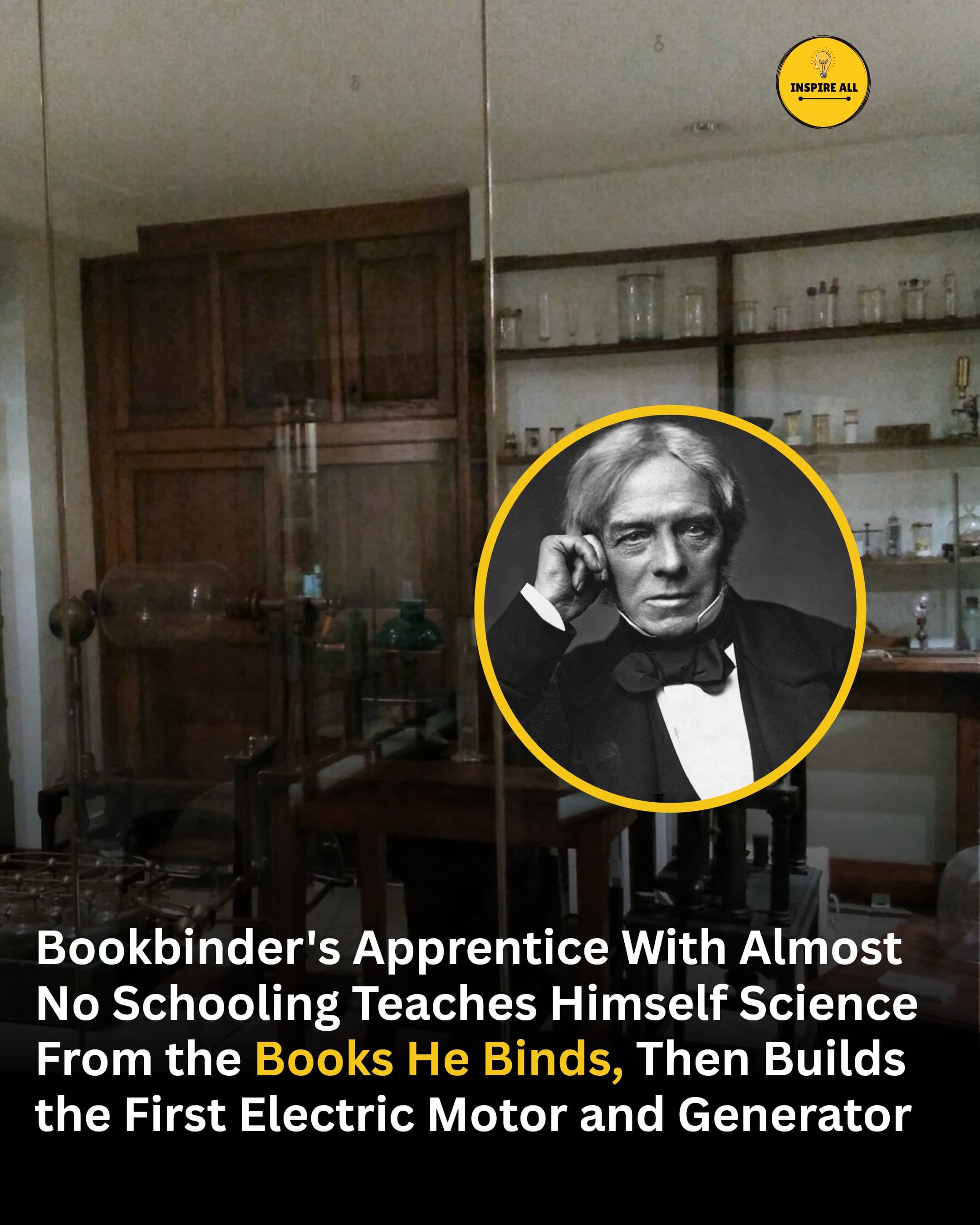
Before his electrical discoveries, Michael Faraday learned science from books he encountered at work and lectures he carefully recorded.
Michael Faraday’s route into science began in a bookbinding workshop. The son of a blacksmith, he had limited formal schooling and started an apprenticeship at 14.
The Royal Institution’s account of his early work explains that he read scientific books as he bound them. A customer later provided tickets to Humphry Davy’s lectures.
Faraday took notes and presented them to Davy in the hope of finding work. A position was not immediately available, but he eventually joined the institution as a chemical assistant.
Learning through careful records
Faraday’s notebooks help give this story substance beyond the familiar label of a self-taught genius.
In a Royal Institution archival essay, five small notebooks from 1810–1812 record his understanding of other people’s scientific teaching.
They are distinct from his later research notebooks. That difference reveals a progression: studying existing work came before documenting discoveries of his own.
The archive preserves both stages, making it possible to examine the habits behind the better-known achievements.
From motion to induction
The institution’s historical timeline dates Faraday’s electromagnetic rotations to 1821 and his discovery of electromagnetic induction to 1831.
Those are related but different advances. The first demonstrated electrical production of continuous rotation; induction concerned generating an electrical effect through changing magnetic conditions.
Calling them simply a modern motor and generator can hide the experimental nature of the original apparatus. The significance lies in the principles they demonstrated and the engineering they helped make possible.
A career built beyond the workshop
Faraday also became an important public communicator of science. The Royal Institution credits him with establishing its Christmas Lectures and Friday Evening Discourses in 1825.
The bookbinding years were an entry point, rather than a substitute for all the learning that followed. His career involved laboratory practice, colleagues, repeated experiments and sustained record keeping.
His story is compelling because the early notebooks survive. They show a young worker taking unfamiliar ideas seriously enough to study and organize them.
That patient work links the apprentice reading a book to the researcher recording an experiment.
This historical profile draws on Royal Institution collections and institutional history. Featured graphic supplied by Inspire All.
Related reading: Himaja’s voice-controlled Braille printer and Gargi Agrawalla’s portable alert prototype.