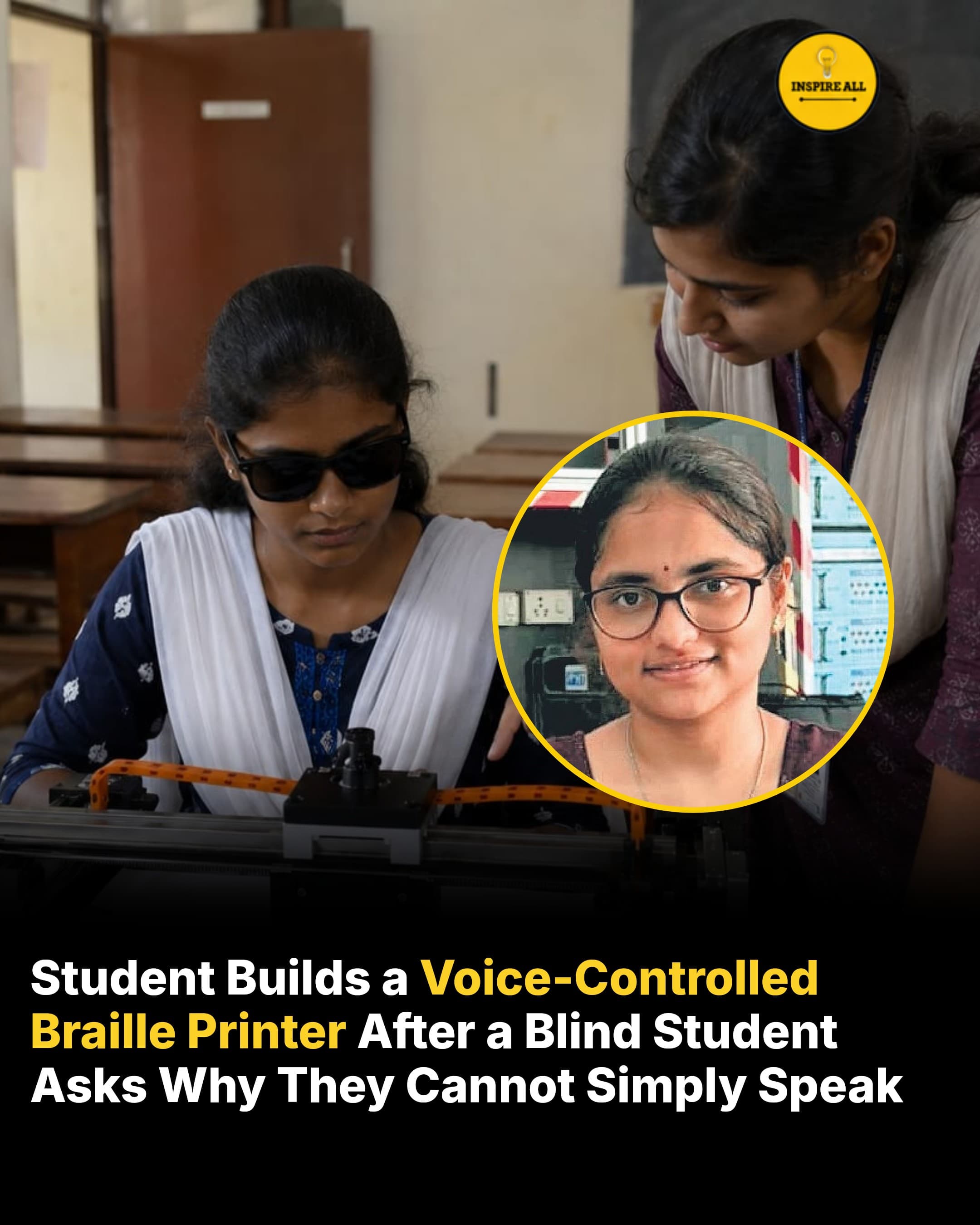
Lingampalli Himaja’s engineering project changed direction when a student suggested speaking instead of pressing buttons. Her voice-enabled Braille printer has since earned national recognition in India.
A visit to a school for visually impaired students gave Lingampalli Himaja a practical problem to explore. Could creating a Braille document require less manual effort?
The engineering student developed a button-operated prototype, then returned to students for feedback. Their response helped turn it into RUDHRA, a system designed to convert speech into embossed Braille.
Himaja studies at Shri Vishnu Engineering College for Women in Bhimavaram, Andhra Pradesh. Her project won India’s national James Dyson Award in 2026 and subsequently reached the competition’s global Top 20 shortlist.
The question that changed the prototype
In a September 2026 interview with The Indian Express, Himaja described watching students write with Braille slates and styluses during a school visit.
Her first prototype used six push buttons to select the dots in each character. Testing it with students brought a different suggestion: why enter the information through buttons when they could speak?
The project then moved toward voice input. Himaja told the newspaper that development took roughly a year and a half to two years, with assistance from college faculty and repeated trials.
That sequence matters. Students were contributing to the design, identifying a change that the initial prototype had not addressed. Their feedback helped define what the next version should do.
Why slate-and-stylus writing uses reversed patterns
A slate and stylus remains a portable way to write Braille by hand. The writer presses dots into paper held in a frame, then turns the sheet over to read the raised side.
The University of Colorado Boulder’s guide explains that conventional slate writing proceeds from right to left so the finished page can be read from left to right after it is turned over.
RUDHRA aims to automate that preparation and embossing work. It does not eliminate the need to understand Braille when reading the result.
Other Braille writing tools already exist. The Florida Division of Blind Services describes six-key Braille writers as well as slates and styluses. RUDHRA’s particular approach combines spoken input with a printing workflow.
How RUDHRA turns speech into Braille
According to the team’s James Dyson Award project entry, Alexa converts spoken input into text. A Raspberry Pi translates that text into the reversed dot patterns needed for embossing.
Stepper motors position the mechanism across the page, and a solenoid presses the dots into the paper. The finished output contains raised Braille characters.
The team also describes voice commands for creating, editing, storing and printing notes. A text-verification step before printing is intended to reduce input mistakes.
That check addresses a practical issue: a speech-recognition error can otherwise become an error on the embossed page. The published description establishes the intended workflow, rather than an independently measured error rate.
Recognition in India and beyond
Dyson’s national-winners announcement, published September 16, 2026, lists RUDHRA as India’s winner.
Its global Top 20 announcement, published October 14, 2026, also includes the project.
As of November 2, 2026, that places RUDHRA among the international finalists. Dyson says the global winners are scheduled to be announced on November 4. A national win and an international shortlist place are separate achievements; neither should be described as winning the global competition.
The recognition provides a verified milestone in the project’s development. It does not establish commercial availability or performance in every classroom.
What still needs development
The project entry identifies automatic paper feeding and broader use in schools, examination settings and homes as future ambitions.
Those plans should be distinguished from features already described in the prototype. The available sources do not establish large-scale deployment, independently verified printing accuracy or a retail launch.
Himaja’s work offers a clear example of how returning to users can change an engineering decision. She began by automating a manual task. A student’s suggestion then helped her rethink how information should enter the machine.
The next stage is to keep testing and refining that experience with the people who will use it.
Related reading: Esther Kimani’s solar-powered crop-alert system and Mansukhbhai Prajapati’s clay refrigerator.
Reporting draws on the published project entry, Dyson announcements, an Indian Express interview and Braille-writing guides linked above. Trending American has not independently tested RUDHRA. Featured graphic supplied by Inspire All; supplied photo credits: project team and EPS.