
Mansukhbhai Prajapati drew on his family’s pottery background to develop Mitticool, a clay refrigerator that cools without electricity. Its story began years before the product reached kitchens.
Before Mansukhbhai Prajapati became known for a refrigerator made from clay, he worked at a tea stall and later in a factory. In Wankaner, in the western Indian state of Gujarat, he began exploring how the material familiar to generations of potters could serve a wider range of household needs.
After the 2001 Gujarat earthquake, that work took a new direction: a cooling cabinet that would use water instead of an electrically powered compressor. The result was Mitticool, an invention already being documented in news coverage by 2011.
It is a story of traditional craft finding another practical use, with an important qualification. Cooling food through evaporation is different from maintaining the controlled temperature of a conventional refrigerator.
From selling tea to working with clay
According to Mitticool’s founder biography, Prajapati came from a pottery family and wanted to modernize the knowledge held by local craftspeople.
His early working life included a tea stall, followed by factory employment. He then pursued making clay tawas, the flat pans used to cook breads. The company describes borrowing money to begin that work despite discouragement.
Those experiences put his later invention in context. The refrigerator emerged from an existing effort to make useful kitchen products, rather than from a sudden departure into an unfamiliar material.
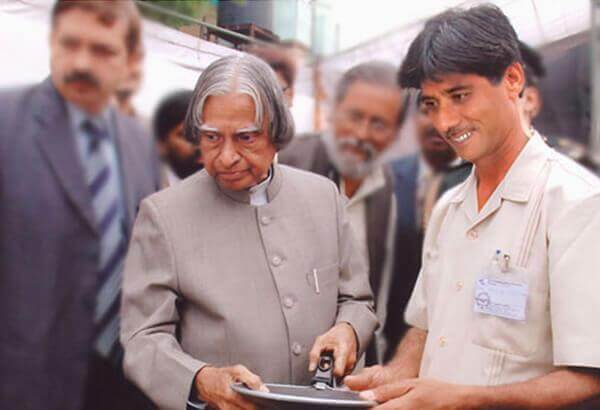
An earthquake prompted a different question
In a report published on June 27, 2011, NDTV interviewed Prajapati about the refrigerator and its origins.
He recalled journalists photographing broken earthen water pots after the 2001 earthquake and describing them as a refrigerator for people with little money. That comparison prompted him to consider building an actual cabinet using the same cooling principle.
The report described four years of experiments with different clay mixtures. Finding a workable material meant repeated testing, including combinations with sand and sawdust to create a porous structure.
By the time of that reporting, his range also included clay water filters, pressure cookers and tawas. The refrigerator was part of a broader effort to adapt earthenware to everyday kitchen tasks.
These are historical milestones, rather than evidence of a newly launched invention. Prices and sales figures from that period should not be read as current offers.
How the Mitticool clay refrigerator works
India’s Science, Technology and Innovation portal identifies Prajapati as the innovator and explains the cabinet’s basic design.
Water occupies an upper chamber. As it moves through the porous clay and evaporates, it removes heat, cooling the storage area below. A tap provides access to water, while lower shelves hold food.
There is no electrically powered compressor doing that cooling. The process draws on the same physical effect that allows water to cool in a porous earthen pot.
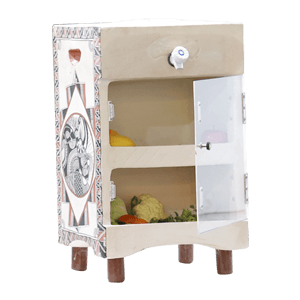
Its performance depends on the surroundings
The manufacturer’s product instructions say the cabinet needs ventilation and that performance depends on outside temperature and humidity. Mitticool says it performs well in hot, dry conditions.
That is consistent with the broader science of evaporation. The Pacific Northwest National Laboratory’s guide to evaporative cooling explains that the process works best in dry climates with low relative humidity. Its guide concerns building cooling, rather than a performance test of this refrigerator.
For food storage, a temperature drop alone does not establish safety. The U.S. Food and Drug Administration recommends keeping refrigerators at 40°F or below and using a thermometer to check.
A clay cabinet should therefore not be assumed to provide safe storage for foods requiring refrigeration simply because its interior feels cooler. This article does not establish that Mitticool consistently reaches that temperature.
A familiar material, a wider purpose
Prajapati’s achievement rests on a concrete sequence: pottery knowledge, household products, a question raised after a disaster, and years of experiments with clay.
His work shows how an established craft can become the basis for another useful design. Understanding the cabinet’s limits makes that achievement easier to appreciate on its own terms.
For more about his early work and ambitions, read Mitticool’s account of its founder’s journey.
Related reading: A Mexican student’s experiment with sound and small flames and a South African student’s safety-earring invention.