Most people reach for water or a fire extinguisher when they see flames.
But a Mexican high school student asked a different question: Could sound put out a fire?
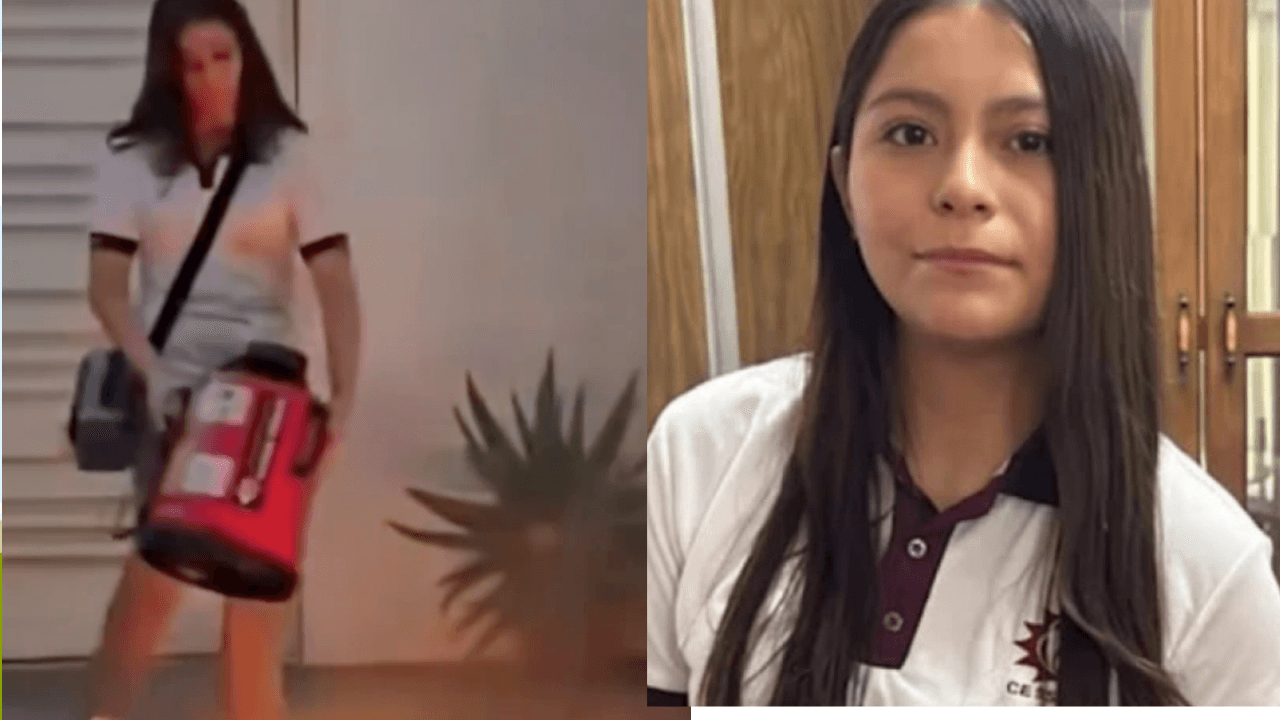
Ángela Karime Venegas Hernández, a student at CETis 78 in Altamira, Tamaulipas, built a device designed to do exactly that.
Her invention, called Vortex Tech, uses low-frequency sound waves to extinguish small flames without spraying water or chemical powder.
In October 2026, her project earned a gold medal at an international science competition in Indonesia.
The Student Who Saw a Different Way to Fight Fire
Ángela was studying at CETis 78 when she developed the idea for a sound-powered fire suppression device.
Instead of using traditional extinguishing materials, she wanted to explore how sound waves affect flames.
The result was Vortex Tech, an experimental device that uses acoustic energy to disrupt the air surrounding a fire.
Her project had already attracted attention in Tamaulipas before reaching the international competition.
With guidance from adviser José Arturo Hernández Muñoz, she developed the prototype and prepared to demonstrate its capabilities.
How Can Sound Put Out a Flame?
A flame needs fuel, heat and an adequate supply of oxygen to keep burning.
Vortex Tech uses low-frequency sound waves to create movement in the surrounding air.
The device reportedly operates at approximately 30 hertz, a frequency close to the lower limit of normal human hearing.
Those sound waves can disturb the combustion zone around a small flame, helping extinguish it under controlled conditions.
The concept is similar in some ways to blowing out a candle, although the device uses a speaker to generate the airflow disturbances.
It does not make fire disappear through sound alone. It changes the physical conditions that allow a flame to continue burning.
A Prototype Powered by a Small Battery
The invention uses a 12-volt battery, a frequency generator, an amplifier and a speaker.
Together, these components produce the low-frequency acoustic waves.
Unlike a conventional extinguisher, the prototype does not release water, foam or dry chemical powder.
In reported demonstrations, it extinguished small flames within about five to eight seconds.
That result is promising for a student experiment, but it does not establish how the device would perform against a larger or more dangerous fire.
Its effectiveness depends on conditions such as fuel type, flame size, distance and surrounding airflow.
Her Work Earned Gold in Indonesia
Ángela presented Vortex Tech at the International Science and Invention Fair, known as ISIF 2026, in Indonesia.
The competition brought together student science and innovation projects from multiple countries.
Published reports describe approximately 110 selected projects from around 25 nations, although the exact totals vary by source.
Ángela earned a gold medal for her invention.
She also received the IYSA Semi Grand Award, creating an opportunity to participate in another international applied-science competition in Indonesia.
The recognition brought attention to her school and to young innovators in Tamaulipas.
Mexico's President Congratulated Her
Following the international award, Mexican President Claudia Sheinbaum publicly congratulated Ángela.
The recognition helped her story reach audiences beyond the science competition.
For a high school student, the achievement represented more than a medal.
It showed that an idea developed through school-level research could attract international interest.
Her success also highlighted the importance of teachers and advisers who help students turn scientific curiosity into working experiments.
Could Sound-Powered Extinguishers Replace Traditional Ones?
Not yet.
Vortex Tech is an experimental prototype, not a commercially certified fire extinguisher.
Its award recognizes the innovation demonstrated at a student science competition.
It does not mean the device has passed professional fire-protection tests or is approved for emergency use.
Researchers would need to test the system against different fuels, flame sizes and environmental conditions.
They would also need to examine reliability, power requirements and safety before considering real-world applications.
For now, people should continue relying on certified fire extinguishers, alarms and established fire-safety procedures.
A Young Inventor With a Bigger Opportunity
Ángela's project offers an example of how familiar scientific principles can inspire new inventions.
Sound is usually associated with music, speech and communication.
She explored whether it could also help suppress flames.
Her work has not solved every challenge involved in firefighting, but it has opened a path for further experimentation.
Independent research could help determine whether acoustic fire suppression has practical uses in specific controlled environments.
From a Classroom Idea to International Recognition
Ángela began with a question that sounded almost impossible.
Could something invisible, like sound, help put out a flame?
She turned that question into a working student prototype and carried it to an international competition.
There, her work earned a gold medal.
Ángela did not need to invent a new element or build a giant machine to attract attention. She looked at something familiar, asked a different question and found a new way to experiment with it.
Editor's note: Vortex Tech remains an experimental student prototype. Its competition awards do not constitute professional fire-safety certification.
Sources: El País — Ángela's international award; El Financiero — invention and competition; UnoTV — gold medal and additional recognition; Mexico News Daily — acoustic extinguisher.