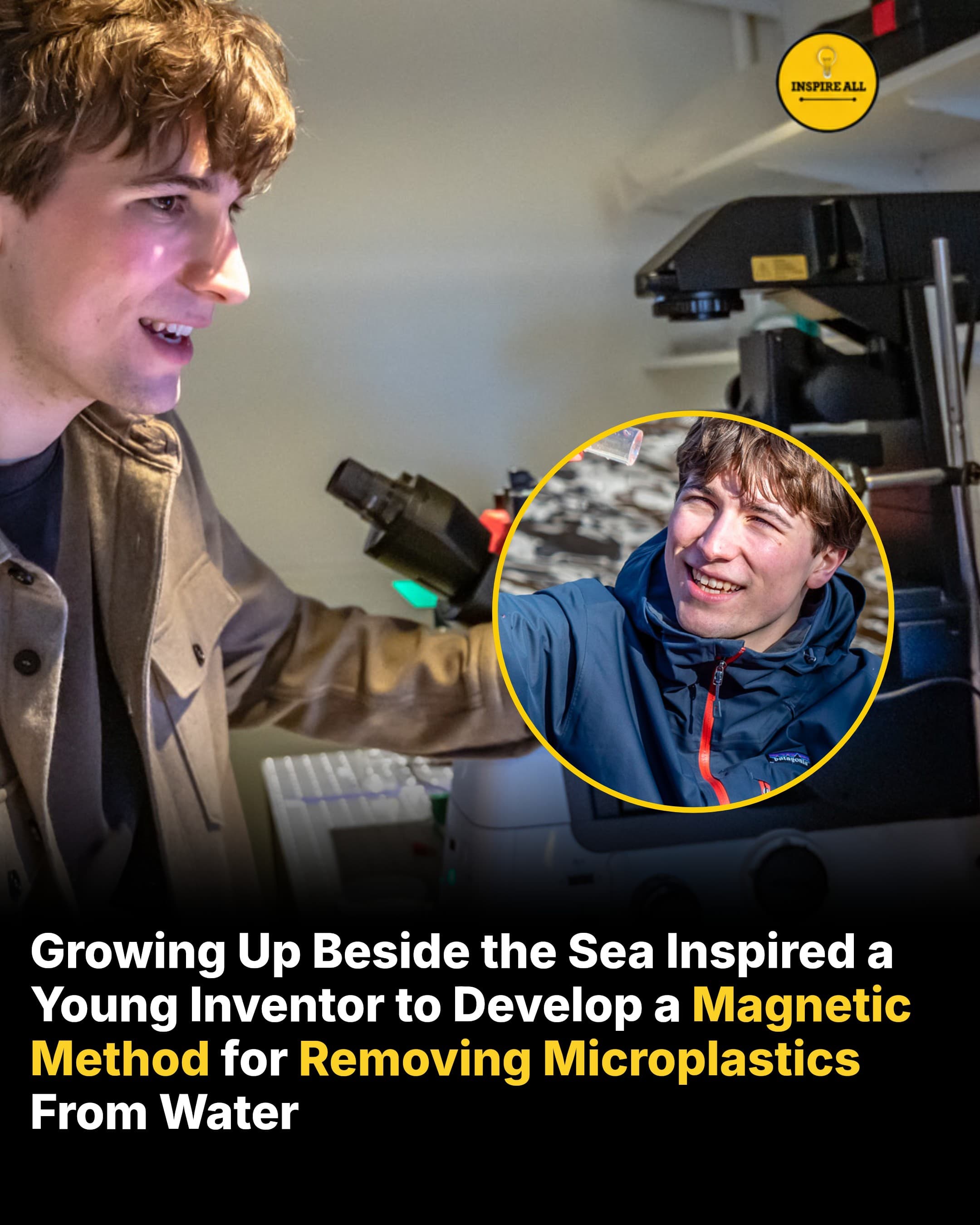
An inventor’s connection to Ireland’s coast helped inspire an experiment with a magnetic liquid and tiny plastic particles.
Fionn Ferreira grew up near the Irish coast in a family of boat builders. His interest in the water around him became a research question: how could microplastic particles be separated from it?
The European Patent Office’s inventor profile describes his approach using ferrofluid, a magnetic liquid that binds to the particles.
Why a magnet can help
The plastic itself does not need to be magnetic. In the described method, the liquid associates with the microplastics, and magnets then remove that mixture from the water.
The EPO reports that much of the magnetic liquid can be recovered and reused.
That recovery is part of the design’s practical importance. Capturing a contaminant creates another question: what happens to the material used to collect it?
A prototype result, not a universal guarantee
In its July 4, 2023 award announcement, the EPO named Ferreira the third-place recipient of the Young Inventors Prize.
It reported that the prototype then described removed more than 85 percent of microplastics in a single pass.
That figure belongs to the prototype and reporting period. It does not establish equal performance for every plastic, particle size or water source.
The announcement identified Ferreira as a chemistry master’s student at the University of Groningen. The research story is therefore one of continuing development, rather than a completed cleanup of the oceans.
What wider use would need to establish
For a separation process, several questions matter beyond an initial removal percentage: repeated performance, recovery of the collection medium and the handling of captured waste.
The sources reviewed here do not establish that this method has been deployed across drinking-water systems. Trending American has not independently tested its safety or efficiency.
The interest of Ferreira’s idea lies in an unusual pairing: using something magnetic to collect something that is not.
His coastal experience provided a reason to investigate. The experimental work turned that concern into a mechanism that could be measured, adjusted and tested again.
This account uses the EPO’s profile and 2023 award announcement. Performance is attributed to that reporting, not independent testing by Trending American. Featured graphic supplied by Inspire All.
Related reading: Himaja’s voice-controlled Braille printer and Gargi Agrawalla’s portable alert prototype.