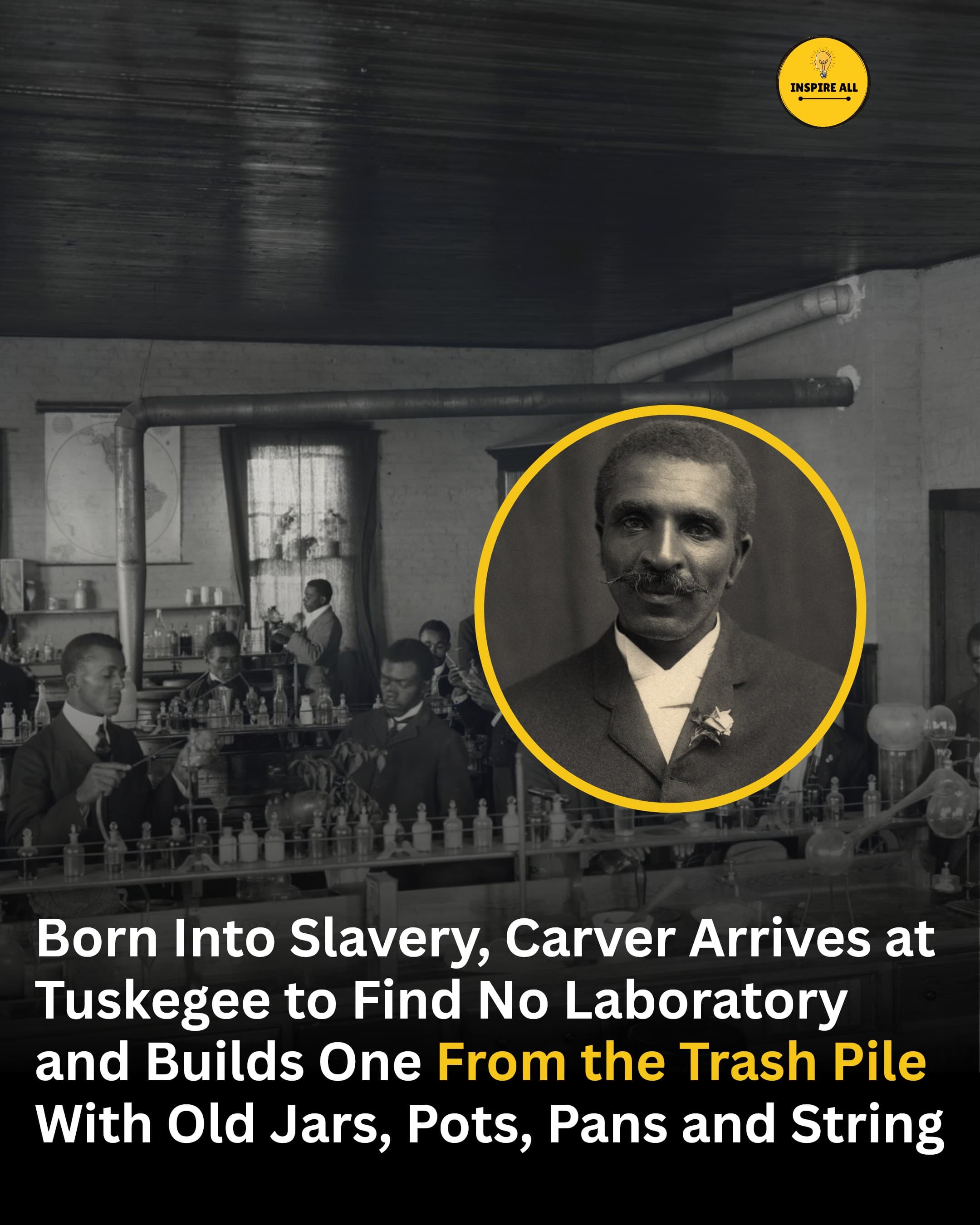
The trained agricultural scientist brought resourcefulness to limited facilities and made useful advice for farmers a central part of his work.
When George Washington Carver joined Tuskegee Institute in 1896, he brought graduate training in agriculture to a school with limited resources.
He later recalled using discarded bottles and fruit jars to begin laboratory work. A quotation compilation tracing the recollection to the Carver Papers and Linda McMurry’s biography preserves that account.
The image of an improvised laboratory is memorable. It belongs within the larger story of a trained scientist adapting his work to the resources available.
Training came before improvisation
Carver earned his Master of Agriculture degree at Iowa State in 1896 before accepting Booker T. Washington’s invitation to Tuskegee.
The American Chemical Society’s historical account explains his preparation and his interest in using agriculture to improve the lives of Black Americans.
He was not discovering science without an education. He was applying his education under difficult conditions.
That distinction helps explain why ordinary containers could become useful: the knowledge of what to investigate did not depend entirely on the appearance of the equipment.
Research with farmers in mind
Carver’s work included soil improvement and the use of crops such as cowpeas, beans, peanuts, and sweet potatoes.
Growing soil-enriching legumes as part of a rotation could help land depleted by repeated cotton cultivation. Carver did not invent crop rotation; he taught and demonstrated practices suited to the farmers he hoped to serve.
His investigations also explored uses for crops beyond selling them in their raw form.
Advice people could use
The USDA National Agricultural Library’s Carver exhibit preserves 38 Tuskegee experiment-station bulletins he wrote.
Their subjects include worn-out soils, food crops, fertilizers, and practical farm management.
Those publications show what the research was for. Useful findings needed to reach people who had little money for equipment or commercial inputs.
Seeing value in what was available
Carver’s early laboratory story illustrates resourcefulness, but it should not make scarce funding sound desirable.
The achievement was continuing useful work despite those limits, and communicating it in forms farmers could apply.
Bottles and jars were a beginning. The larger legacy lies in the questions he investigated and the people he sought to help answer them.
Related: Arvind Gupta’s low-cost science teaching and Lewis Latimer’s learning through technical work.