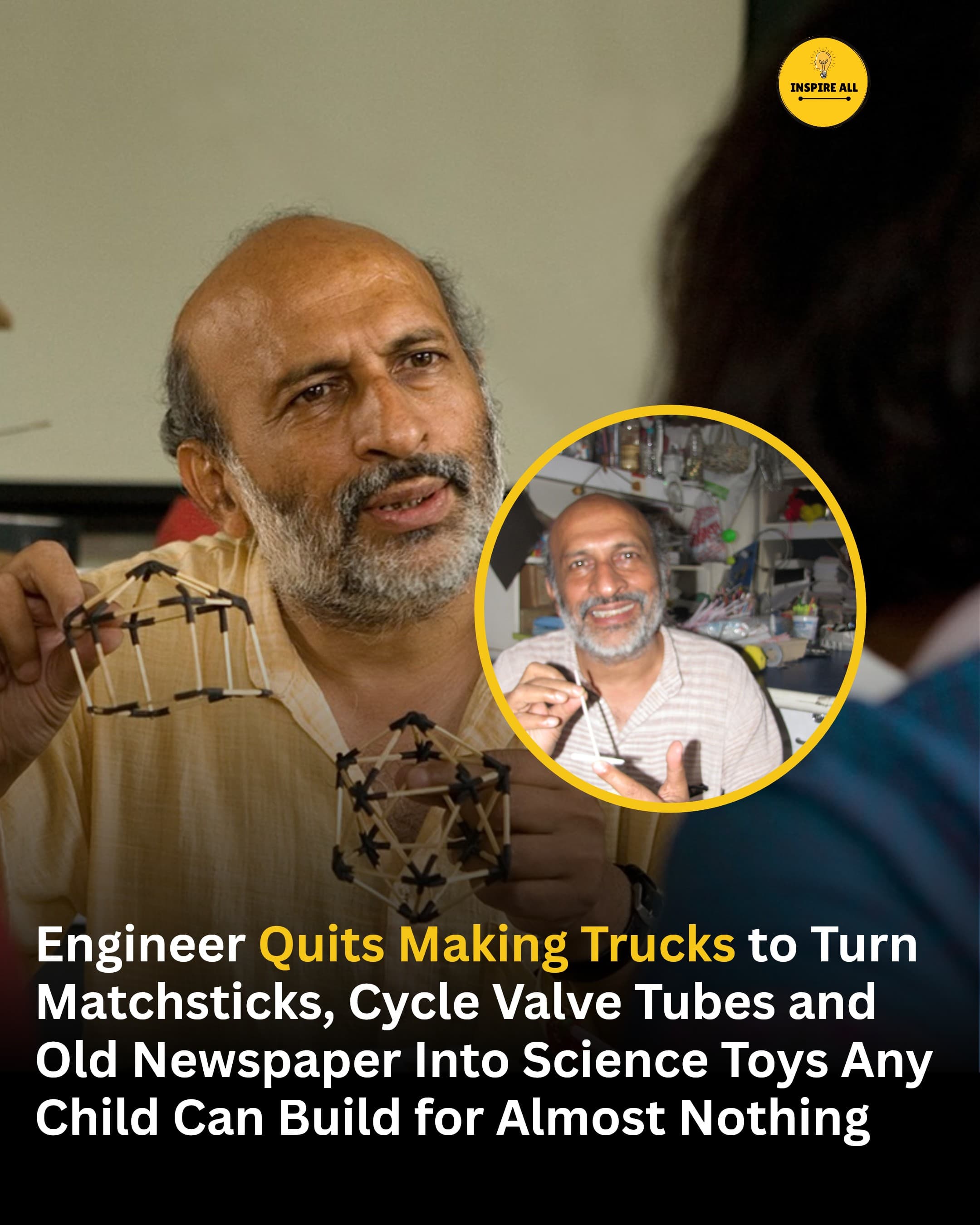
The engineer and educator made familiar objects into tools children could use to explore how the world works.
Arvind Gupta found a way to make a science lesson out of things that could fit in a pocket: short sticks and pieces of bicycle valve tubing.
Joined together, they formed flexible models of shapes and structures. Children could build, move, and test them rather than only look at a diagram.
Gupta’s Matchstick Models and Other Science Experiments explains that approach through activities developed around the Hoshangabad Science Teaching Programme.
A career turned toward learning
Gupta trained as an engineer and worked at TELCO before moving into science education.
A 2004 account preserved on his website describes his study leave to work with the Hoshangabad program, where experimenting with children and teachers helped shape his direction.
The attraction was practical: a child could manipulate an object, notice what happened, and ask a further question.
What a simple joint can teach
The tubing served as a connector between the sticks, allowing different arrangements.
A triangle and a four-sided frame respond differently when pushed at their joints. The contrast gives a child a physical way to investigate shape and stability.
Gupta’s book extends the idea into three-dimensional structures and other inexpensive experiments. The purpose is exploration, with materials chosen partly because they are familiar and accessible.
The lesson is not that equipment never matters. It is that an opportunity to investigate need not always wait for an expensive kit.
A project built with educators
At IUCAA, Gupta helped initiate the Science Toys project in the early 2000s.
The institution’s own account credits a team of educators and researchers developing low-cost, interactive activities across scientific subjects.
That teamwork matters. Making a demonstration understandable and repeatable is part of the educational work.
His 2010 INK talk, published by TED, brought the same approach to a wider audience.
A discarded object became useful because someone asked what a child could discover with it. Gupta’s contribution was to make that question the starting point of a lesson.
Related: Shubham Banerjee’s LEGO Braille printer and Kelvin Doe’s salvaged-parts radio.