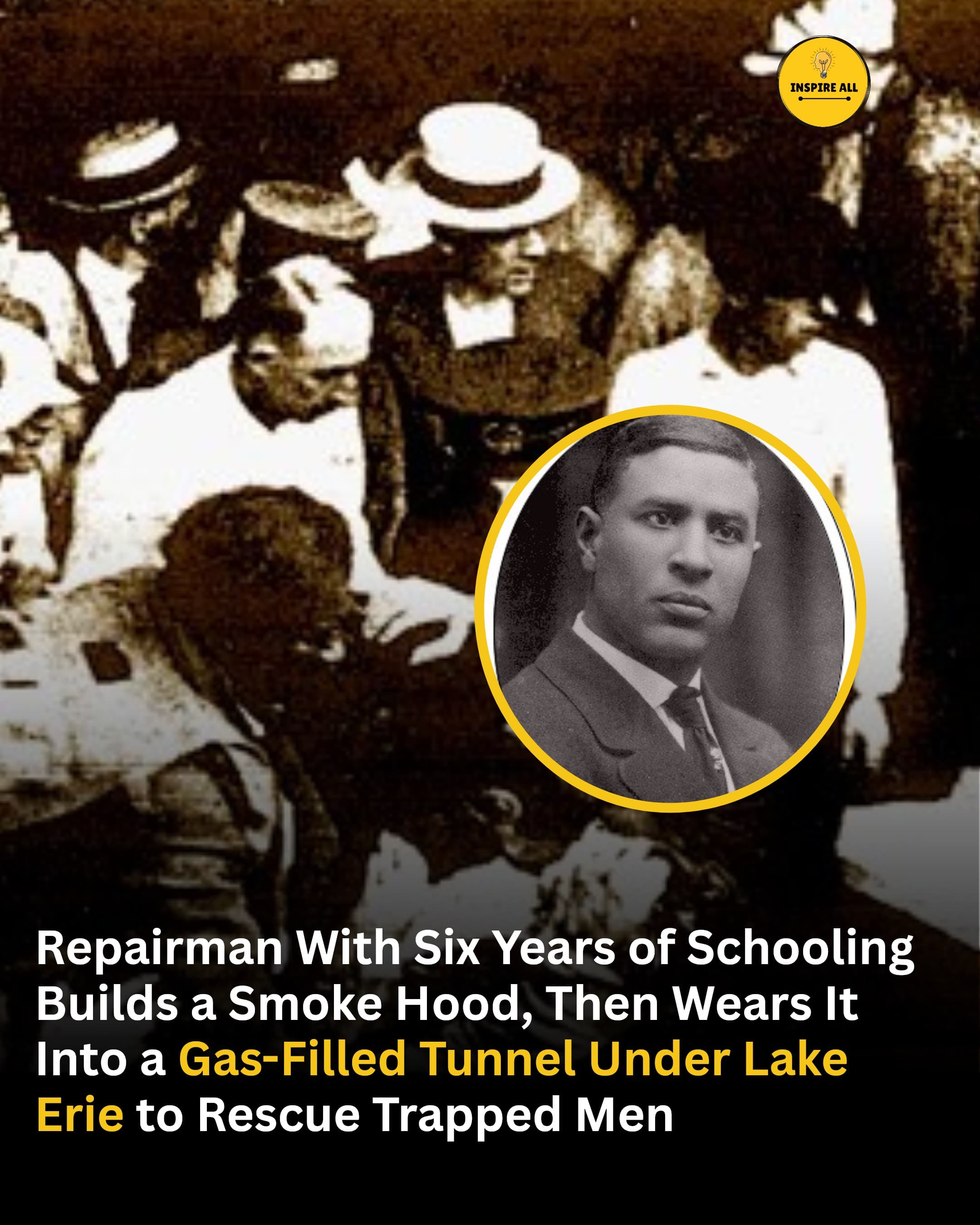
The Cleveland inventor put his breathing device to use in a rescue, then continued developing practical safety inventions.
On July 25, 1916, Garrett Morgan entered a gas-filled tunnel beneath Lake Erie after an explosion at Cleveland’s waterworks.
He wore a safety hood he had developed. His role in rescuing workers and retrieving bodies is documented by Case Western Reserve University’s Encyclopedia of Cleveland History.
The event connected years of inventive work with an immediate need.
Learning through repair work
Morgan was born in Kentucky to parents who had been enslaved. After limited formal schooling, he continued learning, including by hiring a tutor.
In Cleveland, he gained experience with sewing machines and opened a repair-and-sales business in 1907.
Repair work involves understanding why something fails and how its parts interact. In Morgan’s career, that practical knowledge became a foundation for developing new devices.
A hood designed for dangerous conditions
Morgan introduced his breathing device in 1912 and received a patent in 1914.
The National Inventors Hall of Fame describes a hood intended to draw fresh air from near the floor and reduce exposure to smoke.
During the 1916 disaster, Morgan and other volunteers used hoods to reach trapped people. Accounts differ on some casualty and rescue totals, so the essential documented fact is his participation using his own equipment.
A historical hood should not be confused with modern equipment designed for every hazardous atmosphere. Its place here is in the history of rescue technology.
Racism complicated the invention’s reception
The Hall of Fame also records discrimination Morgan faced when marketing his hood to white fire chiefs.
The obstacle was not only whether his design worked. His identity affected whether customers would consider it, requiring changes in how he presented the product.
Another safety problem, another invention
Morgan later developed a three-position traffic signal, patented in 1923. The Cleveland encyclopedia records a $40,000 sale to General Electric.
He did not invent every form of traffic light. His contribution was a particular signal arrangement adding an intermediate stage between stop and go.
The hood and signal share a practical purpose: creating a safer response at a dangerous moment.
Related: Mary Anderson’s windshield wiper and Lewis Latimer’s electrical work.