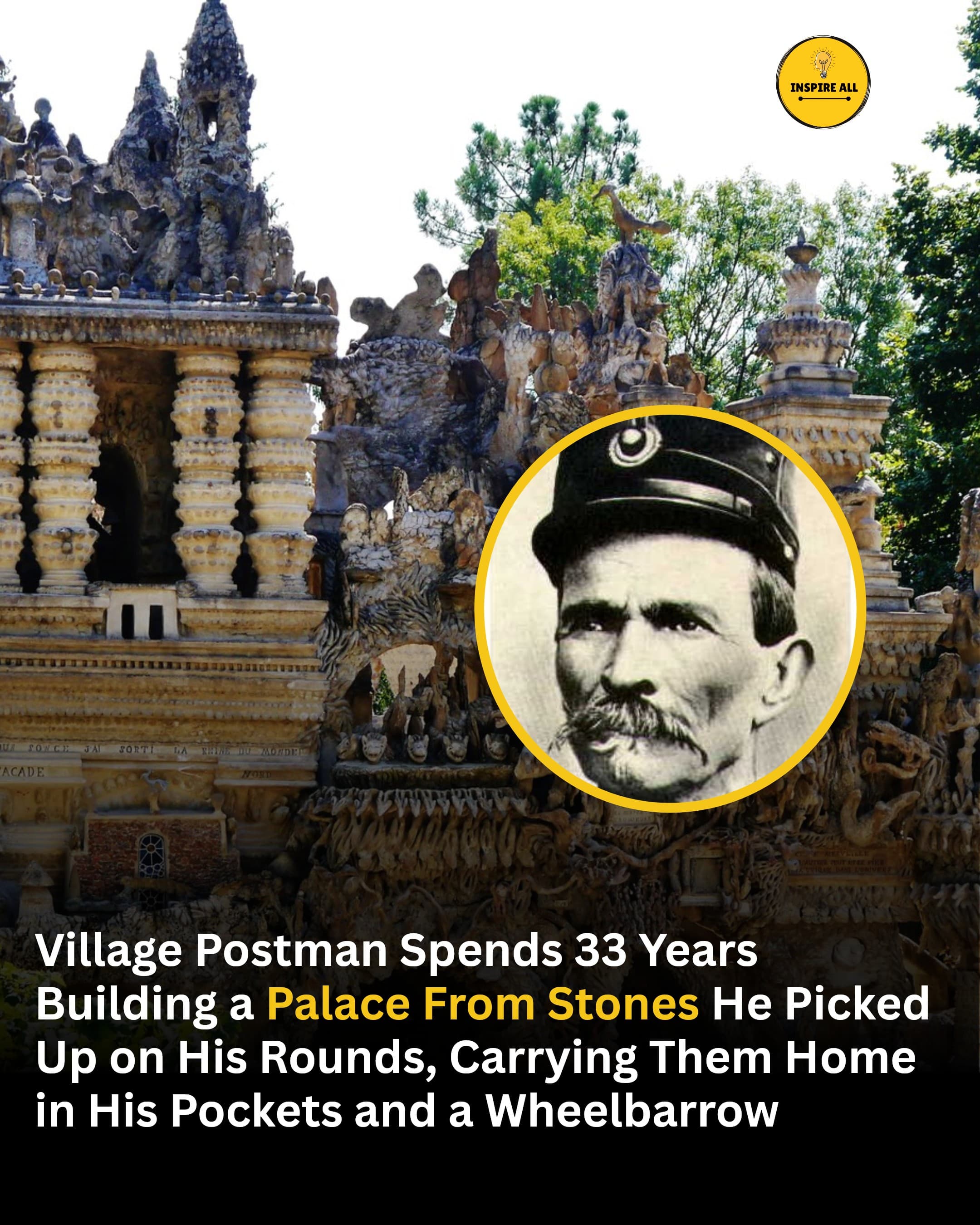
An unusual stone on a postal round became the starting point for a garden monument in Hauterives, France.
In April 1879, rural postman Ferdinand Cheval stumbled over an oddly shaped stone. He picked it up, and the encounter became the beginning of a project that occupied him for thirty-three years.
Completed in 1912, his Palais Idéal still stands in Hauterives, France. The palace’s official history traces its beginnings to that discovery, when Cheval was forty-three.
A building assembled through daily work
Cheval had limited schooling and no conventional architectural training. His postal rounds took him through the countryside, where he gathered stones and brought them home.
A wheelbarrow became part of the work. Piece by piece, he assembled an elaborate structure in his garden.
The postal job supplied more than access to stones. Illustrated publications and postcards exposed him to buildings, landscapes, and imagery beyond his own surroundings.
An imaginary palace rather than a home
The finished work combined animals, giants, grotto-like spaces, and architectural references into a personal landscape. It was not designed as a normal residence.
That makes the word “palace” useful to understand. Cheval was building a place for imagination to take physical form, rather than solving the requirements of a household.
Its details invite a different kind of attention from a conventional building. The visitor encounters a world shaped by what one maker noticed, collected, and returned to over decades.
Recognition outlasted the builder
France classified the Palais Idéal as a historic monument in 1969, as recorded in the Ministry of Culture’s heritage register.
The long gap between its beginnings and that official recognition is part of the story’s force. Cheval could not have completed thirty-three years of work by relying on an award that lay far beyond the project itself.
His achievement offers a concrete picture of sustained creative labor: a repeated journey, another collected stone, and another small addition to something too large to finish quickly.
Related: Nek Chand’s sculpture garden and Justo Gallego’s decades of building.