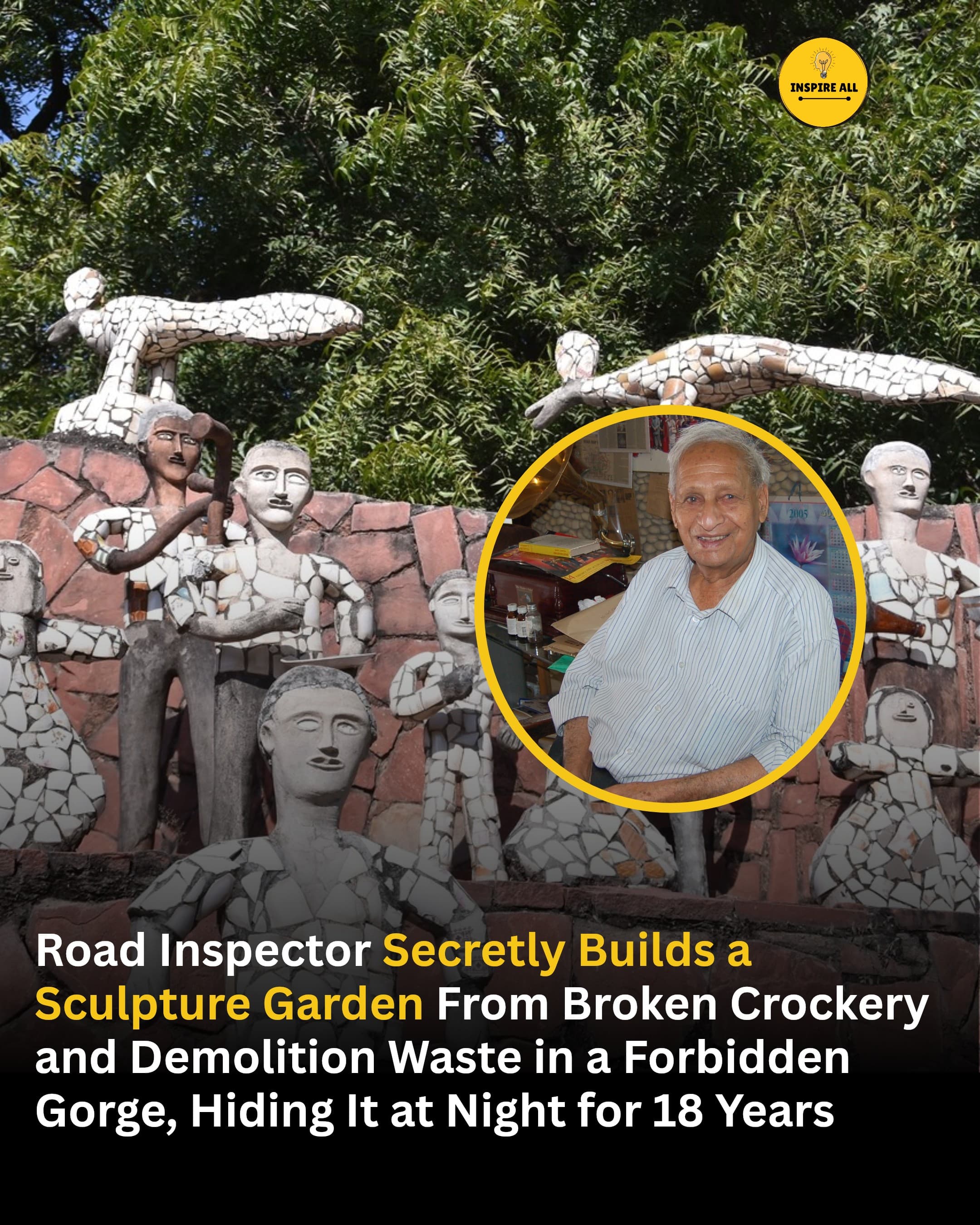
A road inspector’s private work with discarded materials grew into one of Chandigarh’s best-known public places.
In 1957, Nek Chand began making a sculpture garden in Chandigarh, India, during his spare time. He used materials the city had discarded: broken crockery, rubble, glass, and other remnants.
The project grew in a gorge where construction was prohibited. When officials discovered it in 1975, its future was uncertain.
The preservation organization SPACES records the discovery and the public support that helped save it.
Making figures from what remained
Chand worked as a government road inspector and developed his art without a conventional artistic education.
The garden transformed unwanted objects into human and animal forms, courtyards, and an elaborate landscape. Pieces of ceramics and bangles became surfaces with patterns and texture.
The Chandigarh Tourism description identifies these reused materials as central to the garden, alongside its mixture of sculpture, architecture, landscape, and mythology.
The discarded objects did not simply disappear into new construction. Their colors and shapes remained part of what visitors could see.
From a threatened project to a public garden
By its discovery in 1975, the work covered about thirteen acres, according to SPACES.
The risk of demolition gave way to public backing. In 1976, it received recognition as a public space, and Chand was given a salary and a workforce of fifty laborers to continue.
That later support is an essential part of the history. A project that began privately became something a city chose to preserve and help expand.
A lasting public place
Chand died on June 12, 2015, aged ninety.
Visitor figures in reports from that period describe their own time and should not be treated as a new attendance count. What remains clear is the garden’s standing as an established Chandigarh attraction.
Its story also offers a distinctive view of reuse. Material rejected for one purpose became the raw material for another, shaped by years of attention and labor.
The garden survived because people eventually recognized value in both the discarded pieces and the place Chand had made from them.
Related: Ferdinand Cheval’s stone-built palace and Nzambi Matee’s recycled-plastic paving stones.