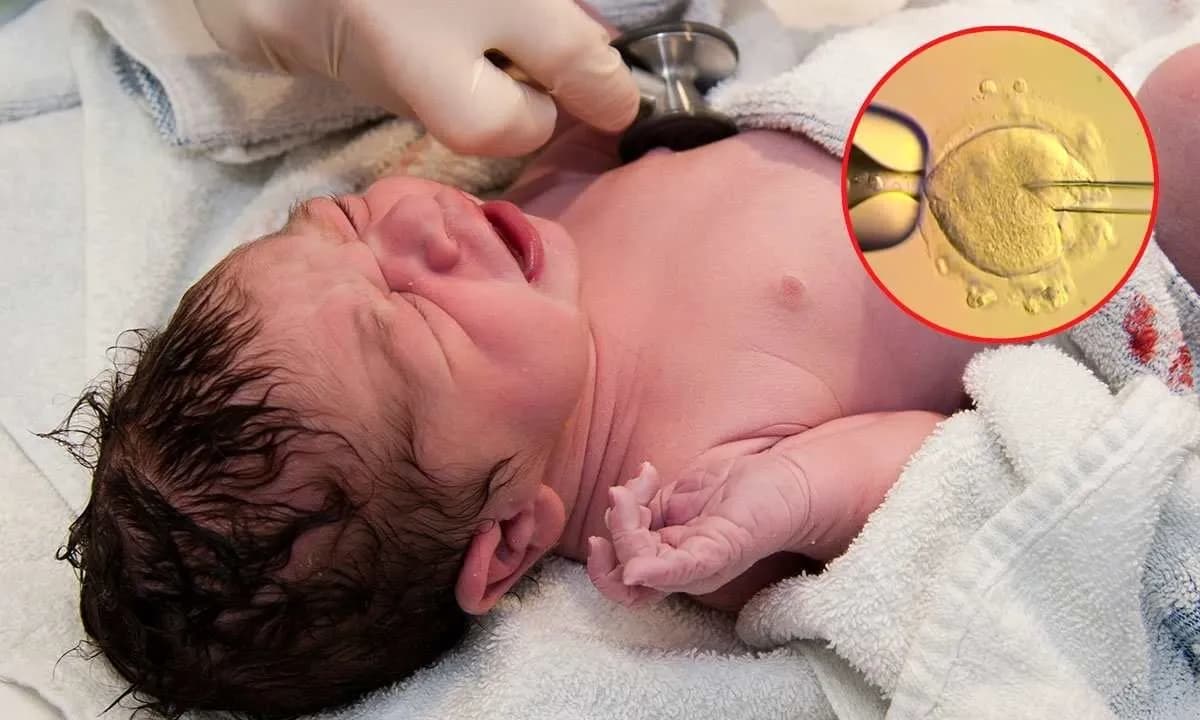
It sounds like science fiction, but it’s real. Eight babies in the UK have been born using DNA from three different people — a mother, a father, and a female donor. They are healthy, free from inherited mitochondrial disease, and represent one of the most unusual but groundbreaking developments in modern medicine.
This medical achievement didn’t happen overnight. Scientists at Newcastle University spent over two decades working on this technique to prevent mitochondrial diseases — serious and often fatal conditions that are passed down only from mothers to their children.
These diseases affect the mitochondria — the tiny structures in our cells that convert food into energy. When mitochondria don’t work properly, organs like the brain, heart, and muscles begin to fail. Many children with this disease can’t walk, talk, or eat normally. Some die young. About 1 in every 5,000 babies is born with it.
The only way to truly stop the disease from being passed on is to stop the faulty mitochondria from entering the baby’s body in the first place. That’s what this new technique, called mitochondrial donation treatment (MDT), was designed to do.
Here’s how it works: doctors take two eggs — one from the mother and one from a healthy donor. Both are fertilized with the father’s sperm. From the mother’s fertilized egg, they remove the central DNA that carries all the traits like eye color and height. They do the same for the donor’s fertilized egg — but they keep the healthy mitochondria from the donor.
Then, the parents’ DNA is placed into the donor’s egg, which now has the best of both worlds: the baby’s identity comes from the real parents, but the energy system (mitochondria) comes from a healthy donor. The result? A baby with about 99.9% of DNA from the parents and 0.1% from the donor.
That’s why some people call them “three-parent babies.”
So far, eight babies have been born using this method — four boys and four girls, including a pair of identical twins. One more pregnancy is still ongoing. They were all born to seven different mothers who carried dangerous mitochondrial mutations. And according to the latest updates from UK scientists, all eight babies are developing normally.
Some minor health issues were reported — one baby had a urinary infection, another experienced muscle jerks, and one had a heart rhythm issue and high blood fat. But these problems were treatable and not linked to the mitochondrial issue. Genetic testing showed that the level of mutant mitochondria that got carried over was either zero or very low — far below the amount that causes disease.
Families who went through this process have chosen to remain anonymous, but some shared their feelings through the clinic. One mother said, “After years of uncertainty, this treatment gave us hope – and then it gave us our baby… we’re overwhelmed with gratitude.” Another said that their family now feels complete and that the emotional burden of this disease has been lifted.
This is the first time in the world that children have been born through this method legally and with government support. The UK became the first country to allow it by law back in 2015 after a vote in Parliament. The fertility clinic at Newcastle University got its license in 2017, and the first group of women went through the process soon after.
Out of 22 women who tried MDT, eight became pregnant (36%). Another technique called pre-implantation genetic testing (PGT) was used for women who still had some healthy eggs. That method resulted in 16 pregnancies out of 39 women (41%). Scientists aren’t fully sure why the success rates are different. It may have something to do with how some mitochondrial mutations affect overall fertility.
The research, published in the New England Journal of Medicine, also raises important questions about the future. For example, some tiny amounts of faulty mitochondria were still found in three of the babies, though well below the danger zone. Scientists say the technique isn’t perfect yet — there’s still work to do to understand why that happens and how to make it even safer.
This method also raises ethical concerns. Because a small amount of DNA from the donor is passed on — especially in girls, who could pass that to their own children — it means changing the genetic line for future generations. Some people worry this might lead to more genetic editing and “designer babies,” which is why the method is still not approved in countries like the United States and France.
But for families suffering from mitochondrial disease, it’s not about design — it’s about survival.
Kat Kitto, whose daughter Poppy lives with mitochondrial disease, knows what it’s like. Poppy, 14, is in a wheelchair, can’t speak, and is fed through a tube. Kat says, “We have a lovely time as she is, but there are the moments where you realize how devastating mitochondrial disease is.”
Kat’s older daughter Lily, 16, might one day face the same fear — of passing the condition to her own kids. Now, she says, the idea of having a normal life and a healthy baby is real. “It’s the future generations… who can have that outlook of a normal life,” she said.
The UK’s success in bringing this science to real families comes from a perfect mix of things: world-class researchers, legal support, and the public healthcare system (NHS) working together. As Prof Doug Turnbull put it, “This is the only place in the world this could have happened.”
Now, there are eight children alive and thriving because of it.
And for families once trapped in the fear of passing on a deadly disease — that changes everything.