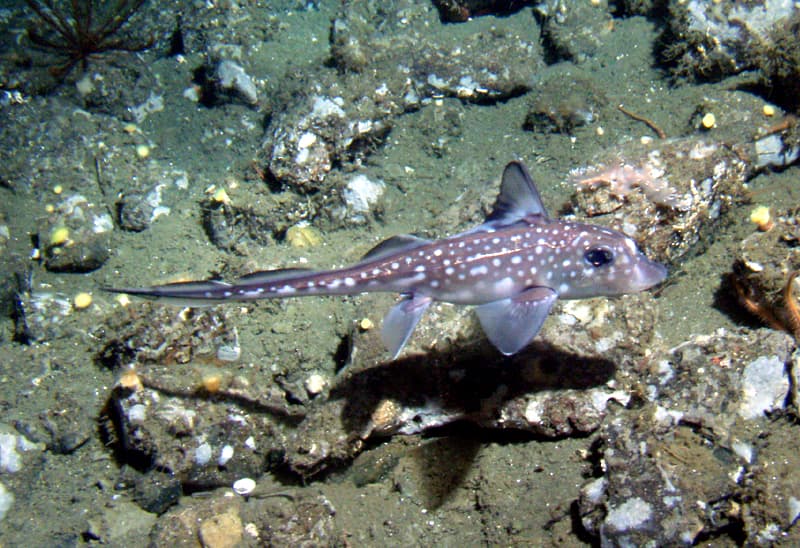
A spotted ratfish moves above the seabed by sweeping broad fins like underwater wings. Its large eyes and long, narrowing tail make it look quite unlike a typical fish.
The resemblance to a rat ends at the tail. This animal belongs to an ancient branch of cartilaginous fishes.
A relative of sharks and rays
The spotted ratfish, Hydrolagus colliei, is a chimaera. Like sharks and rays, it has a skeleton made mainly of cartilage rather than bone.
Its pale spots, rounded face, and prominent eyes give it a distinctive appearance. The Florida Museum describes its anatomy and eastern Pacific distribution.
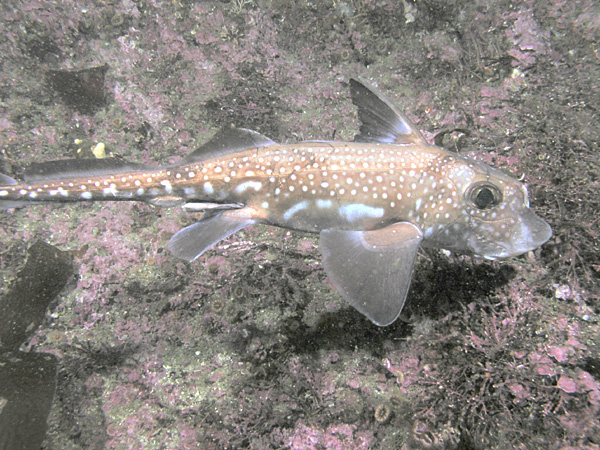
Wings above the seafloor
Broad pectoral fins provide much of the propulsion. Below the face, tooth plates grind food rather than slicing it with rows of pointed teeth.
Crabs, clams, and other seafloor animals form part of its diet. Monterey Bay Aquarium describes ratfish cruising just above the bottom in search of food.
A spine in front of the dorsal fin is venomous. Like other wildlife, a ratfish is best observed without touching or disturbing it.
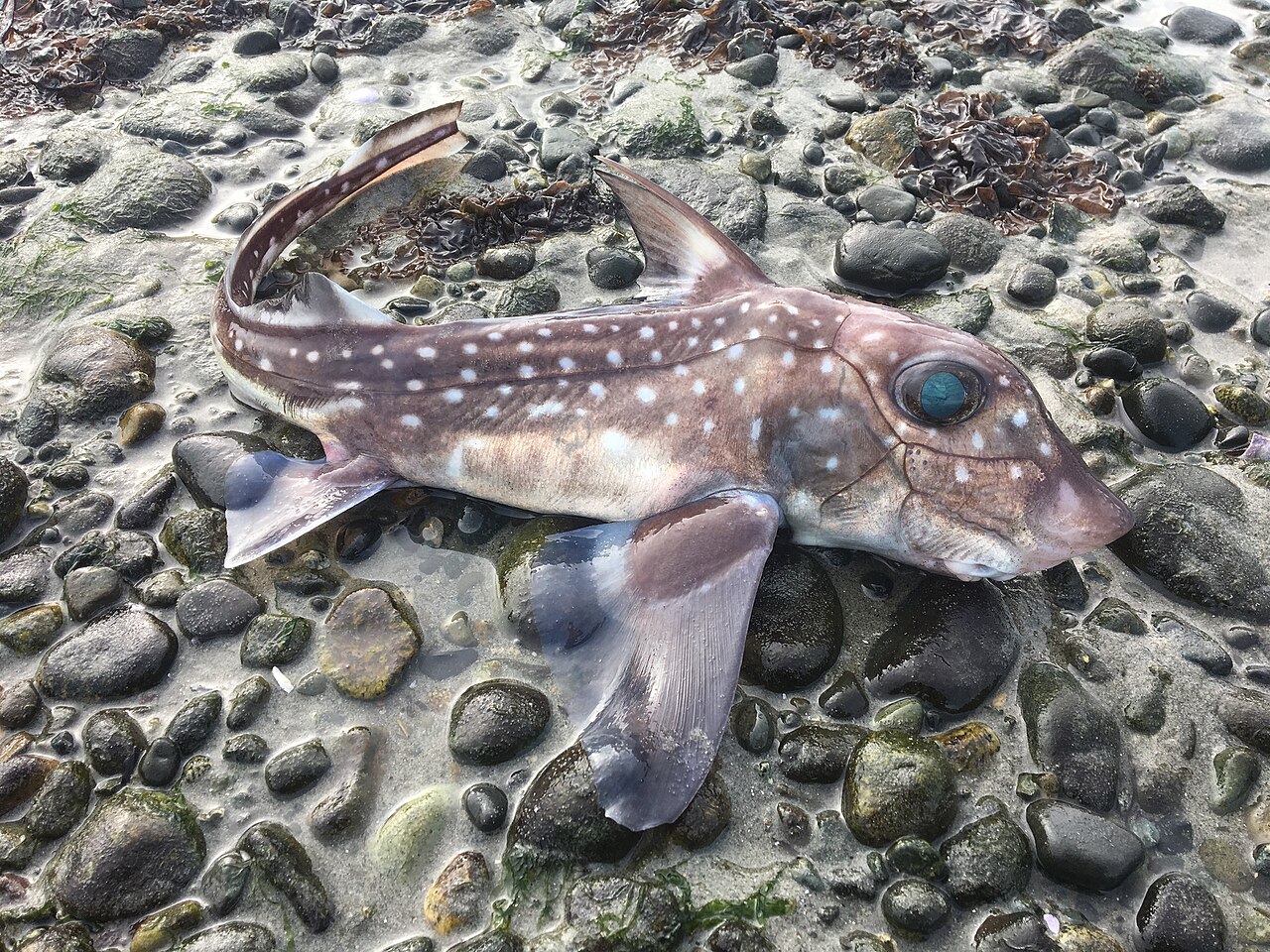
An overlooked neighbor
Ratfish can be caught accidentally in trawl fisheries. Their story connects the appearance of one unusual animal with the wider effects of fishing near the seabed.
Those broad fins and grinding plates show how misleading first impressions can be. Behind a curious name is a specialized predator moving through an ocean world we rarely see.
Photo credits
Featured image: Hydrolagus colliei.jpg — Linda Snook / MBNMS; Public domain.

Body image 1: Hydrolagus colliei 03.jpg — Clark Anderson/Aquaimages; CC BY-SA 2.5.

Body image 2: Hydrolagus colliei 30649646.jpg — J Straka; CC BY 4.0.

Photographs resized for web display where available.