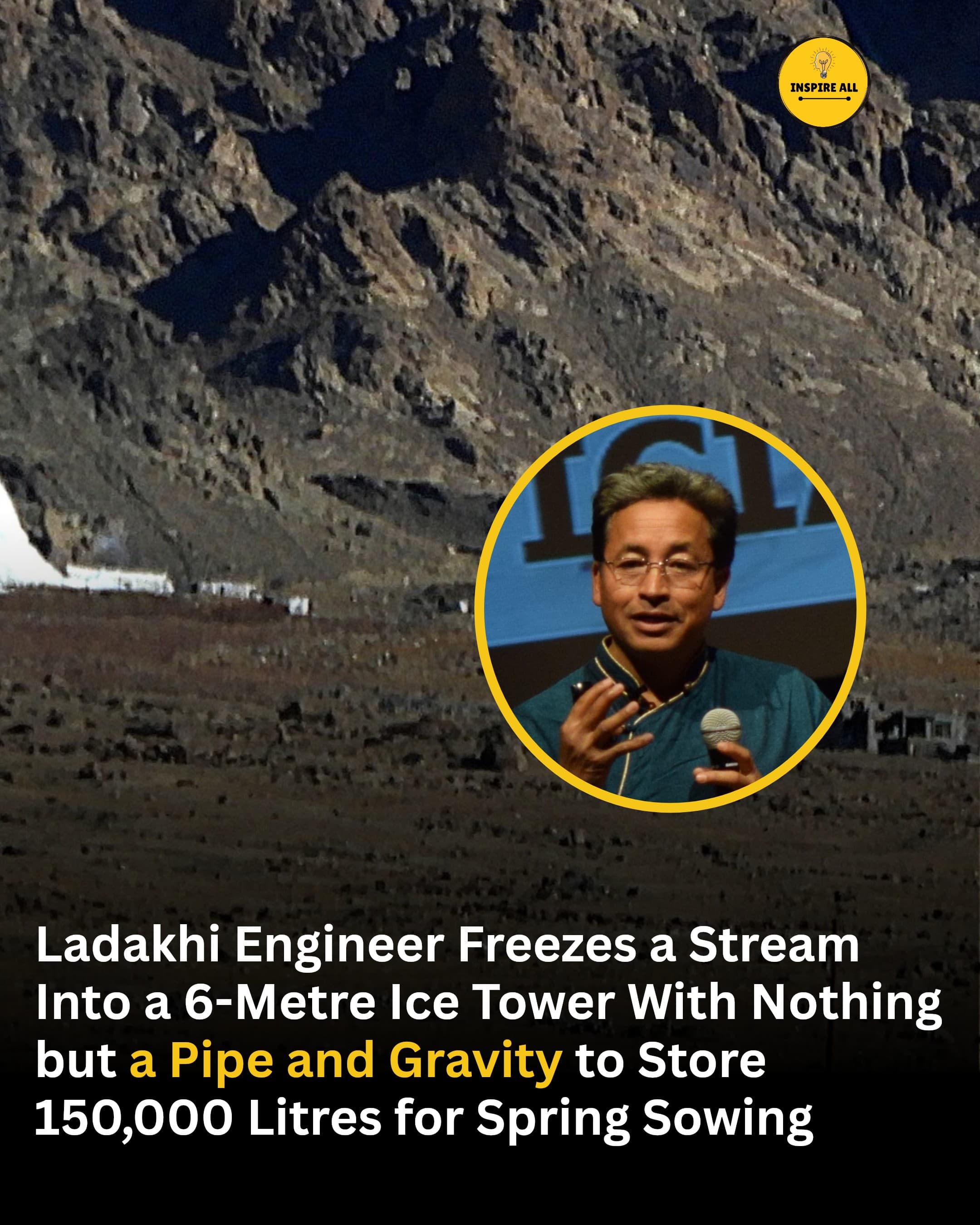
Cone-shaped ice stores offered a way to save winter stream water for the dry weeks before natural glacier melt reached fields.
During the winter of 2013–2014, Sonam Wangchuk and students at SECMOL tested a different way to store water in Ladakh: build it upward as a tower of ice.
A 2015 India Water Portal report describes an early prototype storing approximately 150,000 litres and surviving into May.
The project became known as the Ice Stupa, after the cone’s resemblance to Buddhist structures.
Why shape became part of the solution
Ladakh’s farmers can face a shortage of irrigation water in spring, before the main seasonal melt arrives.
Earlier artificial-glacier work by Chewang Norphel stored water horizontally in cold, shaded locations. Wangchuk explored a vertical form that could hold substantial water in a compact mass.
India Water Portal describes the early pilot as approximately six metres high, storing about 150,000 litres and remaining frozen into May.
Those measurements describe a particular prototype and reporting period. The central result was seasonal: ice remained into the weeks when water could help support planting.
Gravity supplied the water
Water piped from a higher source reached an outlet where it sprayed into freezing winter air. Ice accumulated around the outlet, gradually forming a cone.
The initial arrangement used gravity rather than an electric pump. Its performance still depended on suitable water flow, temperatures, pipe arrangements, and maintenance.
The cone’s compact form helped limit exposed surface relative to stored volume. That is a design principle, not a promise of identical melting rates at every site.
Testing led to larger projects
The 2015 report describes later construction encountering delayed deliveries, frozen sprinklers, and pipe problems. These details are part of the invention’s history, alongside the striking photographs.
A 2017 Rolex and National Geographic account documented a larger 2015 stupa and Wangchuk’s 2016 Rolex Award.
The project’s value lay in testing a specific response to a seasonal shortage. Students and an engineer used the local winter to investigate how water might be available later, when fields were ready.
Related: Chewang Norphel’s artificial glaciers and Jadav Payeng’s forest.