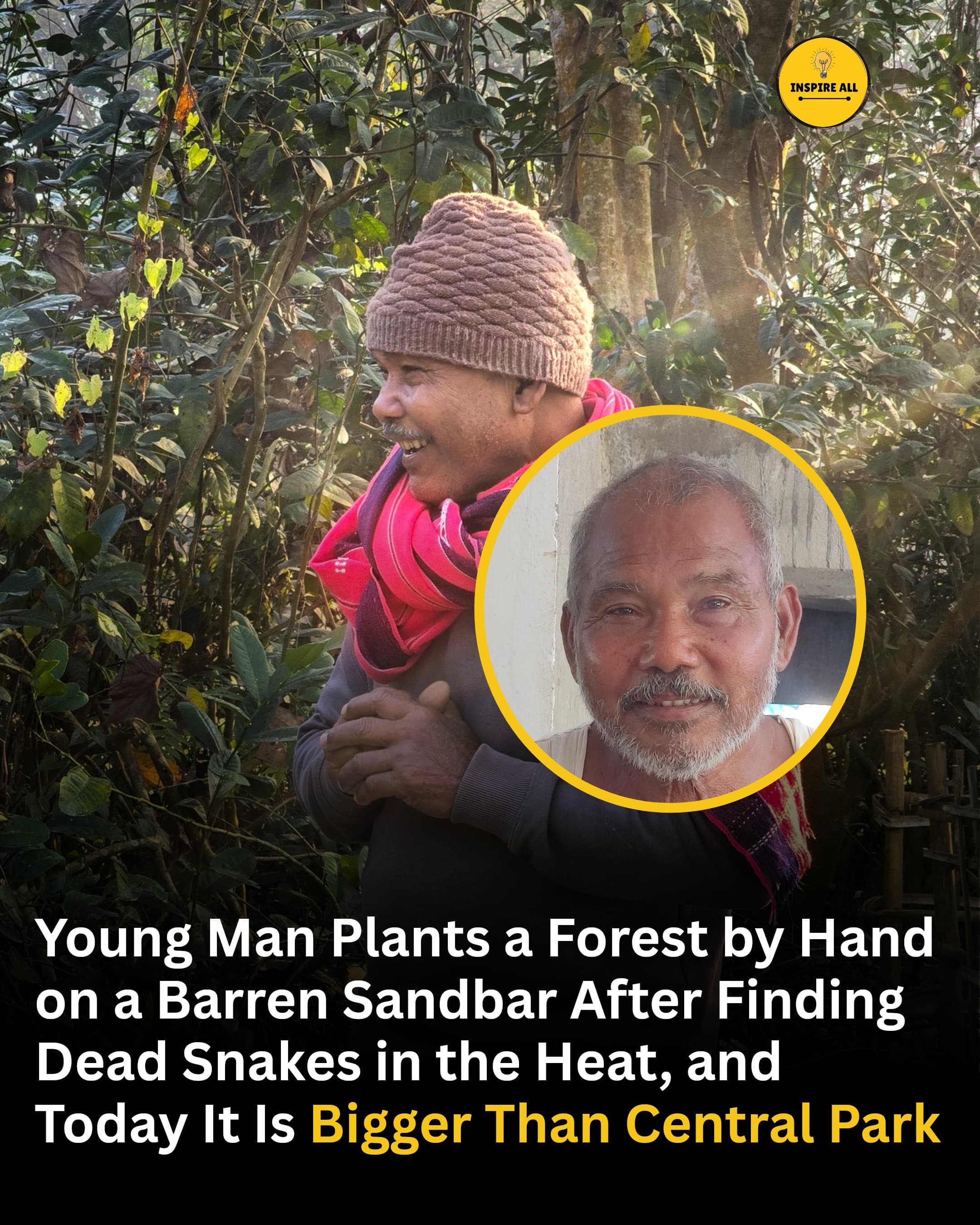
Jadav Payeng’s decades of planting and care helped establish Assam’s Molai forest, a landscape widely reported to cover about 550 hectares.
Jadav Payeng traces his commitment to planting trees to a disturbing sight in 1979: snakes lying dead on an exposed sandbar in the Brahmaputra River in Assam, India.
In his account to NPR, the absence of shade made the deaths a warning about what heat could do to living things. He began planting bamboo, then other trees, and continued tending the land over decades.
Known as the Forest Man of India, Payeng became associated with a forest whose reported area exceeds New York’s Central Park. His achievement is remarkable, and its fuller history includes both sustained human work and nature’s ability to spread.
A forest that took years of care
In Julie McCarthy’s 2017 NPR report, carried by KPBS, Payeng described planting different kinds of trees rather than stopping with the first bamboo.
The reporting followed him across a river channel and along his daily route. It also described his Mishing community’s connection to the landscape and his determination to continue caring for it.
An earlier Mongabay account published in November 2014 adds an important part of the chronology: Payeng worked as a laborer on a government tree-planting project around 1980 and continued after the project ended.
His contribution therefore grew within a wider history of planting. The familiar phrase “one man planted a forest” captures his persistence, but leaves out that early project.
Is Molai forest bigger than Central Park?
Mongabay reported the Molai forest at about 550 hectares in 2014, equivalent to roughly 1,360 acres.
The Central Park Conservancy lists its park at 843 acres, or about 341 hectares. On those figures, Molai’s reported area is approximately 1.6 times Central Park’s.
The comparison conveys scale. It is based on a longstanding reported estimate for Molai, rather than a new survey conducted for this article.
The helpers Payeng credited
When asked about his work, Payeng told NPR: “It’s not as if I did it alone.”
He explained that trees produced seeds and that birds, animals, wind, and the river helped disperse them. Planting and care had made room for a wider living system to contribute.
NPR’s reporting described elephants, deer, monkeys, birds, and tigers in the landscape. These historical observations establish the return of wildlife without supplying a current animal census.
Recognition and a continuing message
India’s 2015 Padma Awards announcement lists him among the Padma Shri recipients, using the spelling Jadav Molai Peyang.
In July 2023, a Government of India report on his visit to IIM Shillong recorded his call to teach children the importance of planting and nurturing trees.
That second word matters. His story is about returning to living things long after the first planting, until a patch of sand becomes a place where other life can take hold.
Related stories: Richard Turere’s Lion Lights and Nek Chand’s garden made from discarded materials.