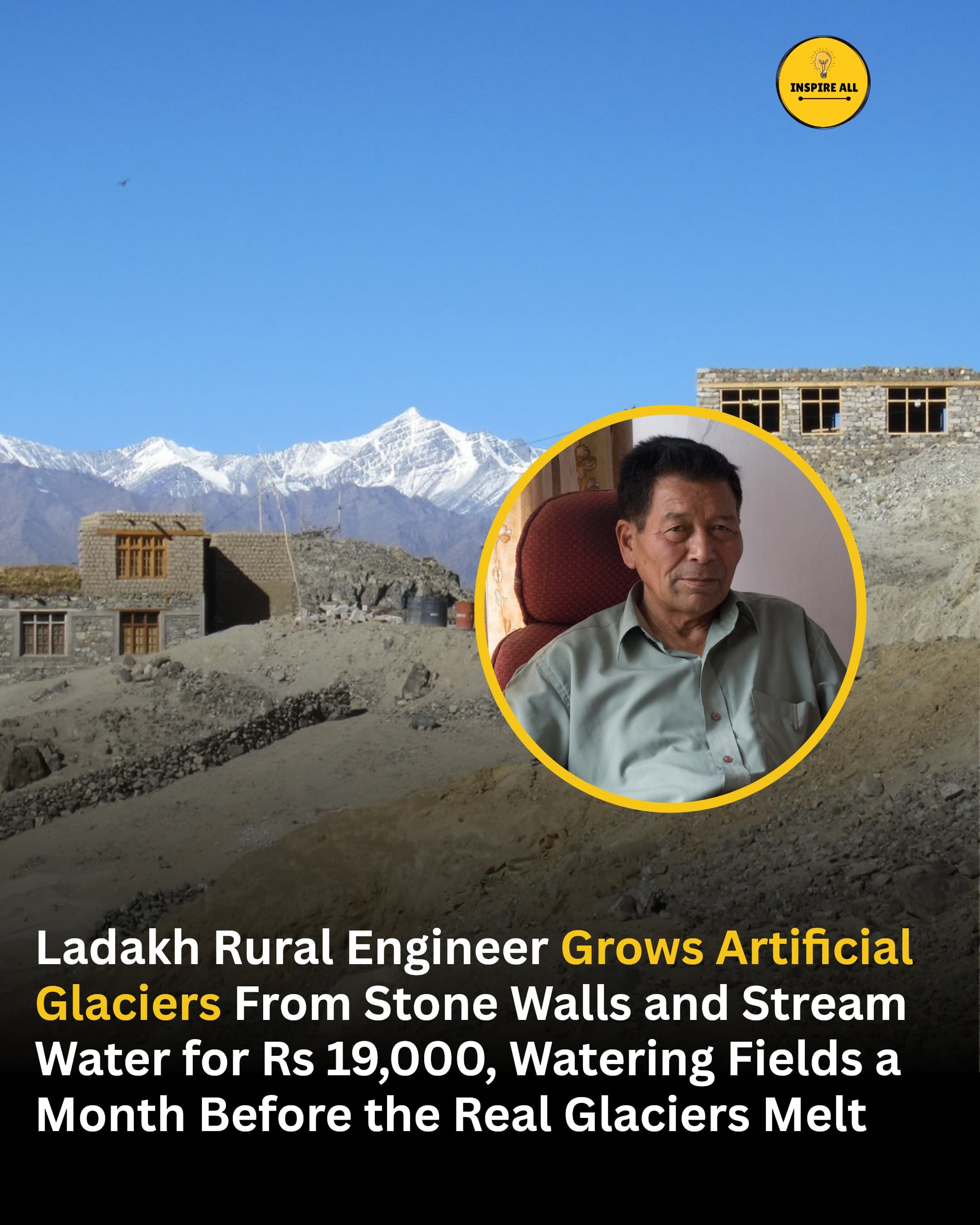
The civil engineer’s artificial glaciers used winter cold to hold water until farmers needed it for planting.
In Ladakh, the timing of water can be as important as its availability. Farmers need irrigation in spring, while meltwater from higher glaciers can arrive later.
Civil engineer Chewang Norphel addressed that gap by storing stream water as ice at lower elevations. When spring warmed those sites, the ice could release water earlier.
An India Water Portal account of his 2012 TEDx presentation dates his first artificial glacier to 1987.
Slowing water so it can freeze
The approach diverted water from a stream into channels leading to suitable shaded ground.
By distributing it in smaller, slower flows and using retaining walls, the project encouraged ice to accumulate through winter. The aim was a seasonal store that could melt when nearby fields needed water.
In a 2014 account explaining his method, Norphel described controlling water velocity and using a series of ice-retaining walls.
The system worked with the cold conditions already present in Ladakh. It did not create water or require the restoration of an entire mountain glacier.
Location and community work mattered
India Water Portal identified several conditions for a suitable site: winter stream flow, shade, and the timing of sun exposure.
It also emphasized community participation. These were local infrastructure projects requiring construction and care, rather than a technique that could be placed anywhere and left alone.
The 2014 report described canals and catchment areas near Phutse village and credited local materials and community labor. Its project totals and costs belong to that reporting period; different accounts describe different project scales.
Solving a problem of timing
The practical insight was to move part of the water supply through time: store it when freezing temperatures made that possible and release it during the spring shortage.
Norphel’s work shows why local engineering knowledge matters. The design depended on understanding streams, slopes, shade, and the farming calendar together.
Later ice-stupa projects explored a different shape for seasonal ice storage. Both approaches addressed the same basic difficulty: helping water arrive when crops need it.
Related: Sonam Wangchuk’s ice stupas and Rajendra Singh’s community water restoration.