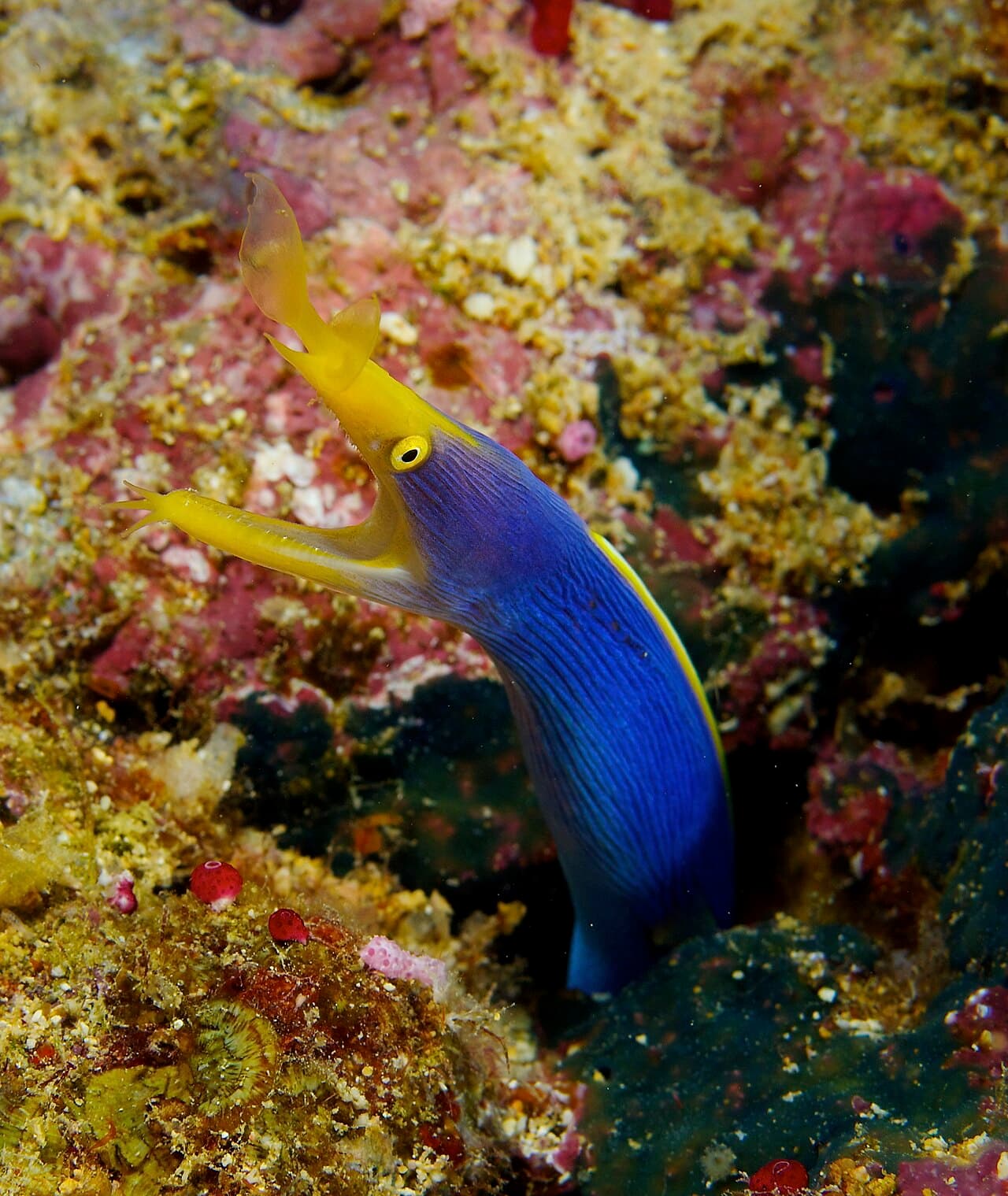
A blue head rises from a hole beside a coral reef. Yellow edges trace its face, and two flared nostrils give it an almost decorative outline.
This is the ribbon eel, Rhinomuraena quaesita. Its narrow body can remain hidden while the head becomes one of the reef's most memorable sights.
The Ribbon Beneath the Reef
The ribbon eel is a moray eel with an unusually slim, elongated body.
The Australian Museum's species account highlights its expanded front nostrils as a useful identifying feature. They are part of the fish's anatomy, rather than horns or a separate animal sitting on its head.
The name captures its form beautifully: a long strip of fish, much of it usually out of sight.
One Species, Different Colors
Ribbon eels do not always wear blue.
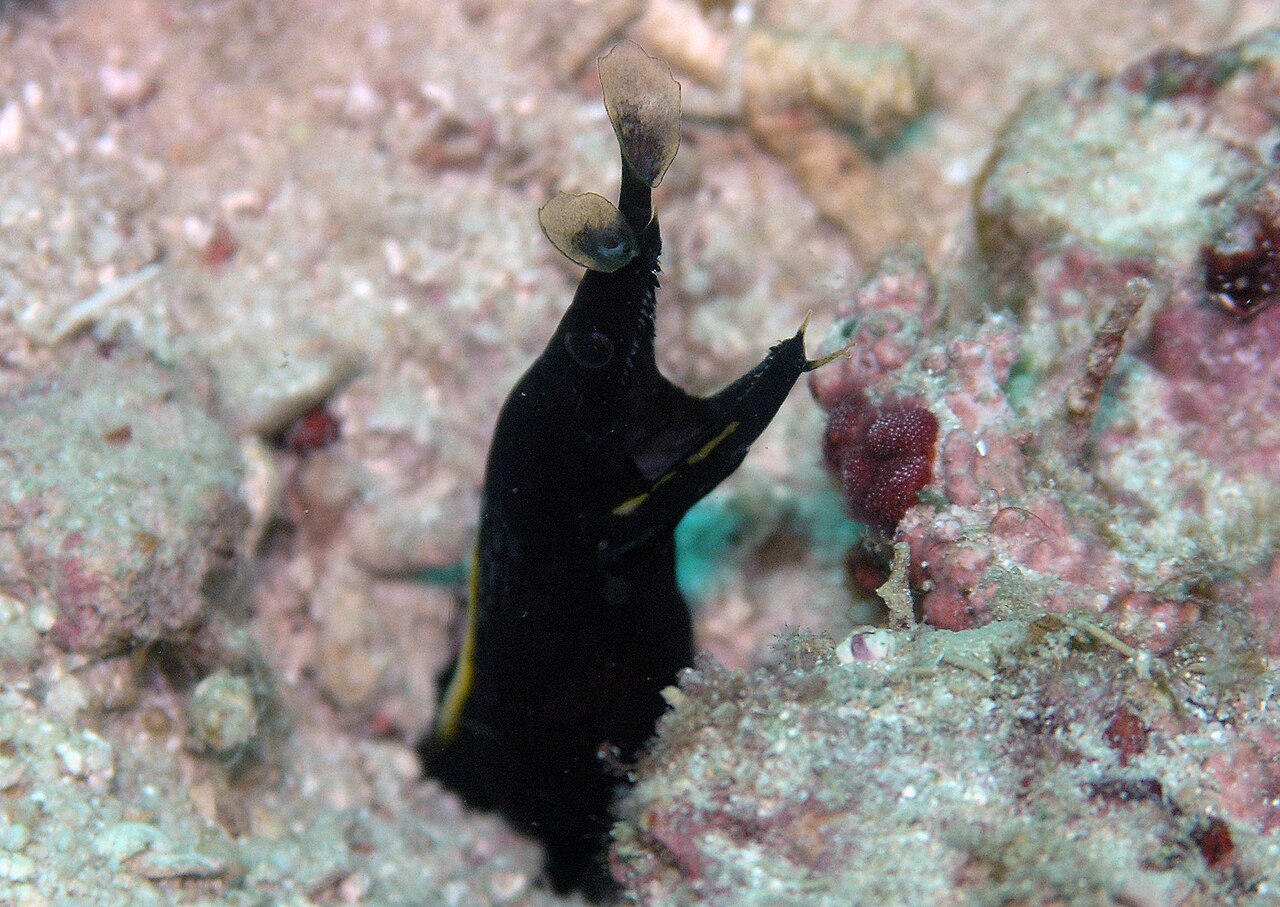
The museum describes juveniles and subadults as black with a yellow dorsal fin. Adult males are blue, with yellow on parts of the head. Females are predominantly yellow.
Those differences help explain why photographs can look surprisingly unlike one another. Color is useful, but identifying the whole animal is better than relying on one shade.
The black-phase photograph here shows a ribbon eel at Sipadan, Malaysia.
A Burrow Beside the Coral
Ribbon eels are often seen in burrows in sand or rubble next to reefs. Their range extends across the Indo-west Pacific.
A diver may see only the front of the animal. That limited view can make a long fish seem much smaller, and emphasizes how important the surrounding shelter is to its way of life.
A Reef Is More Than Living Coral
The sandy and rubbly spaces beside coral can look less spectacular than a bright coral head. For a ribbon eel, they can contain an essential hiding place.
That is a reason to observe carefully without moving rubble or trying to coax a fish from its hole. An interesting photograph should leave the shelter intact.
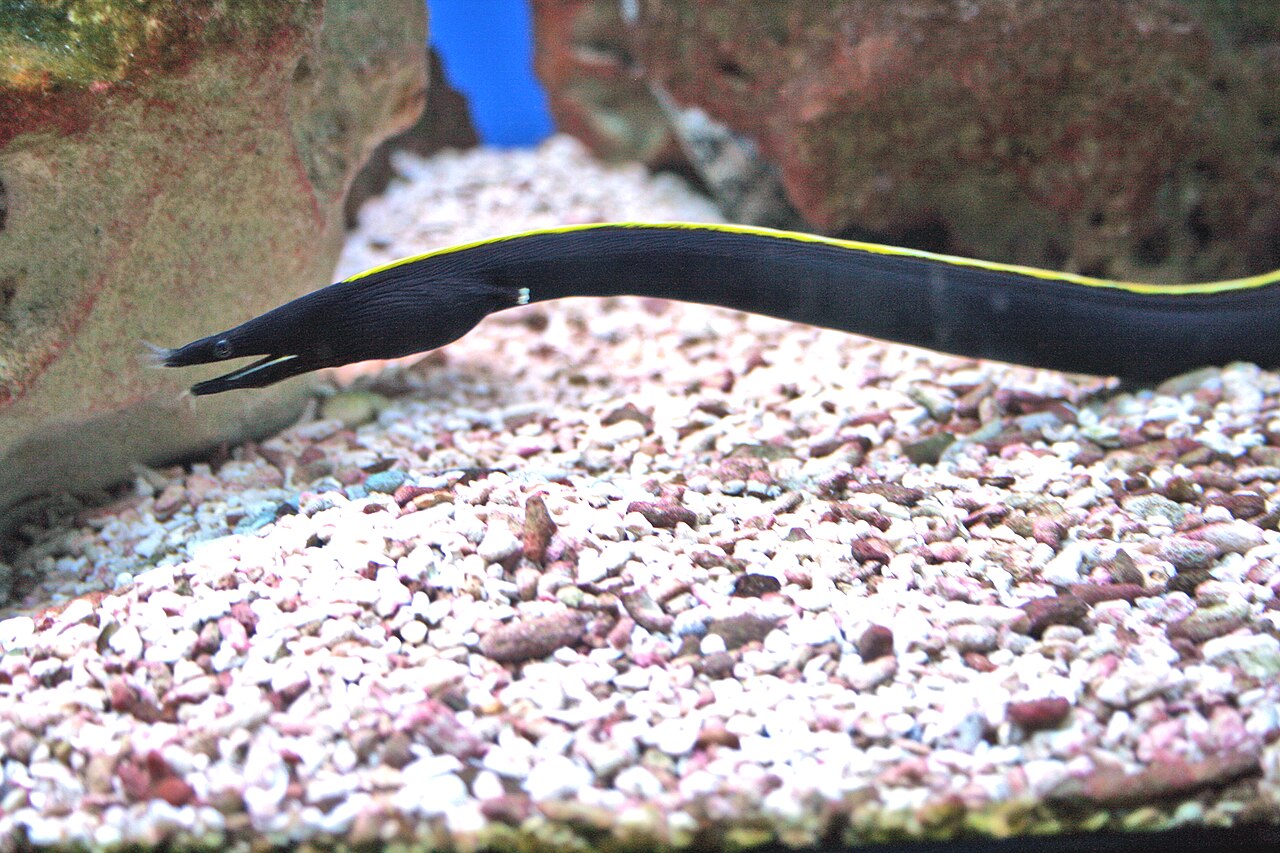
One of the images here was taken in an aquarium and is labeled accordingly; it should not be mistaken for a wild encounter.
A Small View of Something Extraordinary
The ribbon eel shows how little of an animal we sometimes see. A head, a pair of nostrils, and a vivid edge of color can be only the visible beginning of a much longer story.
Leave its burrow undisturbed, and that story can continue beneath the reef.
Photograph Credits
Featured image: Nick Hobgood, CC BY-SA 3.0. Resized for display. Ribbon eel photographed in Fiji.

Body image 1: Jens Petersen, CC BY-SA 3.0. Resized for display. A black-phase ribbon eel photographed at Sipadan, Malaysia.

Body image 2: Karelj, public domain. Resized for display. Ribbon eel in a Prague aquarium; captive photograph.
