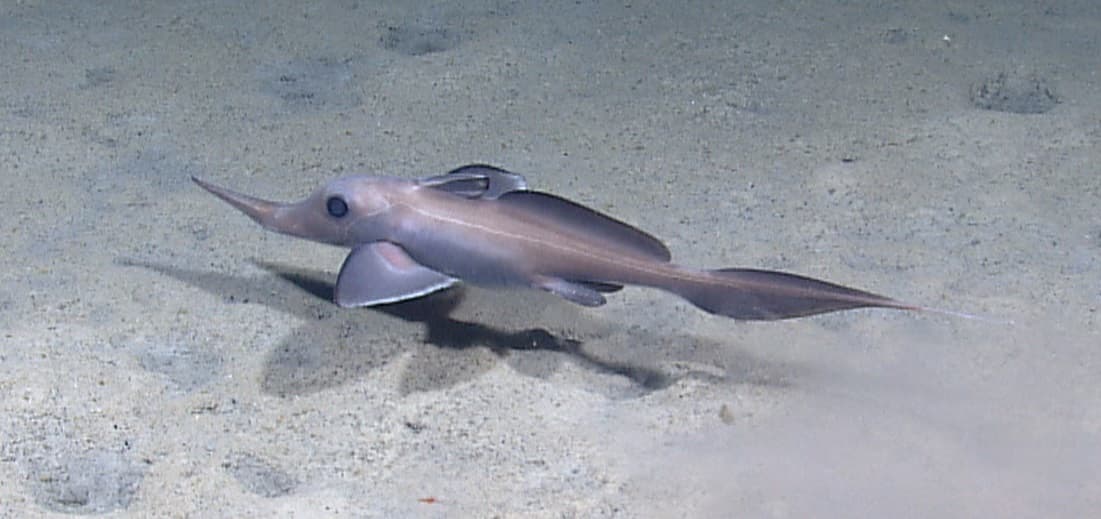
A pale fish moves above the seafloor, led by a pointed snout that seems almost too long for its body. Broad fins carry it through the darkness.
Long-nosed chimaeras look unfamiliar because their lives unfold far below most human visits to the sea.
A Family, Not Just One Fish
The name refers to fishes in the family Rhinochimaeridae. Different species share the elongated form and distinctive snout.
One example is the Pacific spookfish, Rhinochimaera pacifica. Another photographed member of the family is the narrownose chimaera, Harriotta raleighana.
The names “spookfish” and “chimaera” are memorable, but these are real animals with features scientists can study.
Related to Sharks, With a Different Shape
Chimaeras belong to the cartilaginous fishes, the broader group that also includes sharks and rays.
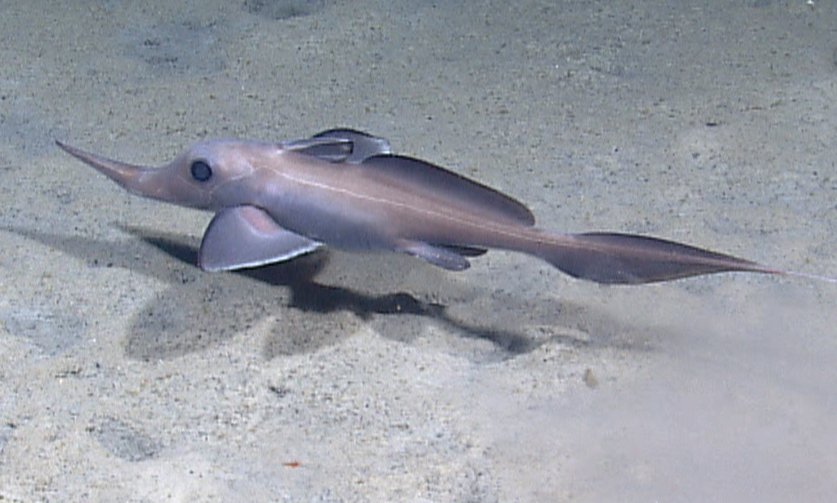
The Australian Museum describes the Pacific spookfish's flexible snout, small eyes, tooth plates, and two dorsal fins. A strong spine supports the first dorsal fin.
Its long tail and broad pectoral fins create a very different outline from a familiar reef shark. Related animals can follow strikingly different paths in body shape.
Life Far Below the Surface
Pacific spookfish records come from deep-water plateaus and troughs. The museum reports that Australian records are mostly from below 700 meters.
The NOAA photograph used here documents a long-nosed chimaera in the Gulf of Mexico. The body detail is another crop of that same expedition image, rather than a second encounter.
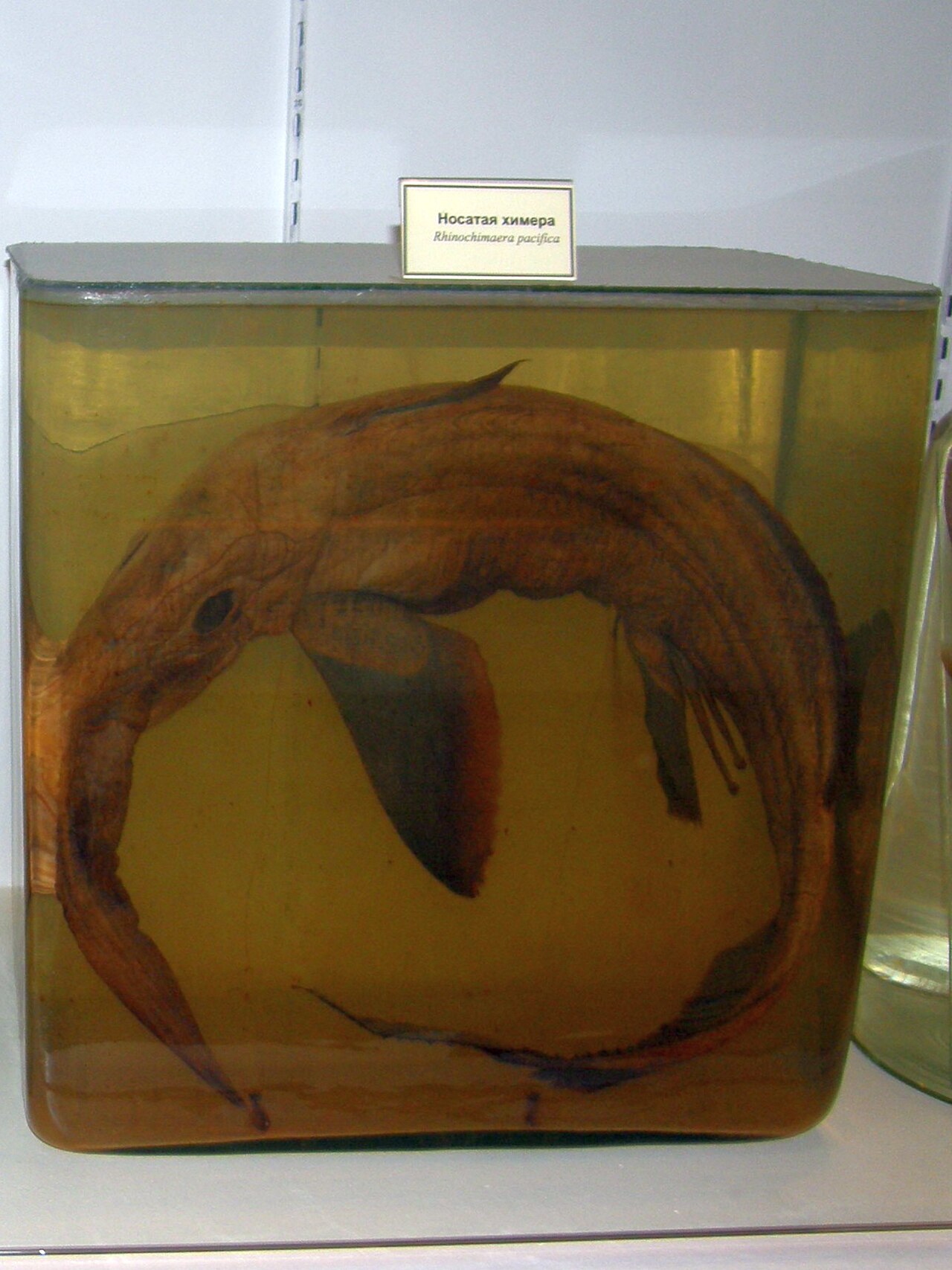
A preserved Pacific spookfish offers a different view of the family. Specimens help scientists inspect features that can be difficult to see in a brief underwater recording.
What We Still Do Not Know
The Australian Museum describes the Pacific spookfish as poorly understood, with little information about reproduction.
That uncertainty is part of the interest. A photograph can reveal an animal without revealing the full pattern of its life: how it finds mates, where it lays eggs, or how many survive.
Different long-nosed chimaeras should not be assigned identical habits simply because their shapes resemble one another.
Wonder Without Invented Monsters
A long snout and a deep-sea setting are enough to stir the imagination. They are also reasons to value careful observation.
Every expedition image and well-documented specimen adds something to our understanding. The long-nosed chimaeras remind us how much of the ocean remains a place of discovery.
Photograph Credits
Featured image: NOAA Okeanos Explorer Program, Gulf of Mexico 2012 Expedition, public domain. Resized for display. Long-nosed chimaera photographed in the Gulf of Mexico in 2012; existing source crop.

Body image 1: NOAA Photo Library / NOAA Okeanos Explorer Program, CC BY 2.0. Resized for display. Another existing crop of the same NOAA expedition photograph, showing the fish's form.

Body image 2: A. C. Tatarinov, CC BY-SA 3.0. Resized for display. Pacific spookfish, Rhinochimaera pacifica, at the Far Eastern Federal University museum; preserved specimen.
