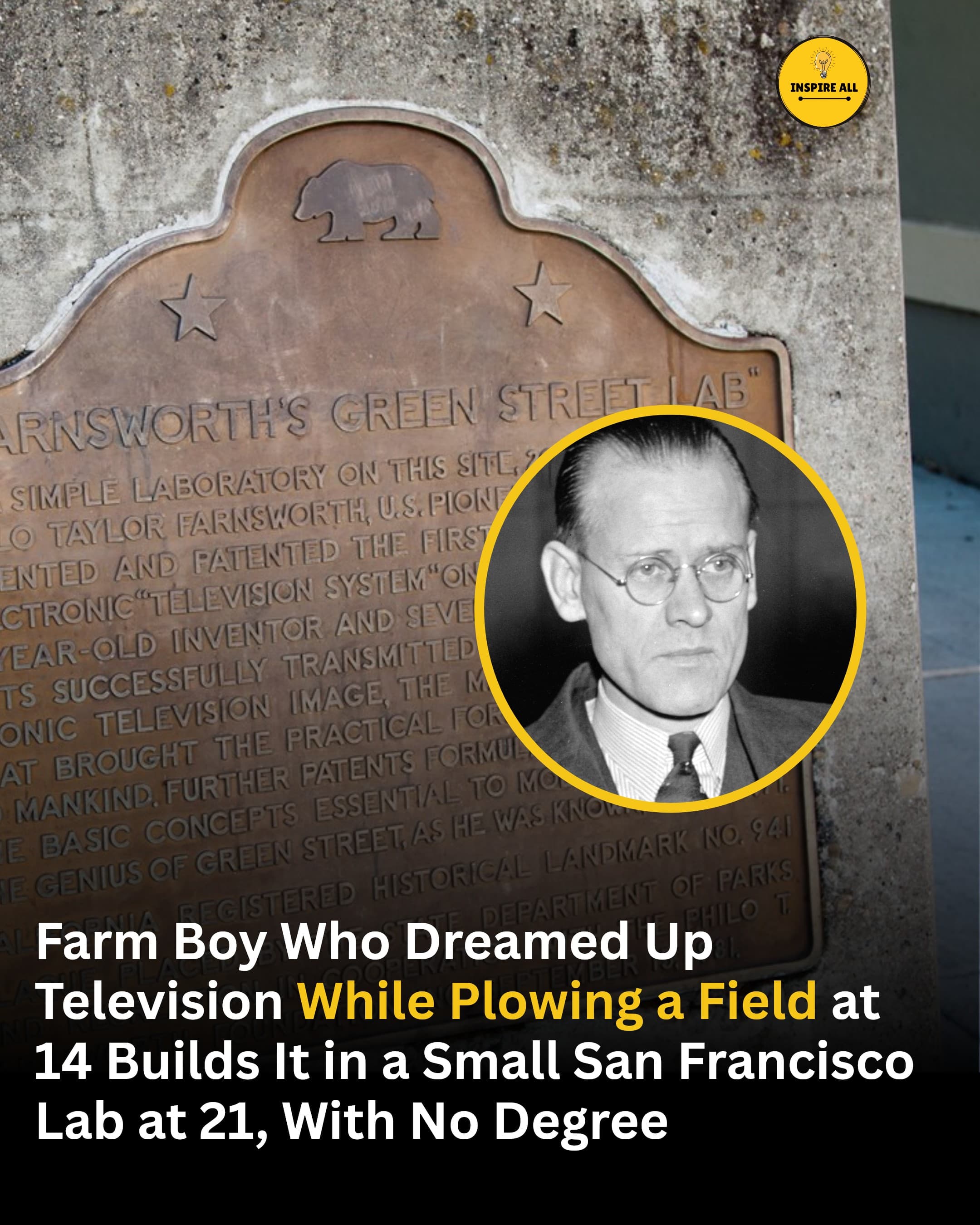
A familiar account links Philo Farnsworth’s teenage insight to rows in a field. The later laboratory achievement depended on years of work and several contributors.
On September 7, 1927, Philo Farnsworth’s San Francisco team transmitted a simple straight-line image electronically between rooms.
The Television Academy’s Hall of Fame tribute recounts the milestone and the earlier idea associated with his years near Rigby, Idaho.
In the account preserved through his wife, Elma “Pem” Farnsworth, rows in a ploughed field suggested scanning a picture line by line.
The idea needed a working apparatus
The same tribute describes Farnsworth explaining his concept to chemistry teacher Justin Tolman in 1922.
Later, Pem contributed to laboratory work, from records to fabrication, while her brother Cliff Gardner learned glassblowing to make tubes.
Those contributions matter. A striking moment of insight and a functioning electronic system are different stages of invention.
The 1927 demonstration was a technical milestone, not the arrival of a finished television service in every home.
An object that preserves the experiment
The Smithsonian’s experimental image-dissector record identifies a television transmission tube designed and made by Farnsworth in 1927.
An image dissector was part of the process of turning a visual scene into an electronic signal.
The object supplies another kind of evidence alongside recollections: a surviving piece of apparatus associated with the work.
The Smithsonian also includes the transmission of an electronic television image in its overview of 1927.
Credit without reducing the history
Television developed through multiple experiments, systems and contributors. Farnsworth’s achievement is best understood as a major step in electronic television, rather than a claim that no one before him had transmitted moving pictures by any method.
The distinction preserves what is impressive about the story.
A teenager imagined a different way to scan a picture. The later team had to turn that concept into tubes, circuits and a repeatable demonstration.
The lasting connection between the field and the laboratory is the willingness to translate an observation into a precise technical question, then build the equipment needed to test it.
This historical profile draws on the Television Academy and Smithsonian collections. The field inspiration is presented as the account preserved in the Academy’s tribute. Featured graphic supplied by Inspire All.
Related reading: Himaja’s voice-controlled Braille printer and Gargi Agrawalla’s portable alert prototype.