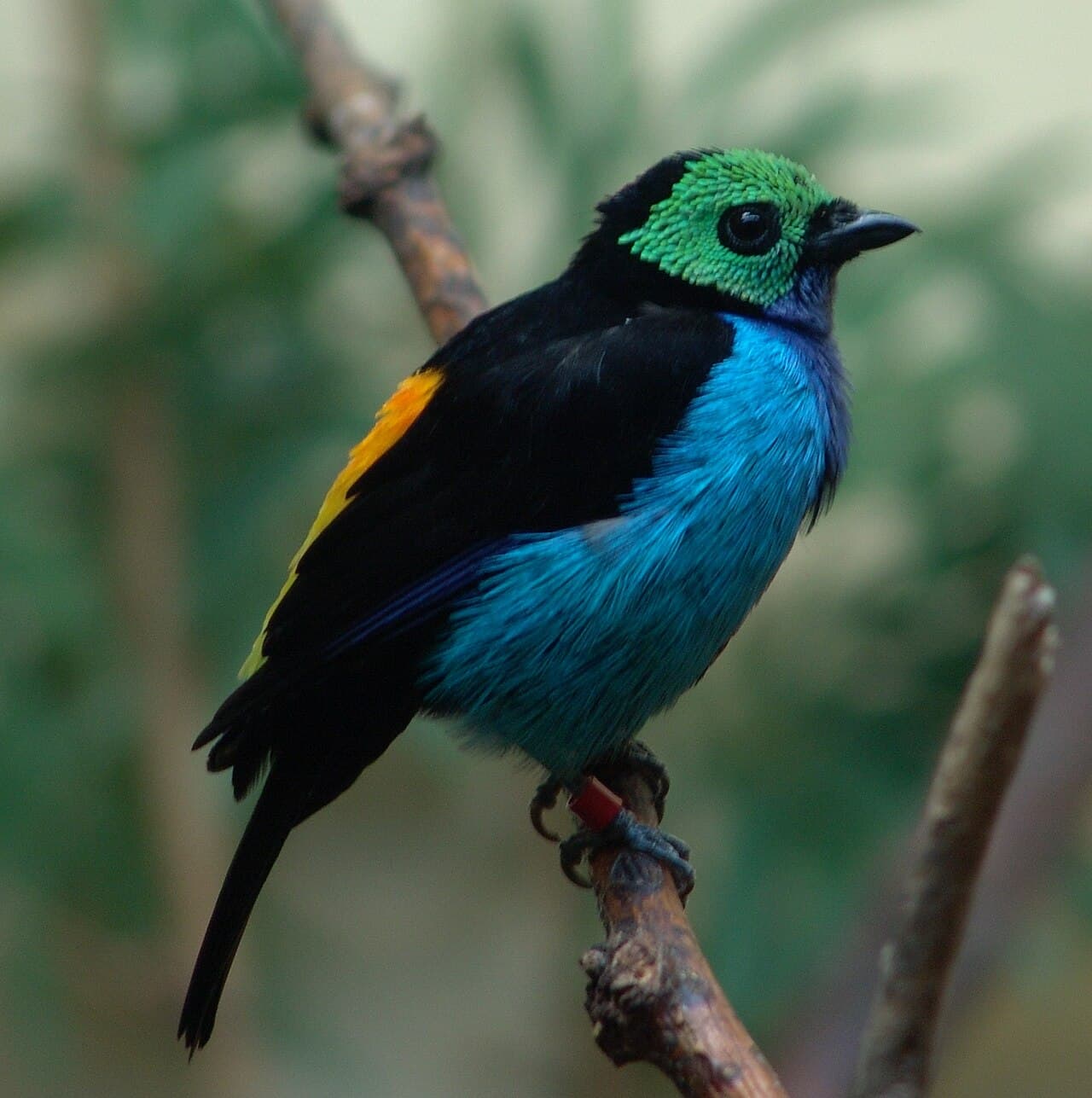
A paradise tanager can reveal lime green, sky blue, black, and a flash of red in a single turn. Its body is small, but the sharply separated colors make it easy to imagine an artist choosing each feather.
The bird is Tangara chilensis, a tanager from tropical South America. Despite that scientific name, it does not naturally live in Chile.
A different picture from every angle
A green head sits above a dark upper body. Bright blue underparts and a red, or red-and-yellow, rump complete the striking pattern. The exact rump colors vary among populations.
Basel Zoo's account describes the vivid head, belly, wings, and back. It also points out the misleading country reference in the scientific name.
Names are useful labels, but they do not always tell us where an animal lives. In this case, a map is a better guide.
A bird of the upper forest
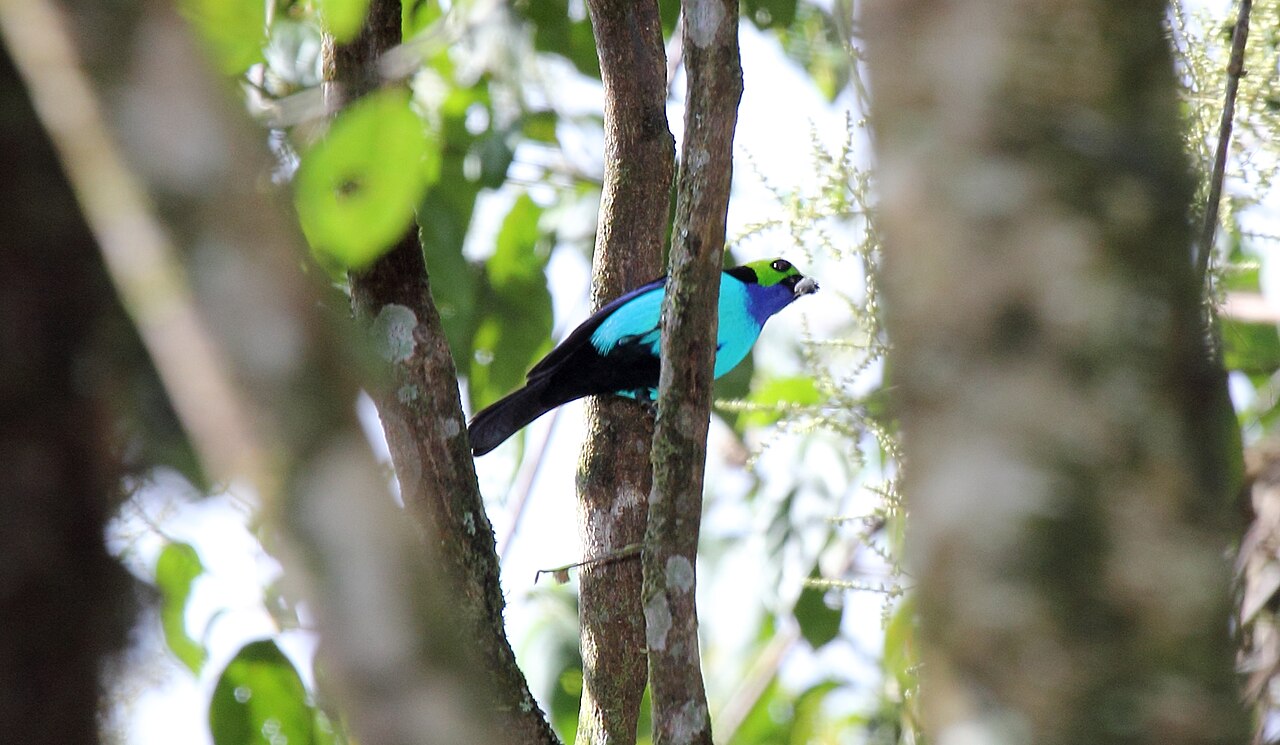
Paradise tanagers occur across a broad area of Amazonia and nearby tropical forests. The Peru Aves field account describes pairs or family groups feeding in the canopy, often among flocks containing other species.
A flock does not have to consist of birds that look alike. Several kinds can pass through the same patch of branches, turning an apparently quiet tree into a lively moving scene.
Watching takes patience. A dark wing may disappear against the leaves before a blue belly or green head catches the light again.
A small bird in a large landscape
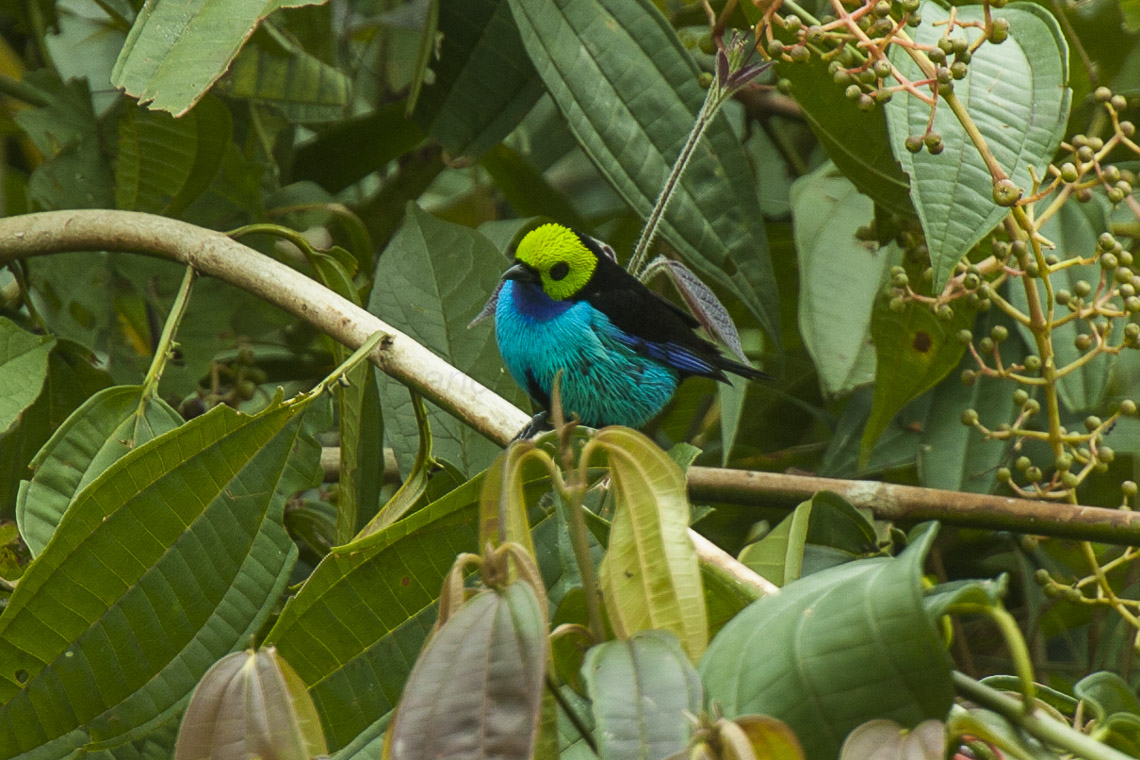
Males and females share the same colorful pattern, as described in the zoo zoology reference Zootier Lexikon. A bright bird is therefore not automatically a male.
The reference lists a range across tropical South America and notes that the species is not currently threatened, although its habitat and population are decreasing. A wide range offers no reason to ignore the loss of forest within it.
A forest worth looking up for
Keeping tropical forests intact protects the setting in which these birds feed and travel. Their beauty is an invitation to notice that wider living world.
With a paradise tanager, the wonder can fit on one small perch. The next turn of its head offers another reason to keep watching.
Photo credits
Featured image: Tangara chilensis -Denver Zoo-8a.jpg — Drew Avery, CC BY 2.0.

Body image 1: Paradise Tanager (Tangara chilensis) (9499638972).jpg — Dominic Sherony, CC BY-SA 2.0.

Body image 2: Paradise Tanager - Manu NP - Perù 7844 (23224160816).jpg — Francesco Veronesi from Italy, CC BY-SA 2.0.

Photographs resized to up to 1,280 pixels wide for web display.