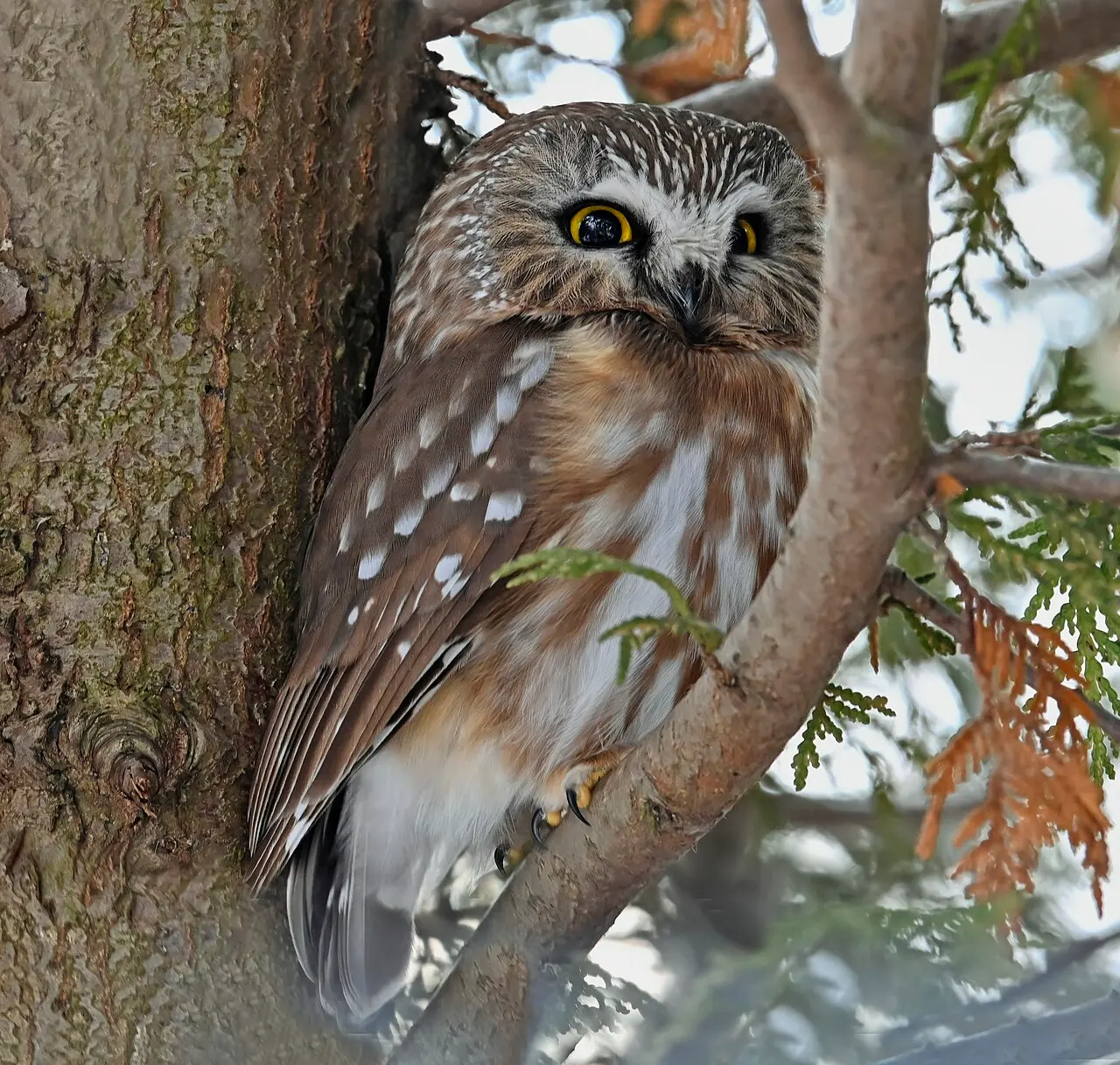
A tiny owl hidden in dense branches can announce itself with a repeating, high-pitched call. The Northern Saw-whet Owl is often easier to hear than to see.
Aegolius acadicus has a large rounded head, bright yellow eyes, and no ear tufts. Its compact shape can disappear into a tangle of evergreen foliage.
Small size, serious hunting
Cornell Lab of Ornithology describes a highly nocturnal owl that feeds mainly on small mammals, especially mice.
Its appealing face does not change its role as a predator. After dark, this small forest resident becomes a focused hunter.
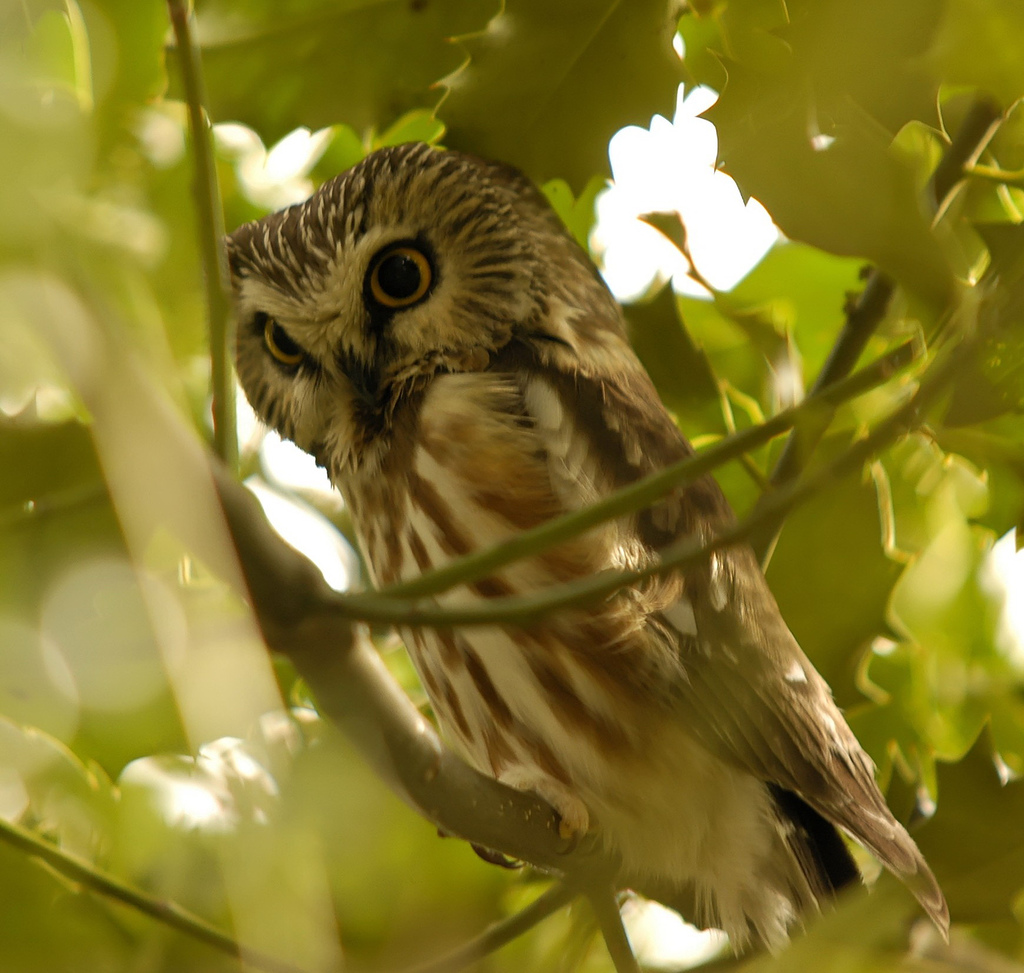
The daytime hiding place
During daylight, saw-whets often roost in dense vegetation close to a tree trunk. Brown and pale markings help break up the bird’s outline.
A Cornell identification account explains the difference between the spotted, paler-faced adult and the darker juvenile.
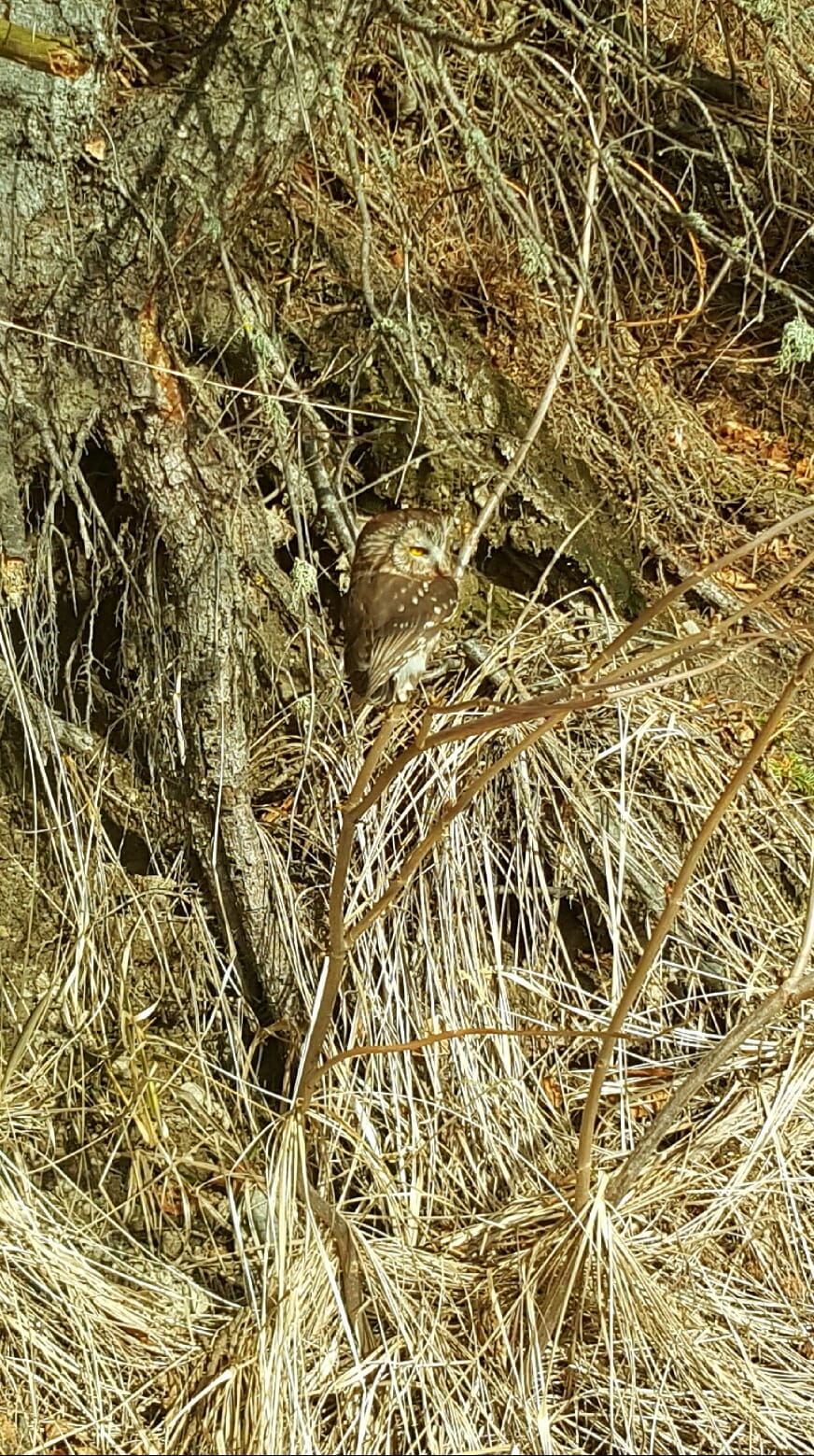
A nursery in a hole
Saw-whets nest in cavities. The female incubates and broods while the male supplies much of the food, as described in Cornell’s life-history account.
Suitable woodland therefore offers more than hunting space: it also contains the hidden places needed to raise young.
Enjoy a resting owl without crowding its cover. An undisturbed glimpse preserves the quiet routine that makes this small bird so difficult—and so rewarding—to find.
Photo credits
Featured image: Aegolius acadicus Downsview Park Toronto.jpg — Mykola Swarnyk; CC BY-SA 4.0.

Body image 1: Northern Saw-whet Owl, Reifel BC 1.jpg — Brendan Lally from Delta, Canada; CC BY 2.0.

Body image 2: Northern saw-whet owl in brush.jpg — Beeblebrox; CC BY-SA 4.0.

Photographs resized for web display where available. Existing crops are identified in their source filenames; captive birds and younger birds are identified in captions.