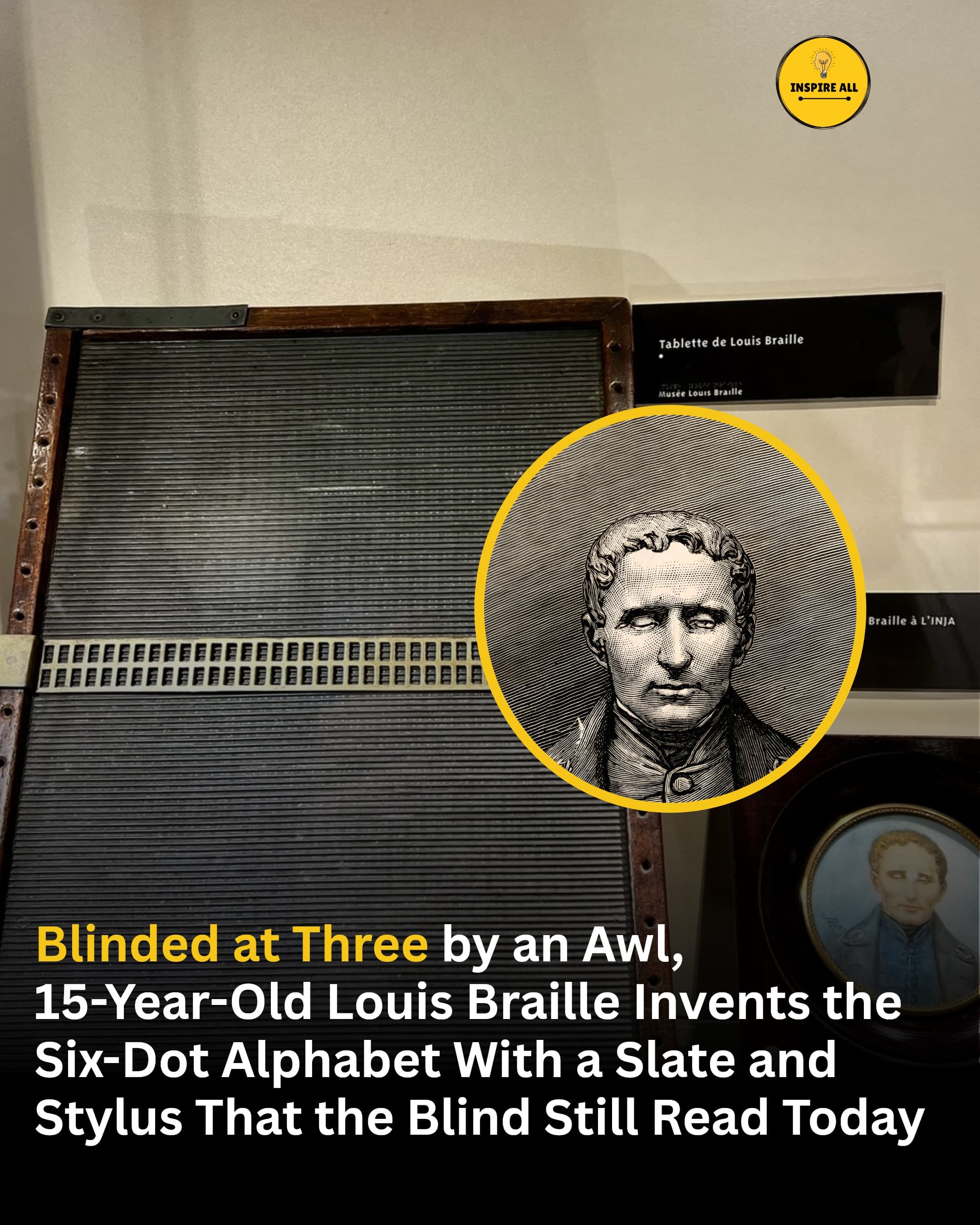
Louis Braille’s achievement was a system designed around touch, giving readers a compact way to represent written language.
Louis Braille lost his sight after an injury at age three. As a student in Paris, he later developed the six-dot system associated with his name.
The Library of Congress’s exhibition overview places his work within a history that also includes the contributions of others.
That context makes the achievement clearer: Braille took an existing approach to raised-dot communication and transformed its usability.
Building on an earlier code
The American Foundation for the Blind’s historical account describes the influence of Charles Barbier’s system and Braille’s work to develop a more compact six-dot cell.
A smaller arrangement could be recognized through the fingertip without following a large raised outline.
The design made combinations of dots central to the reading process. Its value came from organizing those combinations into a usable written system.
More than an alphabet
The Library of Congress’s guide to Braille explains the six-dot cell as two columns of three positions.
Braille is a system for representing language, rather than a separate spoken language. The guide also records his 1829 publication, which included musical notation.
That musical application is an important detail. The work concerned access to more than ordinary prose.
A development that continued beyond its inventor
The familiar teenage-inventor story can compress years of refinement and adoption into one moment.
The surviving history instead shows an evolving code that other readers and institutions had to learn, assess and adopt.
Nor is Braille the only way blind people read. Readers use different tools and formats according to their needs, preferences and circumstances.
Its enduring importance lies in providing direct tactile access to written information.
Louis Braille’s story therefore concerns more than overcoming a personal difficulty. It is about designing a structure that other people could use, extend and teach.
The six dots are simple to describe. The achievement was discovering how much written expression a carefully organized cell could carry.
Historical account based on the American Foundation for the Blind and Library of Congress. Featured graphic supplied by Inspire All.
Related reading: Momofuku Ando’s instant-noodle experiments and Michael Faraday’s route from bookbinding into science.