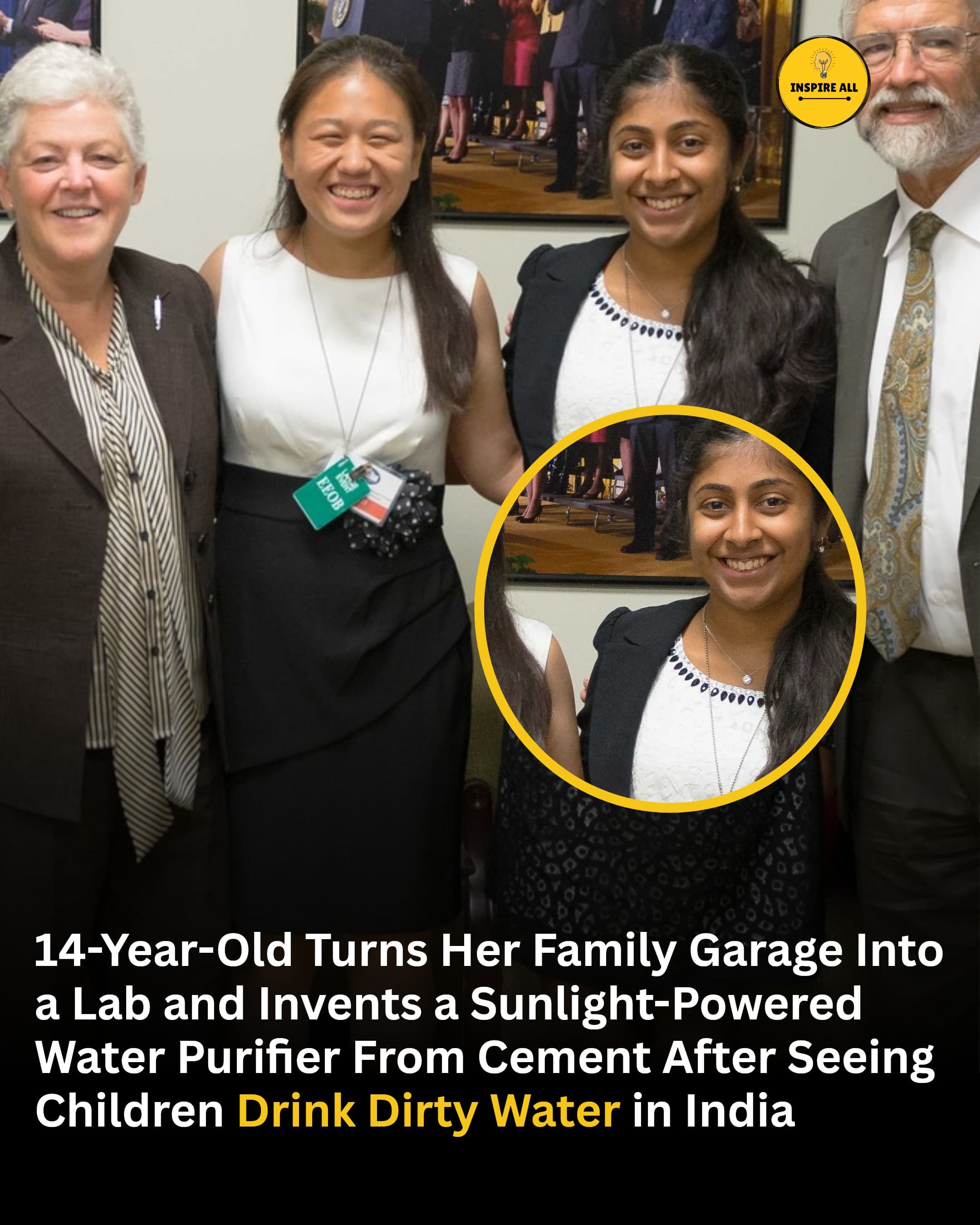
A visit to India helped motivate Deepika Kurup to investigate whether light and a specially designed material could help treat contaminated water.
Deepika Kurup began researching water treatment as a teenager after seeing children drink water she considered unsafe near her grandparents’ home in India.
Her TED account traces that concern to experiments beginning at home.
The project developed into award-winning research, but it should not be described as proof that ordinary cement can make any water safe to drink.
A material designed to work with light
An August 25, 2014 EPA announcement describes Kurup’s lightweight photocatalytic composite for water purification.
The agency reports work on degrading organic substances and inactivating bacteria, along with several prototypes.
Photocatalysis refers to light helping drive a chemical process through a suitable material. The composition and testing conditions matter; it is not equivalent to dropping an arbitrary piece of building material into water.
Recognition at different stages
Young Scientist Lab identifies Kurup as its 2012 grand-prize winner.
The EPA announcement records later recognition through the President’s Environmental Youth Award. These are separate milestones in a continuing research story.
Keeping dates explicit avoids presenting experiments from different years as one unchanged device.
What a purification claim must establish
Water can contain different kinds of contaminants. Showing that a process reduces one organism or substance under test conditions does not demonstrate removal of every possible hazard.
The sources reviewed here do not establish current commercial availability or universal drinking-water safety.
This article is a profile of student research, not instructions for treating water at home.
That qualification preserves the value of Kurup’s achievement. She identified a problem she cared about, investigated a possible mechanism and developed experiments that attracted scientific recognition.
The work between concern and a dependable application is substantial. Her story illustrates the beginning of that process and why measurements are essential to the next steps.
Based on Kurup’s TED account, Young Scientist Lab and EPA reporting. Featured graphic supplied by Inspire All; its purifier wording refers to an experimental project.
Related reading: Momofuku Ando’s instant-noodle experiments and Michael Faraday’s route from bookbinding into science.