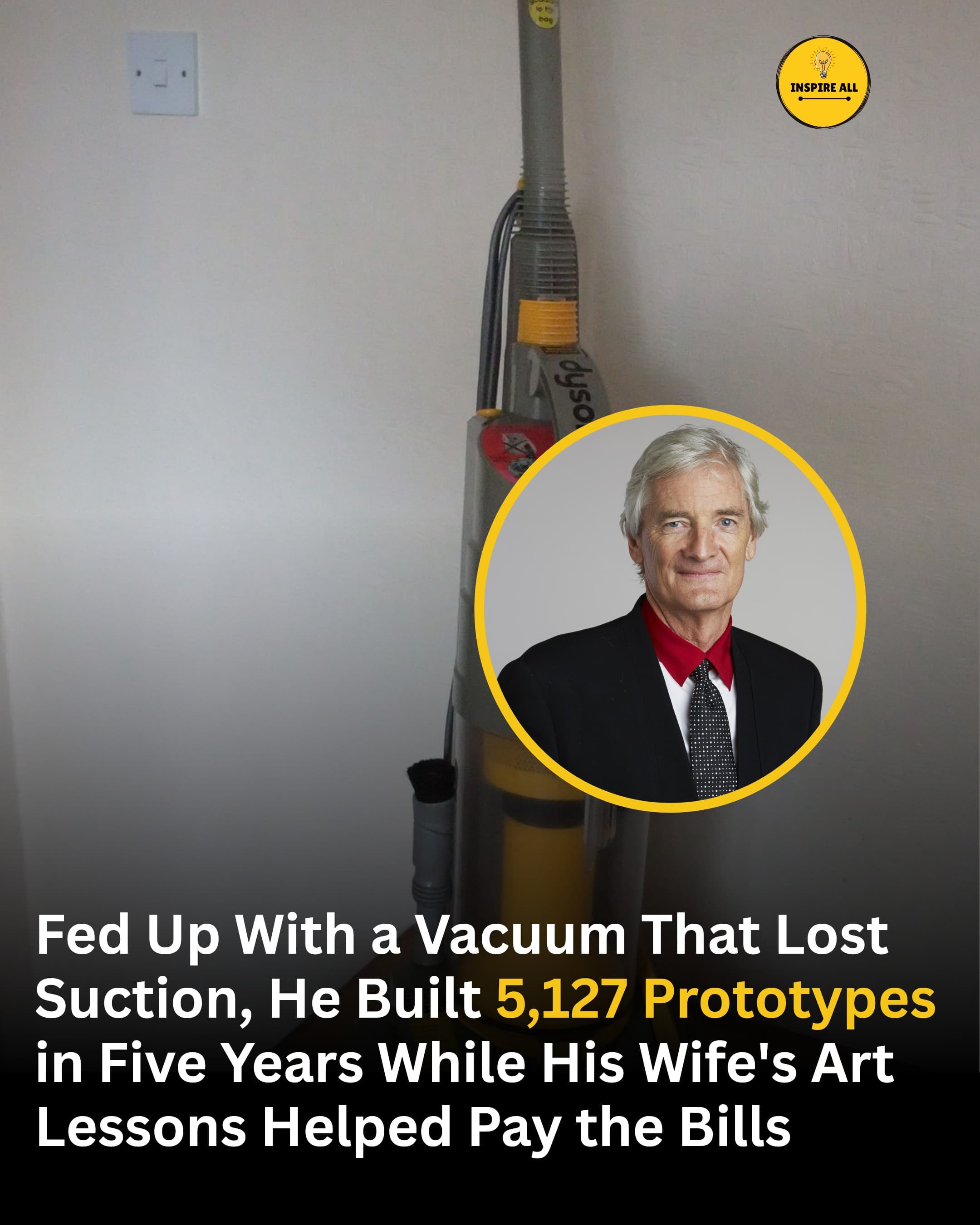
A vacuum that lost suction became the starting point for a long series of experiments with cyclone technology.
James Dyson’s familiar prototype count tells a more useful story when placed beside the problem he was trying to solve.
In a 2011 essay for WIRED, Dyson recalled a bagged vacuum losing suction and his early attempt to apply cyclone separation. He described 5,127 prototypes and a 15-year path to getting the product right, with the DC01 reaching market in 1993.
Those figures describe his retrospective account, rather than a claim that every prototype represented a completely different machine.
Separating dust without a bag
Dyson’s explanation of its cyclone engineering describes using centrifugal separation to remove dirt from airflow.
The practical goal was to address the loss of performance associated with a clogging bag.
A crude model could demonstrate the principle without resolving every requirement of a household appliance. Materials, airflow, dust collection and manufacture still needed attention.
Why the timeline needs care
The company’s founder biography also records 5,127 prototypes, linking them to several years of development before a cyclonic machine was ready for production.
That phase and the longer journey to the DC01 are not interchangeable. A promising design, an early manufactured product and a later market launch are different milestones.
This article therefore avoids attaching every anecdote in the supplied story to a precise prototype number or treating the whole period as five identical years.
Learning from a result that disappoints
The value of repeated prototypes lies in what changes after each test. A failure can identify a problem, but it becomes useful only when the next experiment investigates it.
Dyson’s story is strongest at that practical level. An observation about suction prompted a mechanism; the mechanism then needed sustained development.
The eventual product can make the process look inevitable in hindsight. The prototype count reminds readers that it was built through many decisions whose outcomes were uncertain at the time.
Based on Dyson’s own essay and company histories. These retrospective accounts are attributed; no present product recommendation is made. Featured graphic supplied by Inspire All.
Related reading: Momofuku Ando’s instant-noodle experiments and Michael Faraday’s route from bookbinding into science.