
Imagine a silver ribbon several meters long, edged with a red fin and moving through open water. The giant oarfish looks like something from a sailor's tale.
Yet Regalecus glesne is a real fish. Its unusual body offers a fascinating way to explore where ocean biology meets human imagination.
An Extraordinary Kind of Long
The giant oarfish has a narrow, flattened body that tapers toward the tail. A long dorsal fin runs along its back, with extended rays forming a crest near the head.
The Florida Museum's species account describes silvery skin, red or pink fins, and a small mouth with no obvious teeth.
It is widely recognized as the longest living bony fish. Size reports vary, so a dramatic maximum should not be treated as the length of a typical animal.
How Does That Ribbon Swim?
An oarfish can send waves along its dorsal fin while keeping much of its body fairly straight. It has also been observed hanging vertically in the water.
That is a very different picture from a sea serpent thrashing at the surface. A body that looks strange on a beach belongs to an animal adapted to life in the water column.
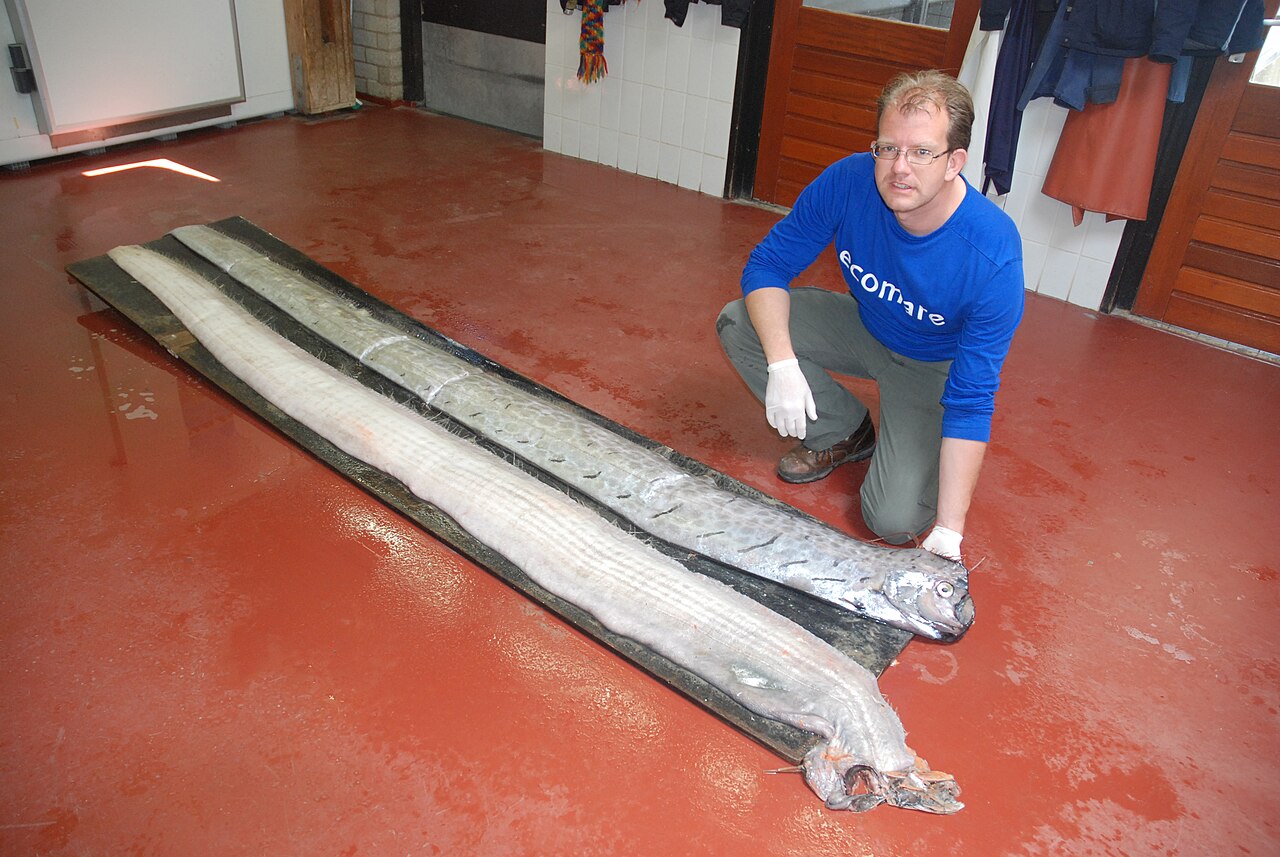
A Giant With Small Food
Despite its size, the oarfish feeds on much smaller animals. The Florida Museum lists planktonic crustaceans, including krill, among its food.
Its length does not turn it into a giant predator chasing swimmers. The small feeding apparatus tells a different story from the dramatic silhouette.
Why People Thought of Sea Serpents
The Australian Museum notes that surface sightings may have contributed to sea-serpent stories.
It is easy to understand the connection. A brief glimpse of a very long fish, an unfamiliar red crest, and a moving ocean leave plenty of room for imagination.
That explanation is plausible; it does not prove that every old sea-monster report described an oarfish. The ocean has inspired many kinds of stories.
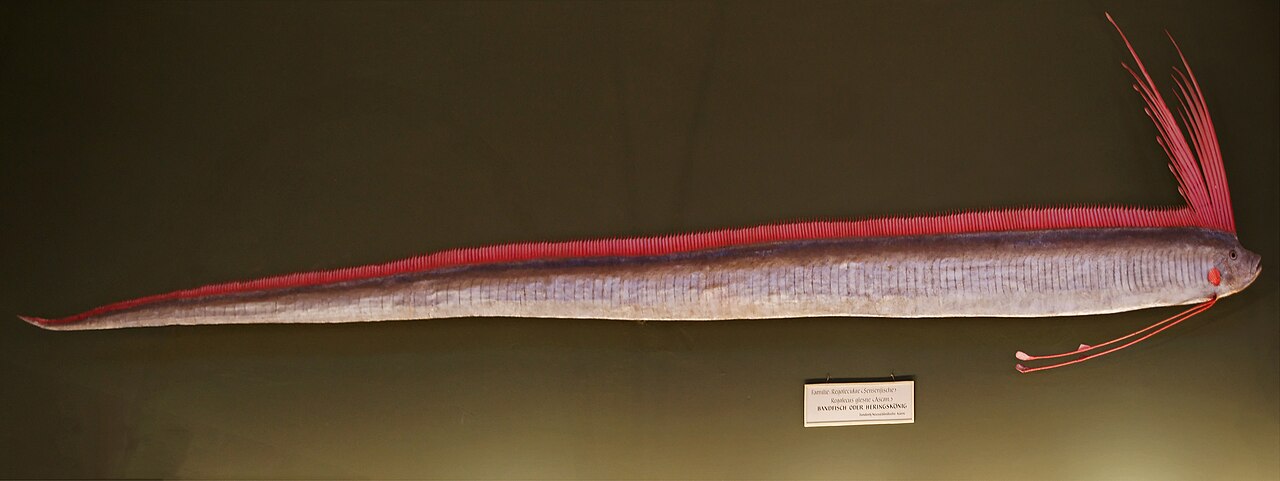
Rare Encounters Are Valuable Clues
Living oarfish are difficult to study because people rarely encounter them in their normal habitat. Stranded specimens and preserved museum material help researchers examine features that are otherwise hard to see.
The photographs in this article show stranded or preserved animals. They document the species, but cannot show its normal swimming behavior.
Strandings are not a reliable earthquake warning. Museum guidance from Te Papa discusses a 2019 study that found no correlation between earthquakes and oarfish strandings.
The giant oarfish needs no invented powers to be astonishing. A real silver ribbon moving through the deep sea is already more than enough to fill us with wonder.
Photograph Credits
Featured image: Wm. Leo Smith / U.S. Navy, public domain. Resized for display. A stranded giant oarfish found near San Diego in 1996; this is not a live underwater scene.

Body image 1: Ecomare / Salko de Wolf, CC BY-SA 4.0. Resized for display. Giant oarfish documented at Ecomare after stranding in May 2009.

Body image 2: Sandstein, CC BY 3.0. Resized for display. A preserved giant oarfish specimen in Vienna; museum display.
