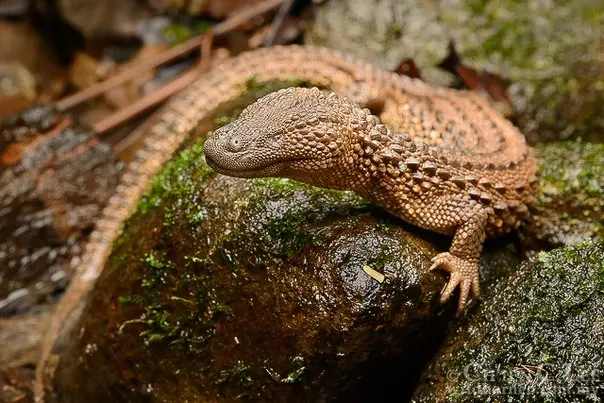
The earless monitor lizard has no visible ear openings—but it can still hear. That surprising detail is only the beginning of the story of Lanthanotus borneensis, a small reptile found on Borneo.
With a long body, short limbs, and rows of raised scales, it has the appearance of a creature from an illustrated legend. Its real life is quieter and harder to observe.
A lizard suited to hidden places
Earless monitors spend time in damp ground and shallow forest streams. They are mainly active at night, which helps explain why people encounter them so rarely.
Their short limbs and elongated bodies suit a life close to the ground. Earthworms and other small animals form part of their diet. Sarawak's Forest Department explains that the lack of visible ears does not mean the animal is deaf.

A family of its own
Despite its common name, this species belongs to Lanthanotidae, a separate family from the true monitor lizards. It is that family's only living species.
Much about its life in the wild remains poorly known. That uncertainty is part of its scientific interest, but it also makes careful research especially valuable.

Wonder should protect its home
Forest destruction threatens its habitat, while demand from collectors adds another concern. TRAFFIC has documented trade in these unusual lizards.
The best place for Borneo's secretive reptile is within a living forest, with streams, shelter, and soil around it. Appreciating an extraordinary animal should help keep its world intact.
Photo credits
Featured image: Real Lanthanotus borneensis.jpg — Chien C. Lee, Wild Borneo Photography; CC BY-SA 4.0.

Body image 1: Tajor waterfall - Natural pool - Bako National Park - Sarawak - Borneo - Malaysia - panoramio.jpg — diego_cue; CC BY-SA 3.0.

Body image 2: Kinabalu Park (13891114634).jpg — Mike Prince from Bangalore, India; CC BY 2.0.

Photographs resized for web display where available. Existing crops are identified in their source filenames; captive animals and landscape context are identified in the captions.