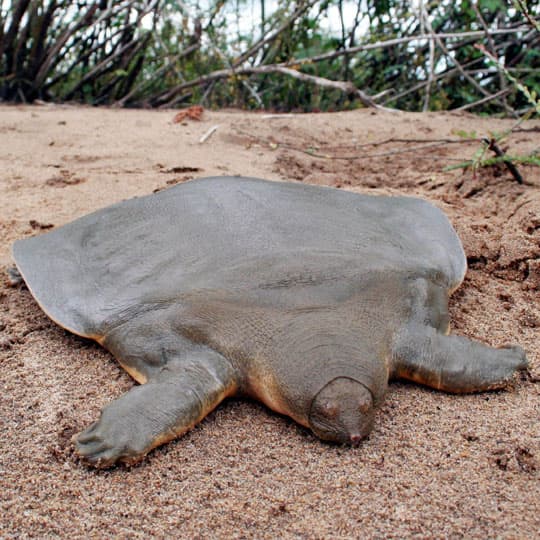
A huge turtle can be remarkably difficult to see when its flat body is buried in a riverbed. Cantor's giant softshell turtle spends much of its life in water, where its outline blends with the bottom.
Its size does not make it easy to study—or easy to protect.
Which giant softshell?
“Giant softshell turtle” can refer to several species. This article focuses on Pelochelys cantorii, also called Cantor's or Asian giant softshell turtle.
The EDGE of Existence profile describes its lowland aquatic habitats, including rivers, wetlands, and estuaries.
Its flattened shell has a leathery covering rather than the familiar arrangement of hard external scutes seen on many other turtles.
A body suited to concealment
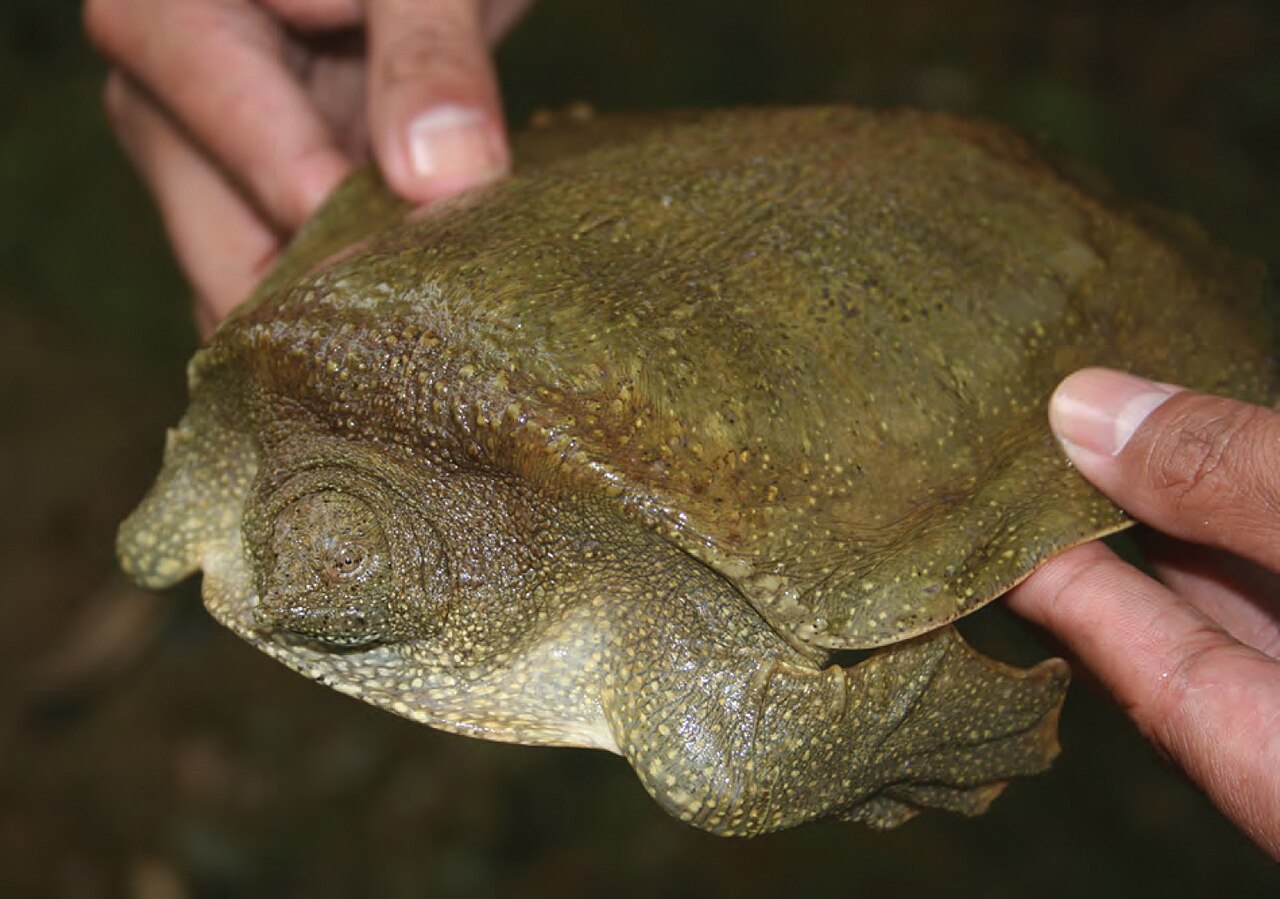
The broad shape helps the turtle settle against the bottom. Its head and nostrils allow it to investigate its surroundings and reach air while keeping much of the body concealed.
It takes aquatic food, including fish and invertebrates. A hidden position can be useful to a predator as well as protection from being noticed.
The species survival blueprint details its ecology and conservation needs.
Local observations reveal hidden lives
Fishers and other river users may encounter animals that formal surveys miss. Working with communities can help researchers locate surviving populations and respond to accidental catches.
A sighting becomes especially valuable when identification is checked carefully. Large softshell turtles can be confused in photographs.
Protect the river, not just the turtle
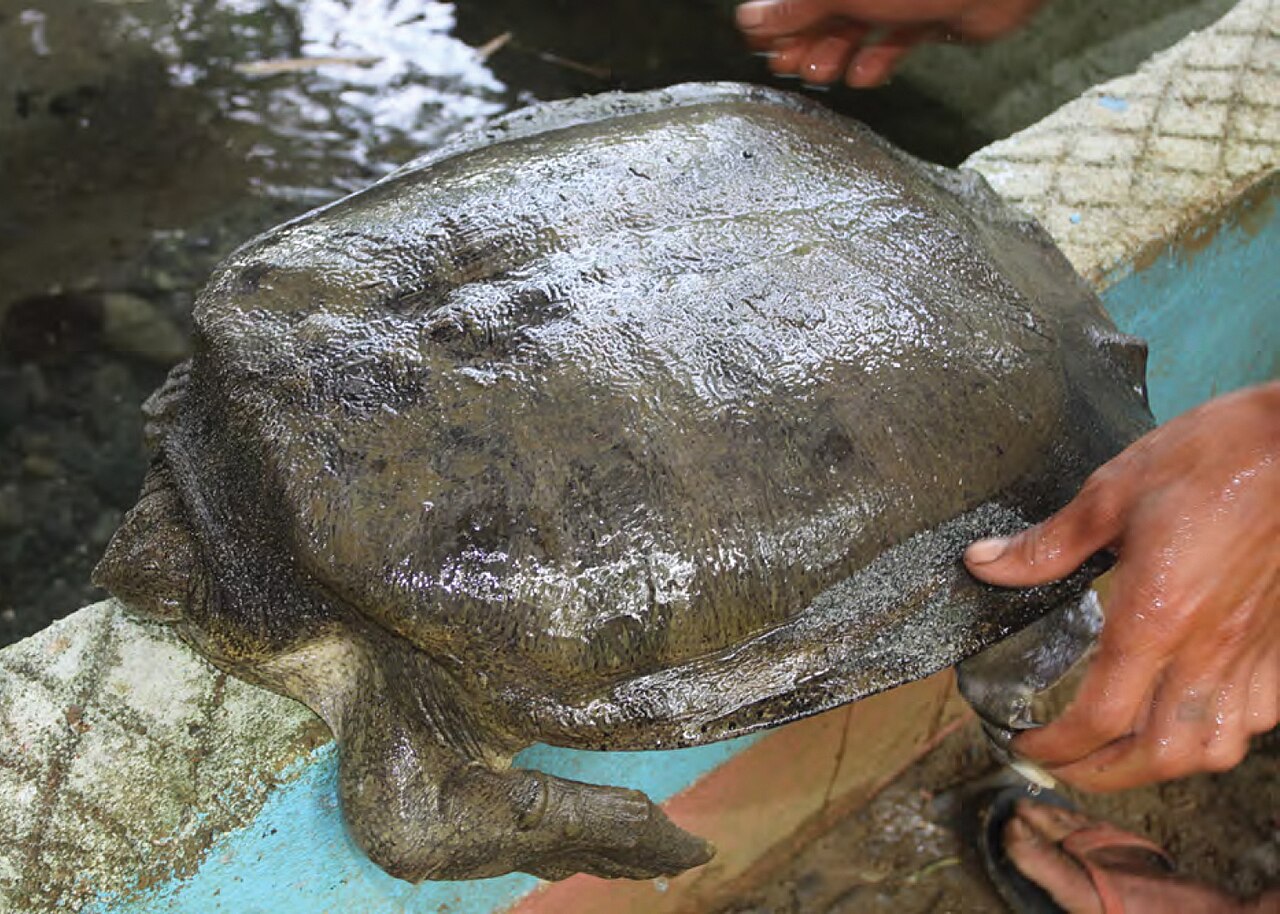
Fishing pressures, collection, sand removal, and changes to waterways can affect these reptiles and their nesting places.
Conservation requires suitable river habitat and cooperation with the people who use it.
Cantor's giant softshell shows that an extraordinary animal can hide in plain sight. A quiet riverbed may hold much more life than its surface suggests.
Photo credits
Featured image: Dementia; Source; CC BY-SA 2.0. Resized for web display.

Body image 1: Brown R, Siler C, Oliveros C, Welton L, Rock A, Swab J, Van Weerd M, van Beijnen J, Rodriguez D, Jose E, Diesmos A; Source; CC BY 3.0. Resized for web display.

Body image 2: Brown R, Siler C, Oliveros C, Welton L, Rock A, Swab J, Van Weerd M, van Beijnen J, Rodriguez D, Jose E, Diesmos A; Source; CC BY 3.0. Resized for web display.
