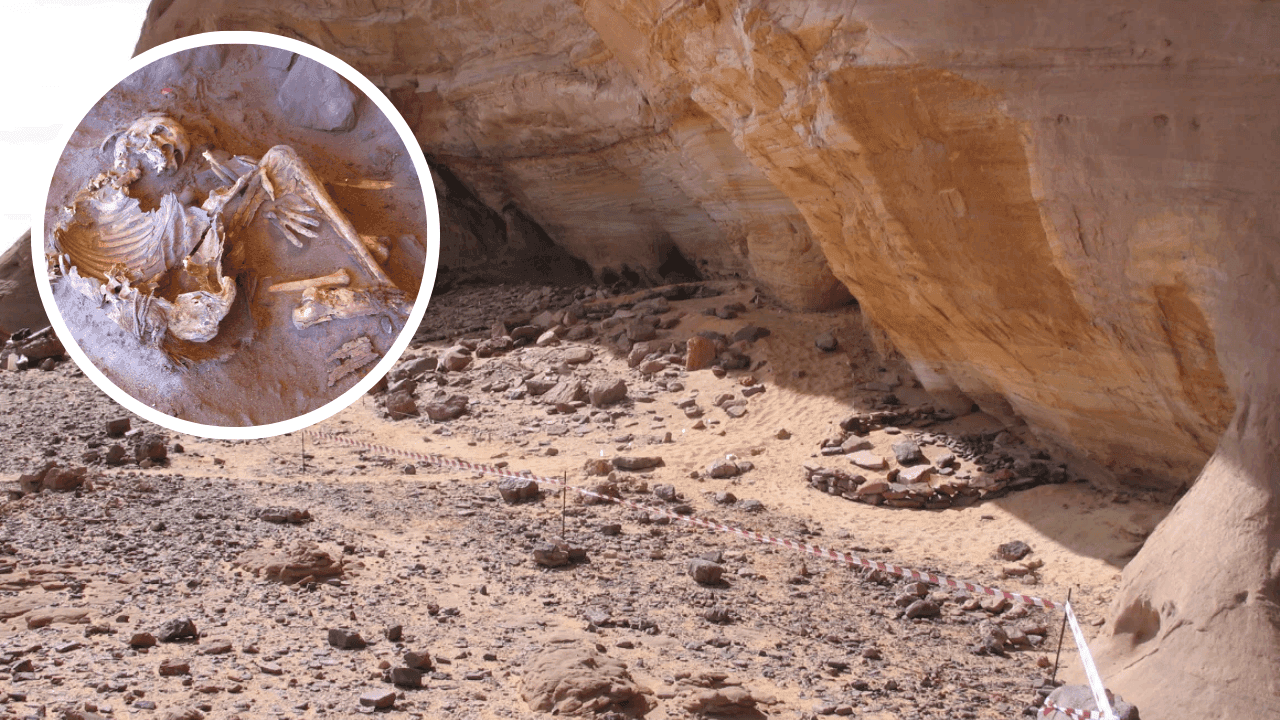
In the desolate expanses of the Takarkori Cave in the Sahara Desert, archaeologists made an astonishing discovery: two mummies, over 7,000 years old, emerged from the depths of history, perfectly preserved. But the age of these women is not the most compelling aspect of this finding. What has truly shocked the scientific community is their genetic makeup. Unbelievably, the DNA of these mummies does not belong to any known human species, challenging everything we thought we knew about our ancestry.
In a groundbreaking study published in Nature on April 2, 2025, researchers proposed that these women could be remnants of a forgotten branch of humanity, a lineage cut off from modern humans by the Sahara’s unforgiving natural barriers. This extraordinary isolation may have allowed a unique human race to flourish, hidden from the rest of the world for millennia.
The discovery was made by a team of dedicated archaeologists who unearthed the remains back in 2008. The bodies were found alongside 15 other skeletons in what used to be the “Green Sahara,” a lush environment teeming with lakes and vegetation—far different from today’s arid landscape. As archaeologists uncovered these ancient relics, a story began to unfold that remained dormant for centuries.
As the DNA was analyzed, the implications started to sink in. No genetic ties were found linking the mummies to contemporary populations. This void sparked an unsettling question: Who were these women, and what secrets did they carry? With no connections to the known human lineage, the study opened a window to an alternate narrative of human evolution, suggesting these women belonged to a long-lost family tree.
With each probe into their DNA, scientists were revealing potential connections to groups long disappeared but possibly thriving in the Sahara’s past. Dr. Maria Al-Hassan, a leading geneticist on the team, expressed the bewilderment of her findings by stating, ‘We’ve scratched the surface of a lost chapter in humanity’s history, and it’s both exhilarating and terrifying.’
As the fascination unfolds, thoughts extend to what this means for our understanding of early human migration and adaptation. The Sahara, once a green utopia, was a significant cradle for human civilization—yet it kept these particular women hidden from view. With climate change altering landscapes, what other secrets might emerge from similar places around the globe?
This jaw-dropping revelation not only paints a vivid picture of a past civilization but entirely reshapes our comprehension of human ancestry. As we delve deeper into ancient DNA, we might find that our history is not a single lineage but a tapestry woven from interwoven, forgotten threads of humanity.
The aftermath of this discovery leaves us peering into the unknown. Do we dare to consider the existence of other isolated populations that may still exist today? Or are we destined to rewrite the narrative of our origins as we uncover more of these ancient familial ties? The reflection lingers: What else could history hold, hidden beneath the sands of time?
Disclosure: We may earn a commission when you make a purchase through the ads.