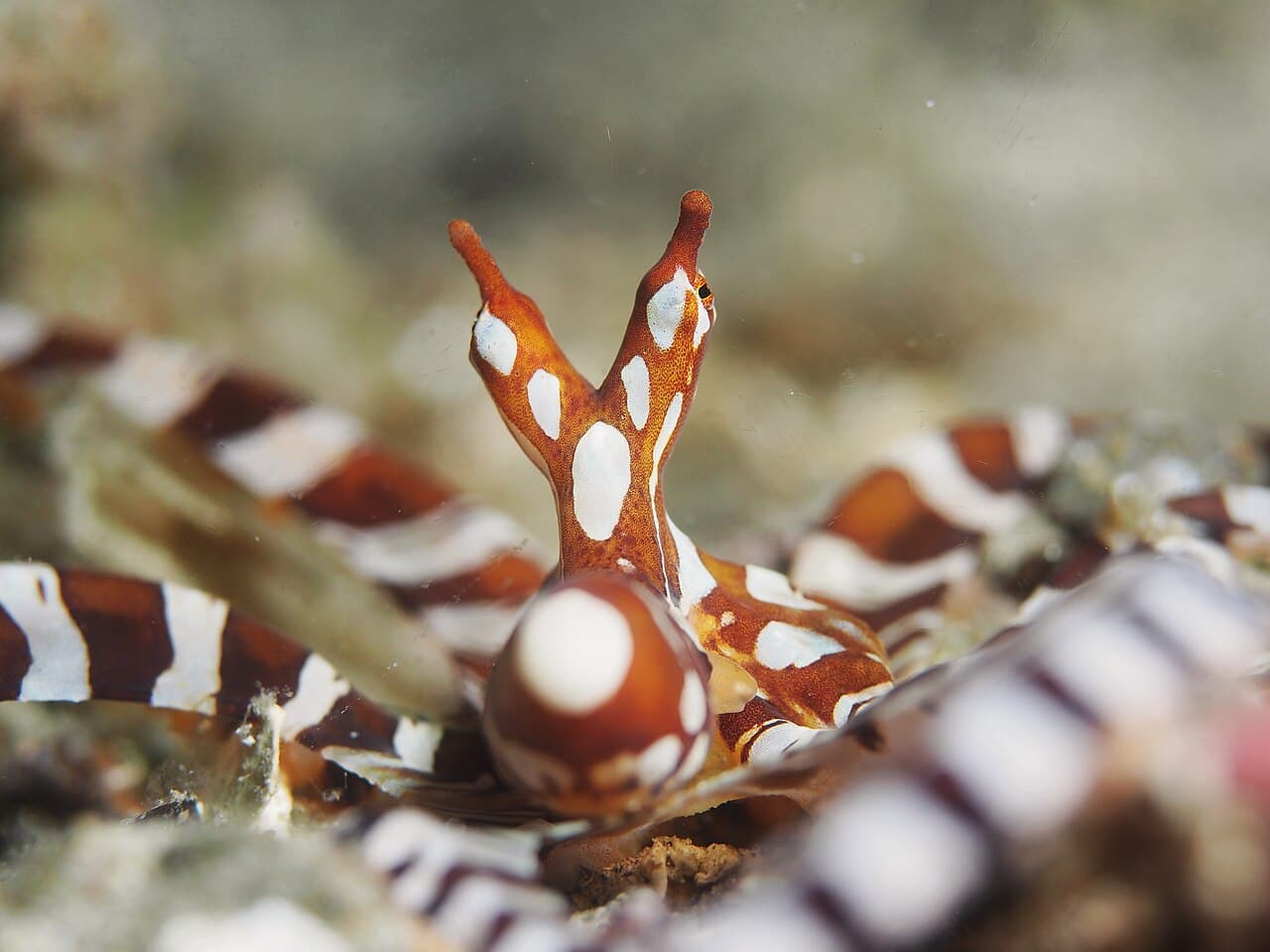
White markings on a wonderpus octopus are more than decoration. The pattern on its head can help researchers tell one individual from another.
Often spelled “wunderpus,” this octopus has the scientific name Wunderpus photogenicus. Its long arms and copper-brown-and-white pattern make it one of the most distinctive small hunters on sandy tropical seabeds.
A pattern with individual details
The Monterey Bay Aquarium account describes a fixed arrangement of spots and stripes whose hue and contrast can change.
The position of the marks is different from their brightness. That distinction explains how a changing animal can still have features useful for recognizing it.
Its raised eyes and narrow head give it an unusual outline, especially when the arms are spread across the bottom.
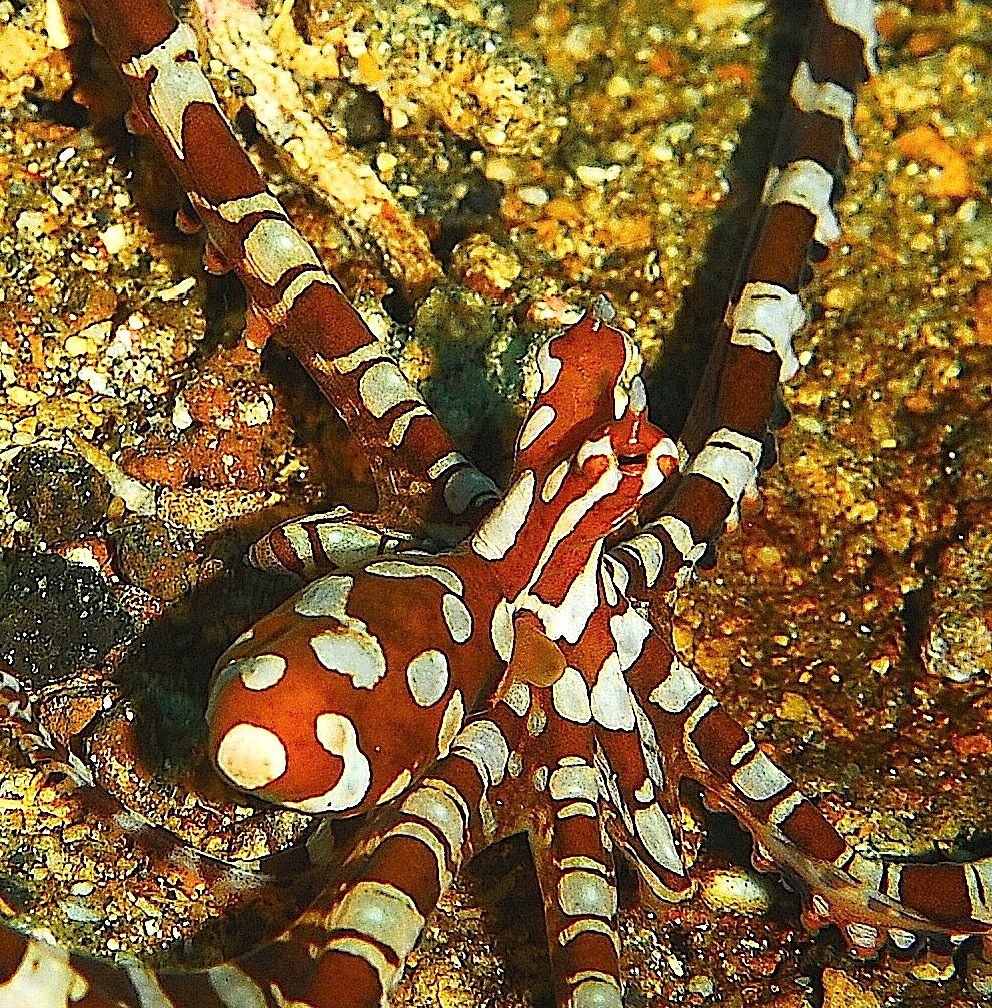
Long arms search the sand
Wonderpus live on soft sediment in shallow waters of the Indo-Malayan region. Burrows offer shelter between feeding excursions.
Small crustaceans and fishes are prey. The long arms reach into holes or spread over the seabed to search for and trap a meal.
A sandy patch that seems empty to a diver can contain hiding prey, burrow entrances, and the routes of several animals. The octopus uses a much more detailed version of that landscape.
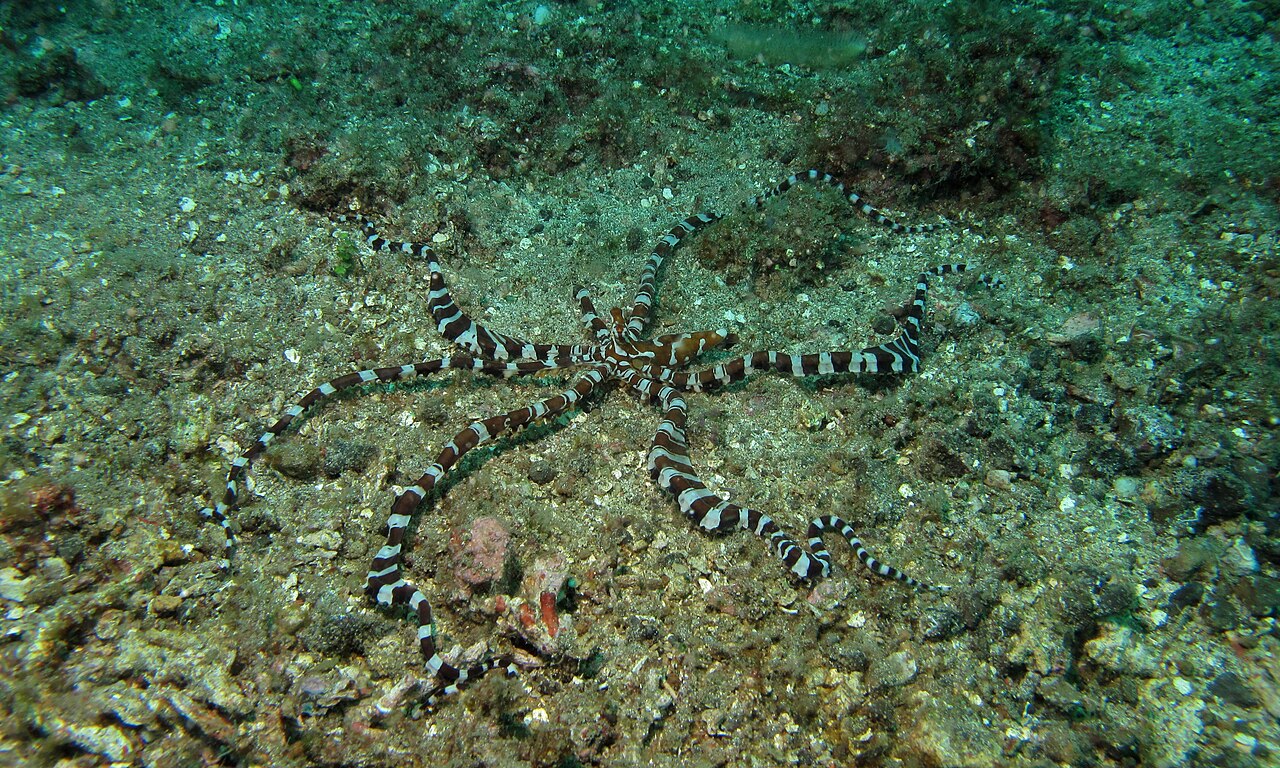
A recent name in science
The species was formally described in 2006. Its popularity with photographers arrived alongside a continuing need to learn about its biology.
The aquarium notes its importance to dive tourism and aquarium trade. Good wildlife observation leaves the animal free to choose its shelter and movements.
Keep the animal behind the portrait in view
Wonderpus can be confused with the mimic octopus. A cephalopod overview from Monterey Bay Aquarium places them within the wider variety of octopuses, squid, and cuttlefish.
The photographs are an invitation to notice differences, rather than give every striped octopus the same name.
One octopus, one pattern, one small patch of seafloor: the closer the observation, the more extraordinary the scene becomes.
Photo credits
Featured image: Wunderpus photogenicus (24326443302).jpg — Rickard Zerpe; CC BY-SA 2.0.

Body image 1: Wonder octopus.jpg — Jenny (JennyHuang) from Taipei; CC BY 2.0.

Body image 2: Wonder Octopus (Wunderpus photogenicus) (6059052281).jpg — Bernard DUPONT from FRANCE; CC BY-SA 2.0.

Images supplied at web display size where available.