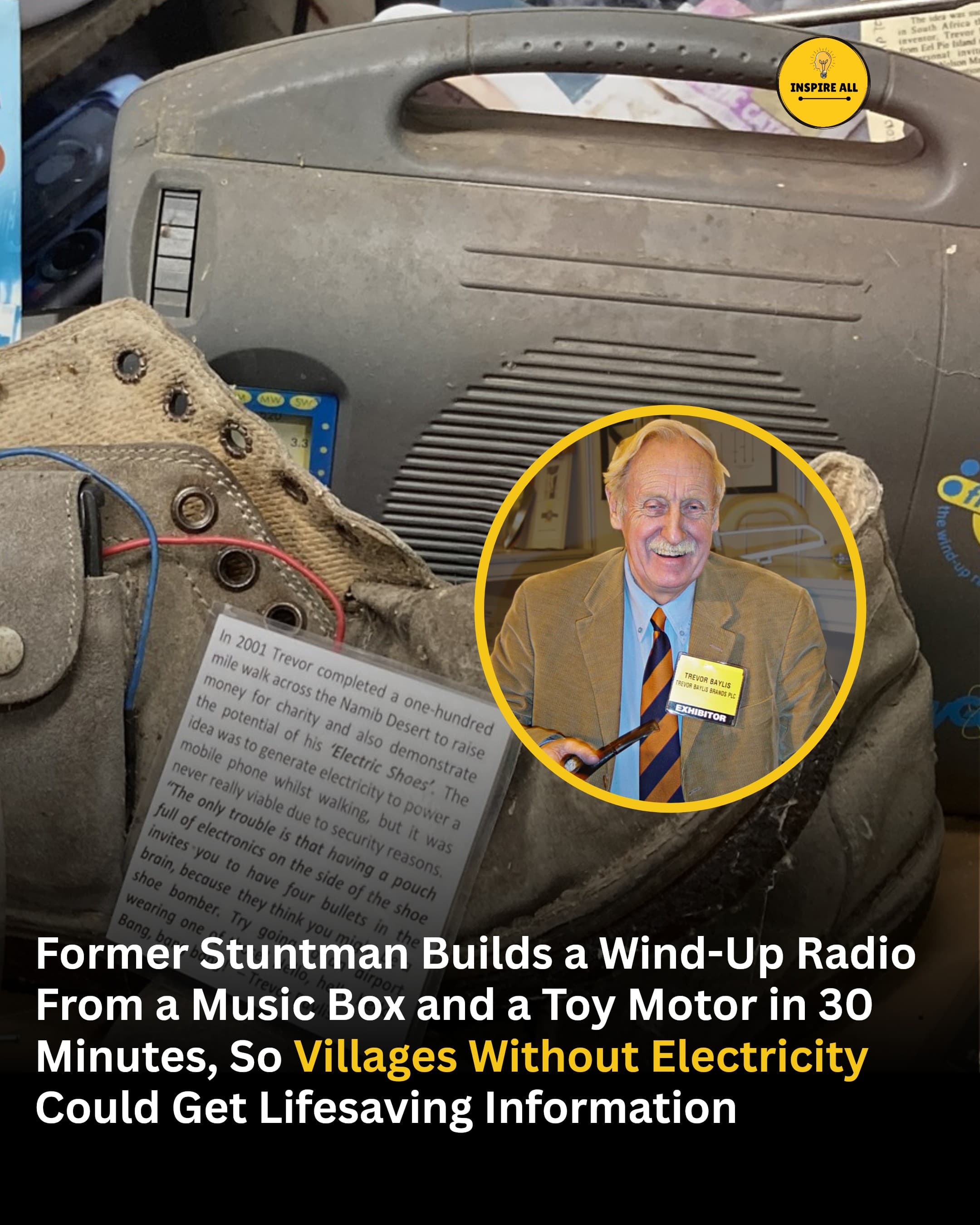
A television programme prompted Trevor Baylis to rethink how a radio could be powered where replacement batteries were difficult to afford.
Trevor Baylis began developing his wind-up radio in 1991. His idea addressed a practical barrier: a broadcast is useful only if the listener can power the receiver.
The Science Museum’s account links the project to a programme about the spread of AIDS in Africa. Baylis saw an opportunity for radio to carry information without depending on a steady supply of batteries.
A handle, a spring and a generator
The Institution of Mechanical Engineers’ collection record describes the original BayGen Freeplay design as a clockwork spring driving an internal generator.
Turning the handle stores mechanical energy. The mechanism then releases it to generate the electricity the radio needs.
The device still uses electricity. Its distinction is how that electricity is supplied, rather than an ability to operate without energy.
For a listener beyond a reliable mains supply, that difference can remove one recurring expense.
Getting an idea beyond the workshop
The Science Museum records the radio’s appearance on the BBC’s Tomorrow’s World programme in 1994 and a BBC design award in 1996.
Those milestones came after the initial idea. A successful experiment did not by itself establish production, distribution or an audience.
The museum also describes Baylis visiting its manufacturing exhibition in 2012, still arguing that inventiveness was not reserved for people in laboratories.
An object that preserves the design
The Institution of Mechanical Engineers holds a radio Baylis donated after speaking at its 150th-anniversary symposium in 1997.
That surviving object offers a concrete reference for the story: a portable receiver designed to work without reliance on disposable batteries or mains electricity.
This historical account does not claim present availability or a particular number of minutes of playback for every model.
Baylis’s achievement connects a communication problem with an alternative source of power. Instead of changing the message, he worked on what stood between the broadcast and the person who needed to hear it.
Based on Science Museum and Institution of Mechanical Engineers records. Featured graphic supplied by Inspire All.
Related reading: Momofuku Ando’s instant-noodle experiments and Michael Faraday’s route from bookbinding into science.