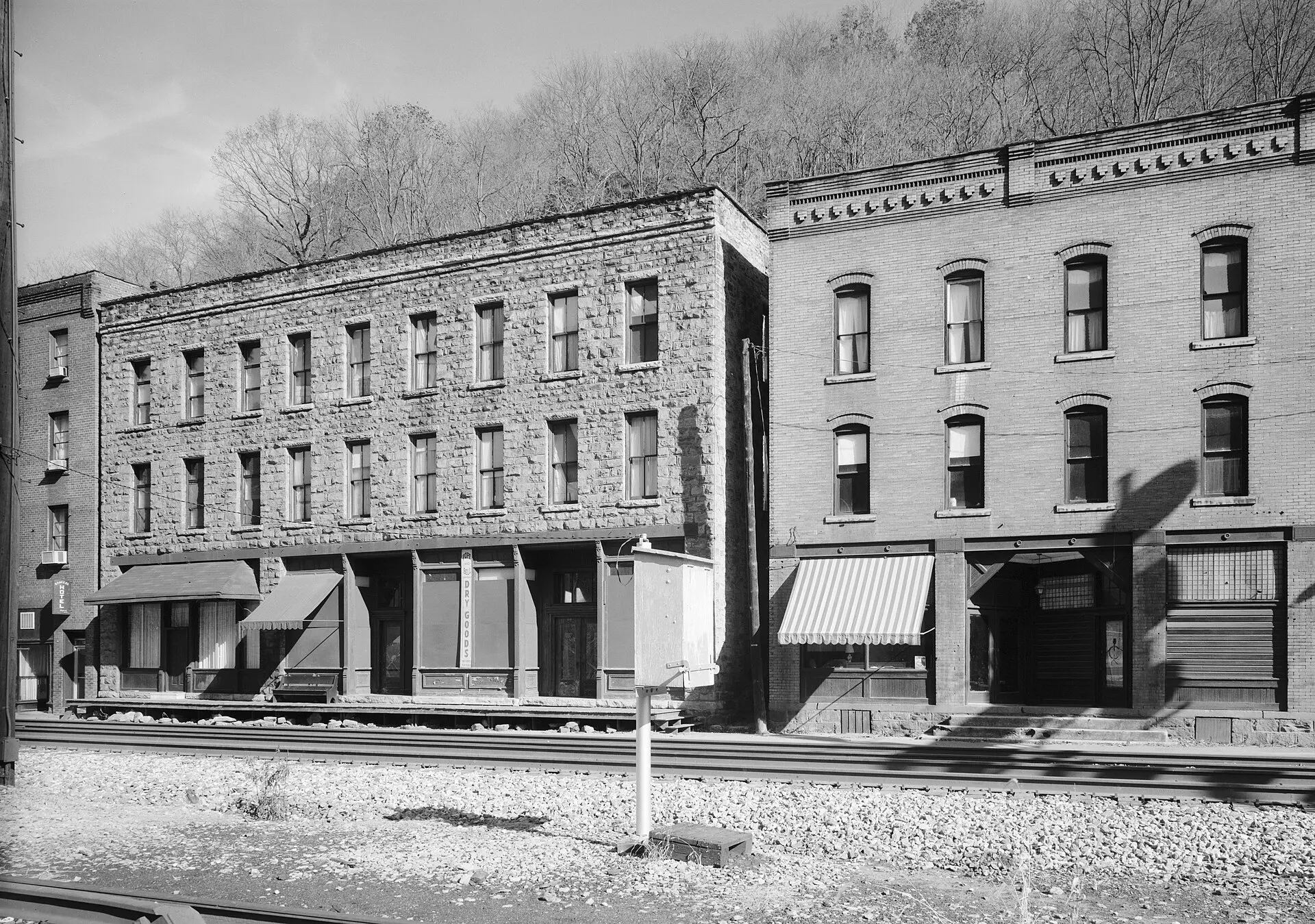
The railroad still passes the storefronts of a town that no longer needs a busy main street.
Thurmond Historic District lies beside the New River in West Virginia's New River Gorge National Park and Preserve. Once a busy railroad service town tied to coal, it declined as transportation and mining changed. Today, preserved buildings and a restored depot help visitors understand its past, while active tracks remind them that the railroad has not disappeared.
Thurmond is often called a ghost town. It is more accurately a small surviving community and historic district whose busiest era is now interpreted for visitors.
Why a town grew in such a narrow place
The landscape explains much of Thurmond's unusual form. Steep slopes rise behind a narrow strip of land beside the river. Railroad tracks occupy the most useful level ground, leaving buildings tightly arranged around them.
The National Park Service's teaching history describes a community created around coal traffic and railroad work. Its commercial buildings faced the tracks rather than a conventional road with room for cars and sidewalks.
That layout can look puzzling to modern visitors. It makes sense when trains are treated as the center of everyday movement. People, goods, messages, and work all depended on the railway.
The town's location was therefore both an advantage and a constraint. It offered access to a valuable transportation corridor, but little room to grow in the way a more spacious town might.
The depot was a working nerve center
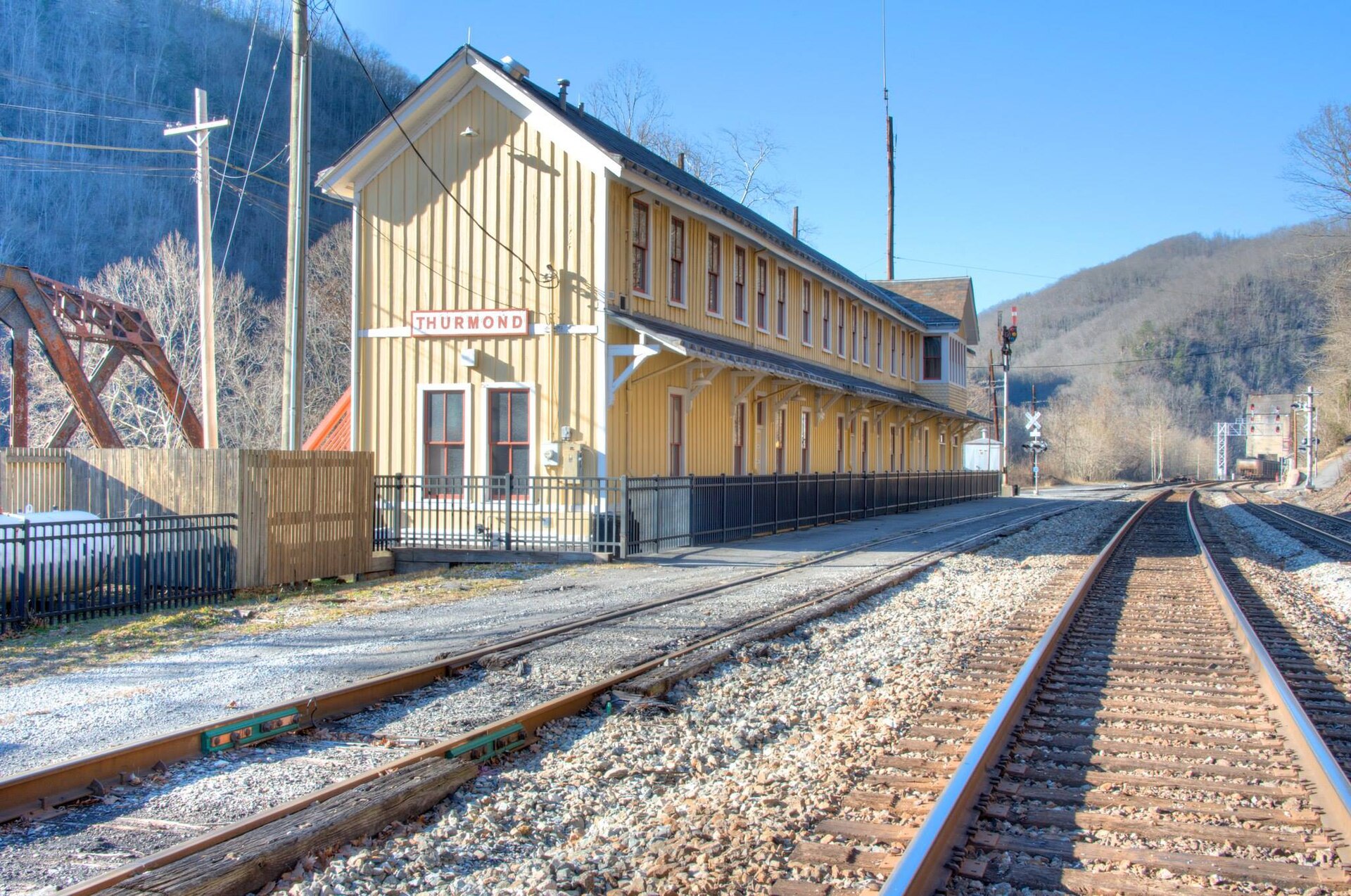
Thurmond's earlier depot burned, and the surviving replacement dates to 1904. It served more than passengers waiting to leave. Railroad staff handled the information and operations needed to keep traffic moving.
The building's long profile and upper level reflect that working purpose. Rather than an ornamental station placed apart from town, it sits directly within the railroad landscape.
An architectural account in SAH Archipedia helps place the district's buildings within West Virginia's industrial history. Together, the depot and commercial row show how transport work supported shops, lodging, and other services.
A bank or storefront in this setting was not remote from industry. It was part of the system that allowed workers and businesses to function around it.
Why Thurmond lost its busiest years
The National Park Service's account of Thurmond today describes several changes behind the decline: the Depression, growing automobile use, mine closures, and the replacement of steam locomotives with diesels.
The last change is especially revealing. Steam engines required servicing facilities and workers that newer locomotives did not need in the same way. A railroad could continue running through a town while employing fewer people there.
That is the key to Thurmond's apparent contradiction. The tracks survived, but much of the economic activity around them did not.
The decline was not a single dramatic evacuation. It was a long reduction in the reasons to work, shop, and live in a place built around an earlier transportation system.
Preservation means making difficult choices
The depot was restored for visitor use in 1995. Other buildings have required stabilization, and the district's future involves more than keeping every structure exactly as it appears in an old photograph.
In 2025, the National Park Service issued a decision on managing deteriorated Thurmond structures. The selected approach includes removal of certain buildings while retaining and stabilizing key historic resources, including the commercial row.
A preservation decision is not the same as confirmation that every action has been completed. Check current park information for work areas and closures rather than using an old map as a guarantee of access.
The broader challenge is familiar at industrial sites. Empty buildings still need roofs, drainage, structural repairs, and regular attention. Deciding where limited resources can protect the most history can involve painful tradeoffs.
Thurmond's surviving buildings are valuable partly because their relationship remains understandable. The tracks, depot, storefronts, river, and steep hills together explain how the town worked.
Planning a visit to Thurmond Historic District
The official visitor page warns that the approach on West Virginia Route 25 is narrow and winding. Large recreational vehicles and trailers are not recommended, and visitors should not expect normal town services.
The depot visitor center operates seasonally. Confirm its schedule before relying on exhibits, ranger assistance, or indoor access. A building visible from outside is not necessarily open when you arrive.
Use designated public routes and crossings, stay away from the rails, and never stand on tracks for photographs. Active railroad equipment can approach more quickly and quietly than expected.
An Amtrak stop does not turn the track area into a general walking route. Anyone arriving by train should check current service and onward arrangements directly with the carrier.
Thurmond's strongest impression comes from the close fit between its buildings and the railway. Spend time looking at that relationship. The town's history becomes clearer when the train is understood as the reason everything else once gathered there.
Frequently asked questions
Is Thurmond completely abandoned?
No. It remains a community as well as a preserved historic district, and trains still use the line.
Why did the town decline?
Changes in coal mining, transport, and locomotive technology reduced the work and trade that supported it.
Is the depot open all year?
The visitor center is seasonal. Check the National Park Service's current schedule before traveling.
Can you walk on the railroad tracks?
No. Use designated public routes and crossings. The tracks are active and are not a photography location.
Image credits
Body image: Bestbudbrian, CC BY-SA 4.0.

Featured image: Jet Lowe, Public domain.
