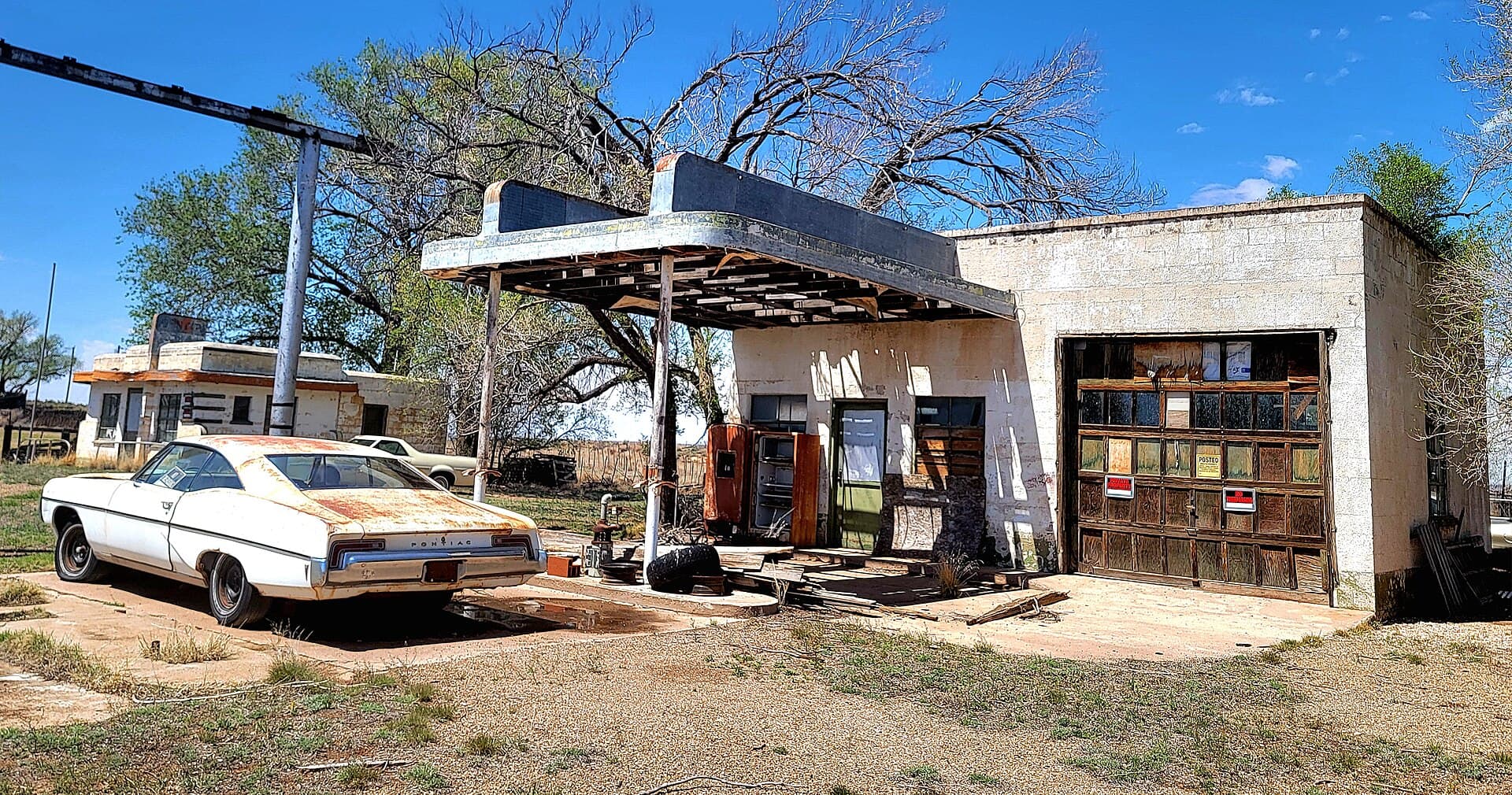
One small town offered travelers both their first stop in Texas and their last.
Glenrio Ghost Town straddles the Texas–New Mexico border on historic Route 66. Its roadside businesses lost passing traffic when Interstate 40 bypassed the community in 1975. Surviving motels, service stations, signs, and homes preserve evidence of a place shaped by transportation and an unusually useful state line.
Yet Glenrio is not entirely frozen in its abandoned appearance. Recent projects and a recreated sign show that its story is still changing.
Glenrio existed before Route 66
The town's first important transportation link was the railroad. The National Register nomination traces the community's development from a railway settlement into a roadside service center.
That sequence matters. Route 66 did not create every town along its path. In Glenrio, the highway gave an existing community a new way to make a living.
Travelers needed fuel, food, repairs, and somewhere to sleep. Businesses clustered where motorists could see them, turning the road itself into the town's most important commercial space.
The change can be read in the buildings. A railroad town organizes itself around tracks and a depot. A highway town turns signs, entrances, and parking toward passing drivers. Glenrio carries traces of both arrangements.
A state line that shaped business
The National Park Service's history of Glenrio explains how the Texas–New Mexico boundary affected where businesses operated. Different rules and taxes encouraged certain services on one side rather than the other.
The border also became advertising. A business could present itself as the first stop in Texas to someone traveling east and the last to someone heading west. Geography became a sales pitch that required no long explanation.
That is one reason Glenrio remains so memorable among Route 66 communities. The state line was not an abstract mark on a map. It influenced the experience of arriving, buying, and leaving.
The historic district entered the National Register in 2007. Recognition documents its importance, but it should not be confused with a guarantee that every building is restored or open to visitors.
Reading the roadside architecture
A Texas Historical Commission study of Route 66 places Glenrio's surviving resources within the road's broader development. The compact roadside arrangement makes the connection between commerce and traffic easy to see.
Look for the low, broad profiles of service buildings and the way signs reach above them. A driver had only a short time to decide whether to stop. Large lettering and visible forecourts made the offer clear.
Some buildings use streamlined forms associated with the automobile age. Their curves and horizontal lines once suggested movement and modern service. Weathered today, they can still communicate the optimism of the road they served.
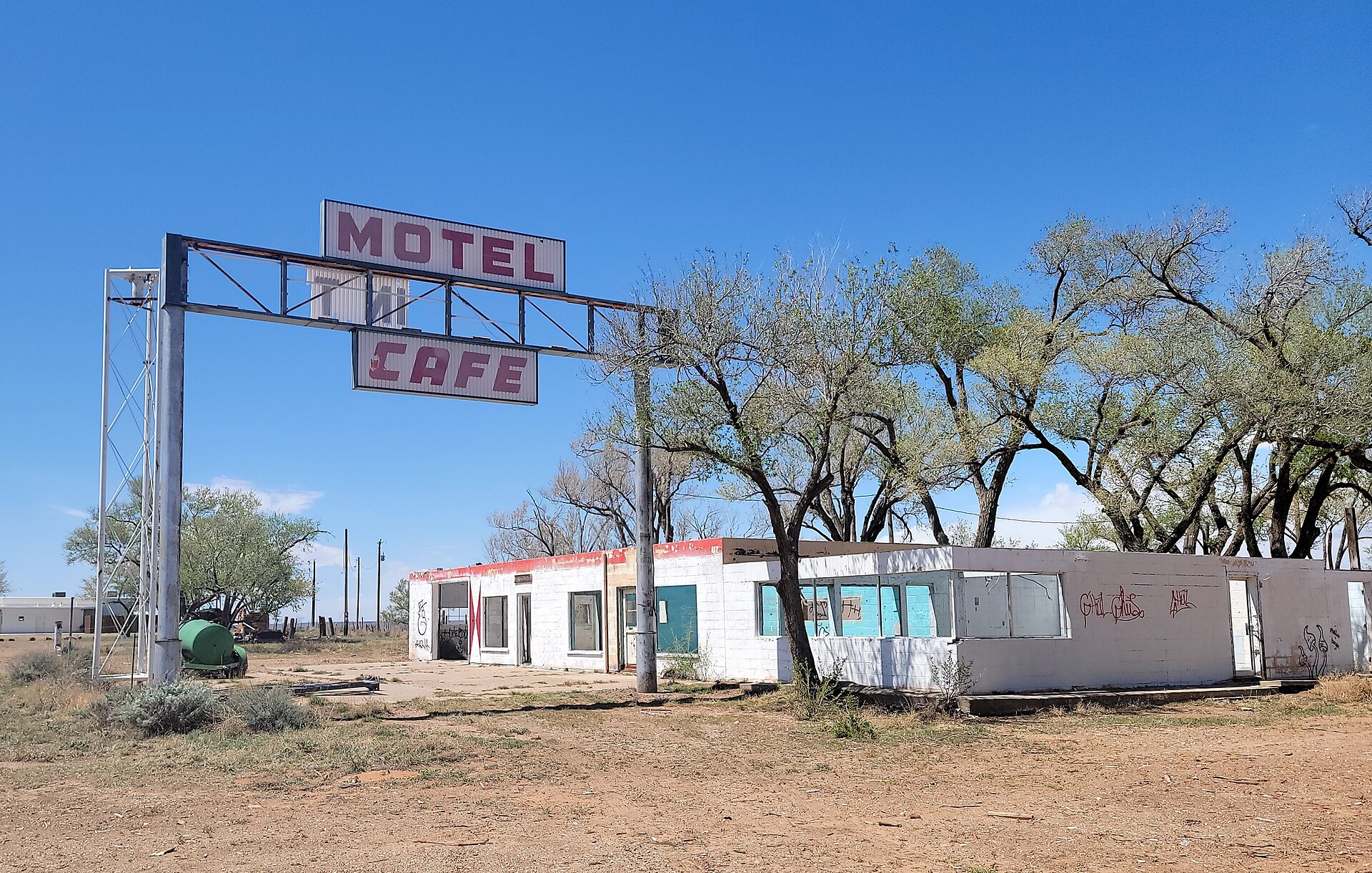
The photograph also reveals a useful caution. An empty building can remain someone's property. Broken windows, faded paint, or an unused doorway are evidence of condition, not permission to enter.
What the interstate changed
When Interstate 40 bypassed Glenrio in 1975, the main flow of through traffic shifted away from the old road. For businesses dependent on motorists stopping spontaneously, that was a fundamental change.
The lesson is visible without imagining that everyone left at once. A town can lose its commercial role gradually as customers, services, and investment move elsewhere. Different buildings may close or change use at different times.
The term ghost town captures the quiet roadside scene, but it can flatten that process. Glenrio's buildings belonged to businesses and households, each with a history beyond the moment the highway moved.
For a visitor, the empty forecourts are the strongest reminder. They were designed for cars arriving, stopping, and leaving. Their present stillness makes the missing movement easy to understand.
Glenrio is receiving new attention
A 2022 Route 66 News report described redevelopment ideas involving the Longhorn property. Plans are useful evidence of renewed interest, but do not establish that every proposed use opened.
More recently, Route 66 News reported a July 2026 lighting ceremony for a recreated First/Last Stop in Texas sign. The word recreated matters: the project revives an iconic design rather than proving the original sign survived intact.
Such work complicates the familiar abandoned-town image. Preservation, new business, and historical interpretation can coexist with weathered buildings.
Before a visit, confirm which businesses or properties actually welcome the public. Use current directions, bring what you need for the drive, and treat the old road as an active roadway. Stay outside fenced areas and closed structures, and do not remove objects as souvenirs.
Glenrio's appeal lies in a simple connection: roads bring opportunity, and a changed road can take it away. The surviving district lets travelers see that process at human scale, on a border where even the direction of travel once changed the advertising.
Frequently asked questions
Is Glenrio in Texas or New Mexico?
It straddles the state line, and that location helped shape its businesses and identity.
Why did Glenrio decline?
The 1975 interstate bypass diverted the through traffic on which its Route 66 businesses depended.
Can you enter the abandoned buildings?
Do not assume so. Respect private property, barriers, and current access signs.
Is everything in Glenrio abandoned today?
No. Recent projects and businesses mean the situation is more varied than the ghost-town label suggests.
Image credits
Body image: Cullen328, CC BY-SA 4.0.

Featured image: Cullen328, CC BY-SA 4.0.
