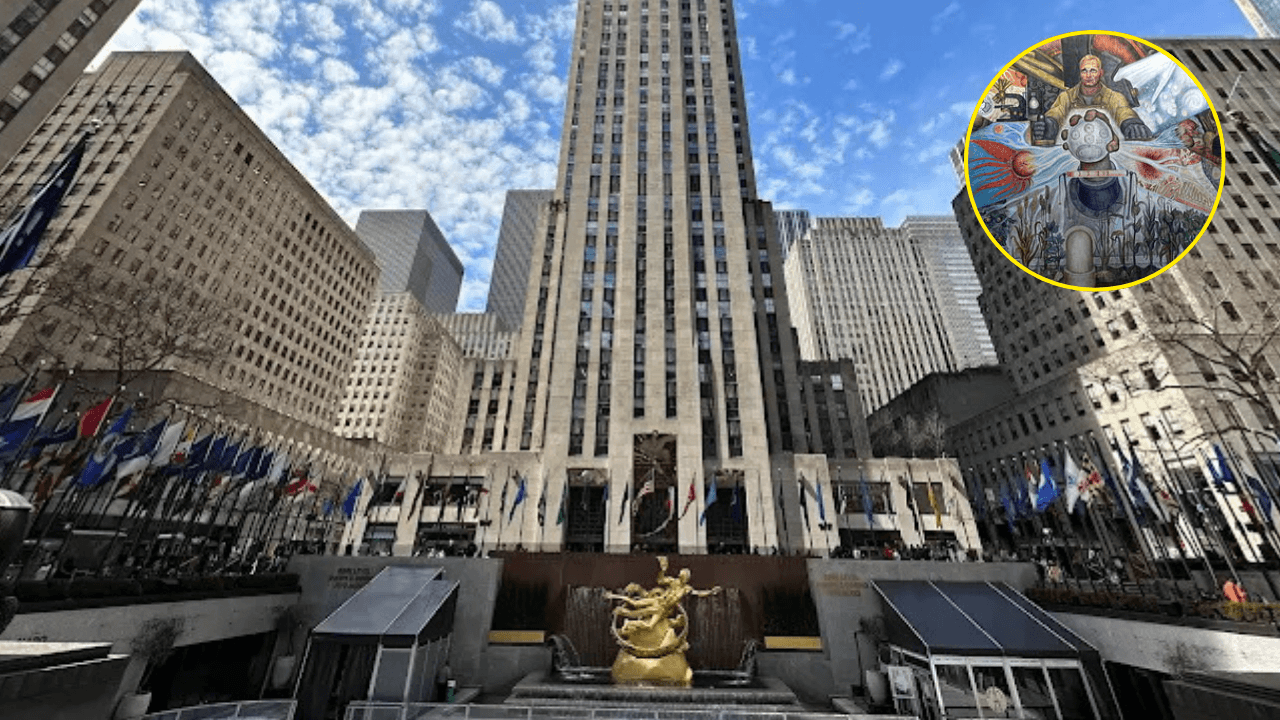
It was supposed to be the crown jewel of Rockefeller Center. In 1933, the newly built RCA Building, now 30 Rockefeller Plaza, commissioned a mural by Diego Rivera, one of the most celebrated artists in the world. Rivera had already achieved fame for his bold, sweeping murals in Mexico and the U.S., infused with powerful political themes and vivid depictions of workers and revolution. But no one expected what he would paint next, least of all his wealthy patrons.
The mural, titled Man at the Crossroads, was ambitious. Rivera envisioned humanity torn between capitalism and socialism, science and industry, the future and the past. But at the center of it all, one figure stood out: Vladimir Lenin. A calm, stoic Lenin extending his hand to workers, a symbol of unity in Rivera’s eyes, but in Nelson Rockefeller’s, a red flag.
Nelson Rockefeller, heir to one of the most powerful capitalist families in the world and a director of Rockefeller Center, was horrified. He asked Rivera to remove Lenin’s image. Rivera refused. He even doubled down, adding more radical imagery, including Soviet May Day parades. What followed wasn’t a debate. It was a quiet execution.
On a May night in 1933, the entire mural was covered by canvas without public notice. By early 1934, it was destroyed, chopped up, carted away in wheelbarrows, and dumped. In its place, a new mural was later installed, stripped of any politics. Just buildings, progress, and quiet order.
Rivera called it “cultural vandalism.” He never forgot it. Later, in Mexico City, he painted a nearly identical version of the original mural at the Palacio de Bellas Artes. There, Lenin still stands.
Today, most visitors to Rockefeller Center walk past the walls without knowing what once lived there. But behind the sleek Art Deco shine is a ghost of something bolder, a mural that dared to show two ideologies clashing in the very temple of American capitalism. It wasn’t just a painting. It was a confrontation.
And when power didn’t like the picture, it erased it. Quietly. Efficiently. But never completely.