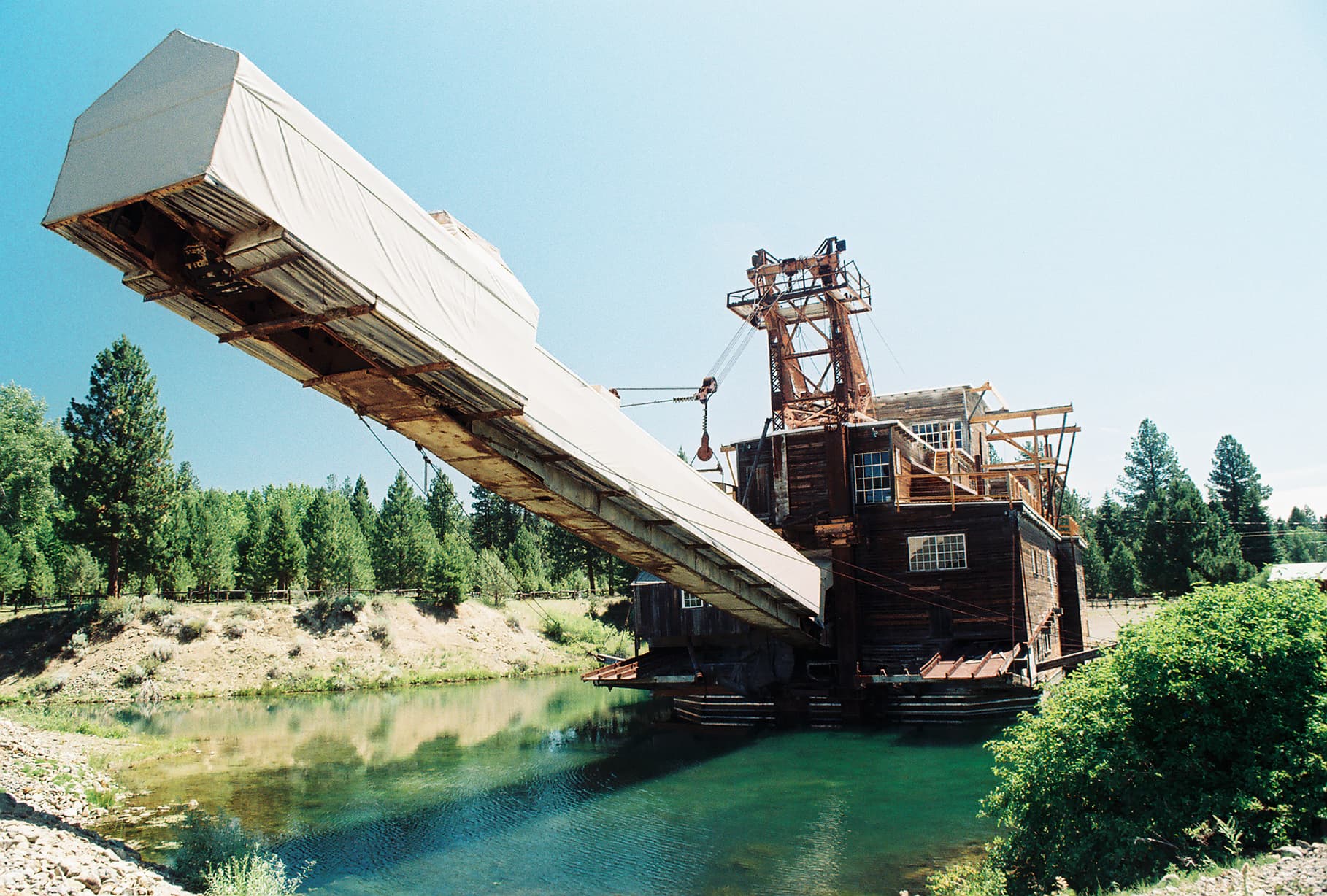
A floating factory once chewed through Sumpter Valley, leaving stone ridges where it searched for flakes of gold.
Sumpter, Oregon, is a living town with a dramatic mining past, not a completely abandoned settlement. Its best-known historic attraction is the Sumpter Valley Dredge, a preserved gold-mining machine that operated from 1935 to 1954. Visitors can explore the surrounding state heritage area and board the dredge during its open season. Oregon State Parks
The machine explains the town’s history at an unusual scale. Instead of a small prospecting pan, you encounter an industrial structure large enough to transform the valley around it.
Sumpter, Oregon, before the great machine
Gold discoveries in the Blue Mountains and Sumpter Valley in 1862 drew prospectors into northeastern Oregon. As the most accessible deposits became harder to find, mining required more capital and equipment.
The town developed the businesses and public spaces of a busy settlement. The A.R. Bowman Museum’s historical account describes saloons, churches, a brewery, newspapers, and an opera house. A.R. Bowman Museum’s Sumpter history
Those details matter because a mine does not explain a whole town. Shops supplied households, entertainment filled evenings, and transport connected a remote valley with larger markets.
A major fire in 1917 destroyed much of the commercial area. The damage came as the town was already facing the limits of its earlier boom. Fire accelerated a decline that economic change had begun. Oregon genealogy and local-history account
Yet the fire did not end every form of mining, and it did not end Sumpter.
How the dredge moved through a valley
Three dredges were built in Sumpter Valley, in 1912, 1915, and 1935. The surviving machine is the last of them.
Its buckets dug material ahead of the vessel. The excavated earth passed through equipment that separated gold from the surrounding gravel, while waste material was discharged behind it. Water filled the newly dug area, allowing the floating machine to advance.
The result was a factory that effectively created its own route. The piles left behind, known as tailings, remain a visible part of the valley. Oregon State Parks’ dredge brochure
Understanding that sequence changes what you see outside. The stone heaps are not simply rough natural terrain. They record material moved, sorted, and discarded during the search for a much smaller amount of valuable metal.
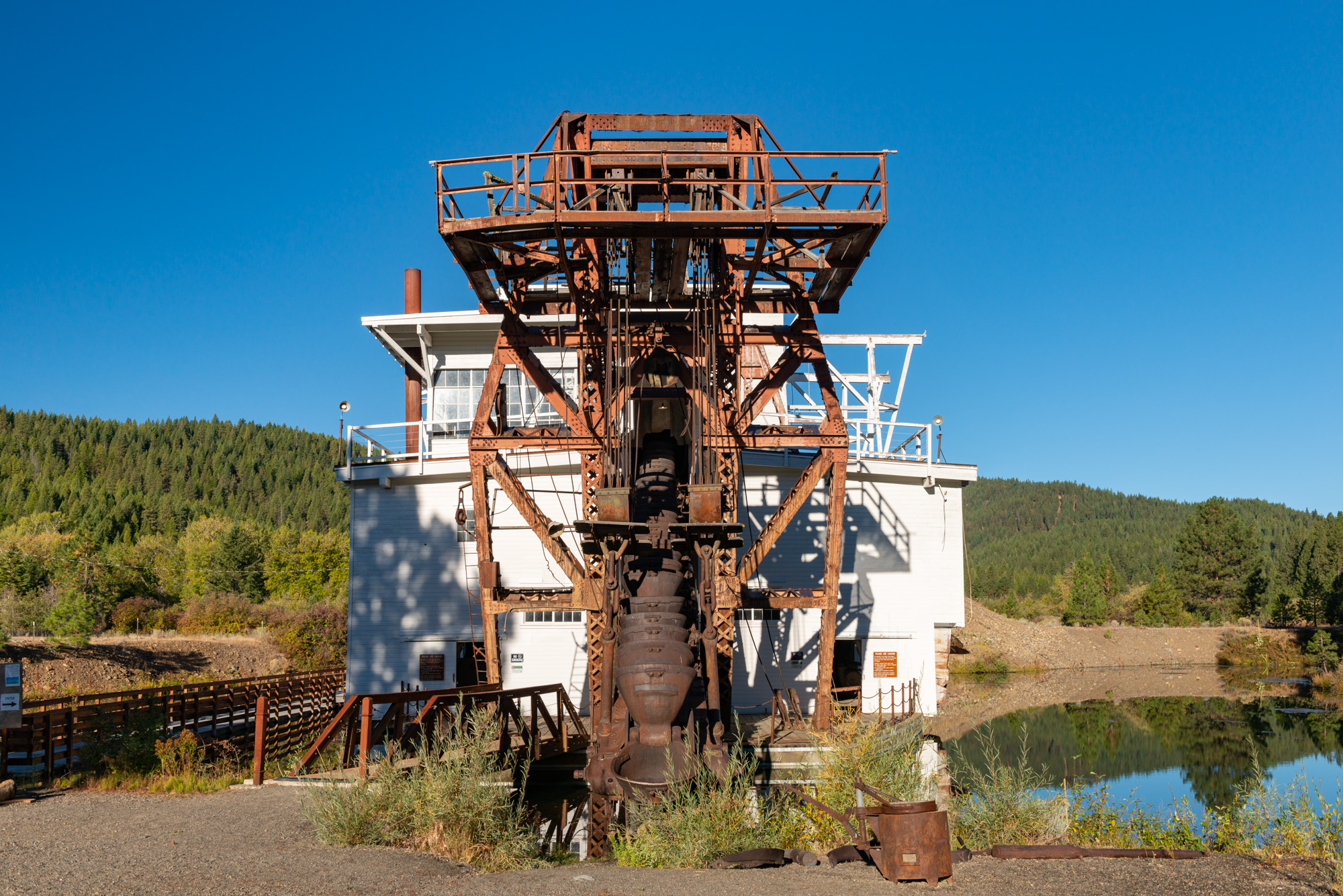
A working life that ended in 1954
The surviving dredge operated almost continuously for much of its working life. Oregon State Parks estimates that it recovered more than $4 million in gold at the values of the time.
Rising operating costs and pressure from local residents helped bring the operation to an end in August 1954. The machine then faced years of weather and neglect before preservation work gave it a new role.
That ending is more revealing than a simple claim that all the gold ran out. Mining depends on the relationship between recoverable material, costs, and the consequences for people and land around the operation.
The preserved dredge lets visitors examine that relationship without reducing the story to treasure. Its size conveys the effort involved, while the surrounding landscape records the price of that effort.
The railroad that volunteers rebuilt
Sumpter has another industrial survivor nearby: the Sumpter Valley Railroad. Its current heritage operation is the result of a sustained restoration effort.
The original track was scrapped in 1947. Volunteers organized a restoration group in 1971, rebuilt track along portions of the earlier route, and reopened passenger service on July 4, 1976. Sumpter Valley Railroad’s history
This is active preservation. A moving train requires skills, maintenance, and people willing to keep the work going. It offers a different experience from the stationary dredge, but both depend on choices made after their original commercial purpose ended.
The railroad’s early history began with construction from Baker City in 1890. Its route served the region’s timber and other traffic, placing Sumpter within a wider industrial network. Sumpter Valley Railroad historical brochure
Planning a thoughtful visit
The state park currently lists dredge boarding from May through October, with guided tours on weekends. Check the park’s current information before traveling, especially near the ends of that season.
About 1.5 miles of trails wind through the heritage area’s wetlands. They provide a chance to compare the machine, its tailings, and the land around them. Leave time for that outdoor context rather than treating the dredge as a single photograph.
If you want to ride the railroad, consult its separate timetable and ticket information. A park visit does not guarantee that a train is running the same day.
Sumpter still has residents and businesses, so approach the town as a community. Stay within designated visitor areas, avoid climbing machinery, and respect private premises.
The lasting image is a remarkable one: an enormous gold machine at rest beside a town that continued. Sumpter’s story is about extraction, loss, and the work of deciding what deserves to survive.
Frequently asked questions
Is Sumpter a ghost town?
It is commonly included on ghost-town itineraries, but it remains an inhabited town with businesses and heritage attractions.
Can visitors go aboard the dredge?
Yes, during the open season. Oregon State Parks currently lists May through October; check for closures and tour details.
What are the rock piles around the dredge?
They are mining tailings, material left after the dredges processed valley gravels in search of gold.
Is the steam railroad part of the state park?
It is a separate heritage operation with its own timetable and tickets. Plan the two attractions independently.
Photo credits
Featured photo: Doug from Portland, USA, CC BY 2.0.

Body photo: Gary Halvorson, Oregon State Archives, CC BY 4.0.
