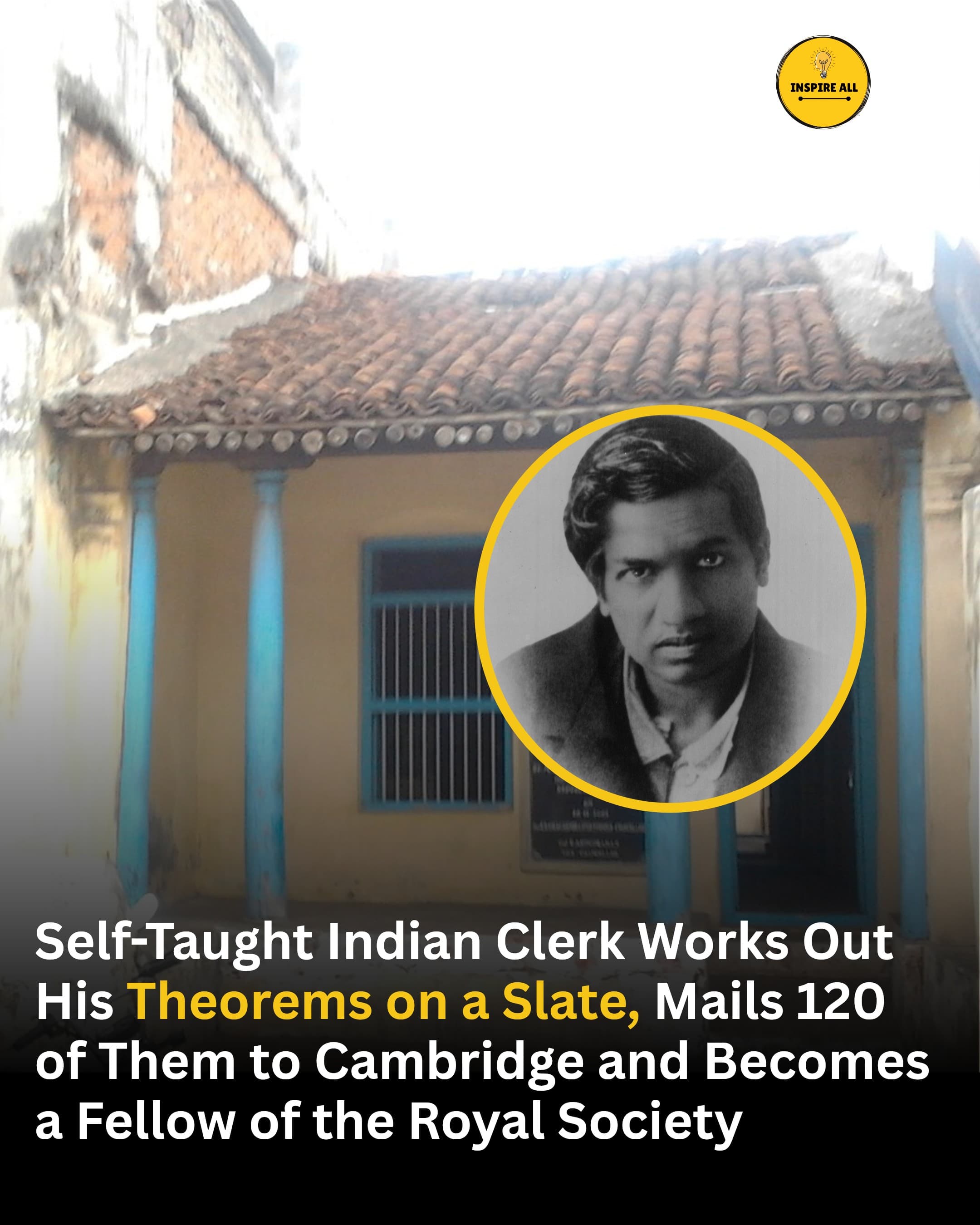
Srinivasa Ramanujan’s unconventional mathematical education met a new opportunity when G. H. Hardy took his letter seriously.
In January 1913, Srinivasa Ramanujan wrote from India to Cambridge mathematician G. H. Hardy, enclosing a selection of mathematical results.
Ramanujan was working as a clerk at the Madras Port Trust. His route into advanced mathematics had not followed a conventional university course.
The University of St Andrews’ MacTutor biography describes his self-directed study and the local mathematicians who recognized his ability before the Cambridge correspondence.
What Hardy did with the results
Hardy and J. E. Littlewood examined the statements in the letter. Hardy replied on February 8, expressing interest while asking to see proofs.
That response is important. Recognition did not require treating every assertion as already established; it meant taking the work seriously enough to investigate.
The correspondence helped lead to Ramanujan’s arrival in England in 1914 and an important mathematical collaboration.
A surviving record of recognition
The Royal Society’s account of Ramanujan discusses his work with Hardy and the papers preserved in its collections.
Its 1918 election certificate supplies a primary record of his nomination and mathematical contributions.
He became a Fellow of the Royal Society in 1918, followed by a fellowship at Trinity College, Cambridge.
These records connect the celebrated letter to sustained work and institutional recognition.
Beyond the image of an isolated genius
Calling Ramanujan entirely without teachers or support misses part of his history.
He learned from books and developed ideas independently, but local contacts helped him obtain work and reach other mathematicians. Later collaboration helped communicate and establish results.
The precise number of pages or theorems in a viral retelling is less important than what the correspondence documents: unusual work reached someone prepared to examine it carefully.
Ramanujan died in 1920, but his notebooks continued to generate mathematical study.
His story combines individual imagination with the value of an attentive response. A letter did not contain the end of the work; it opened another place for that work to develop.
Based on MacTutor and Royal Society records. Featured graphic supplied by Inspire All.
Related reading: Momofuku Ando’s instant-noodle experiments and Michael Faraday’s route from bookbinding into science.