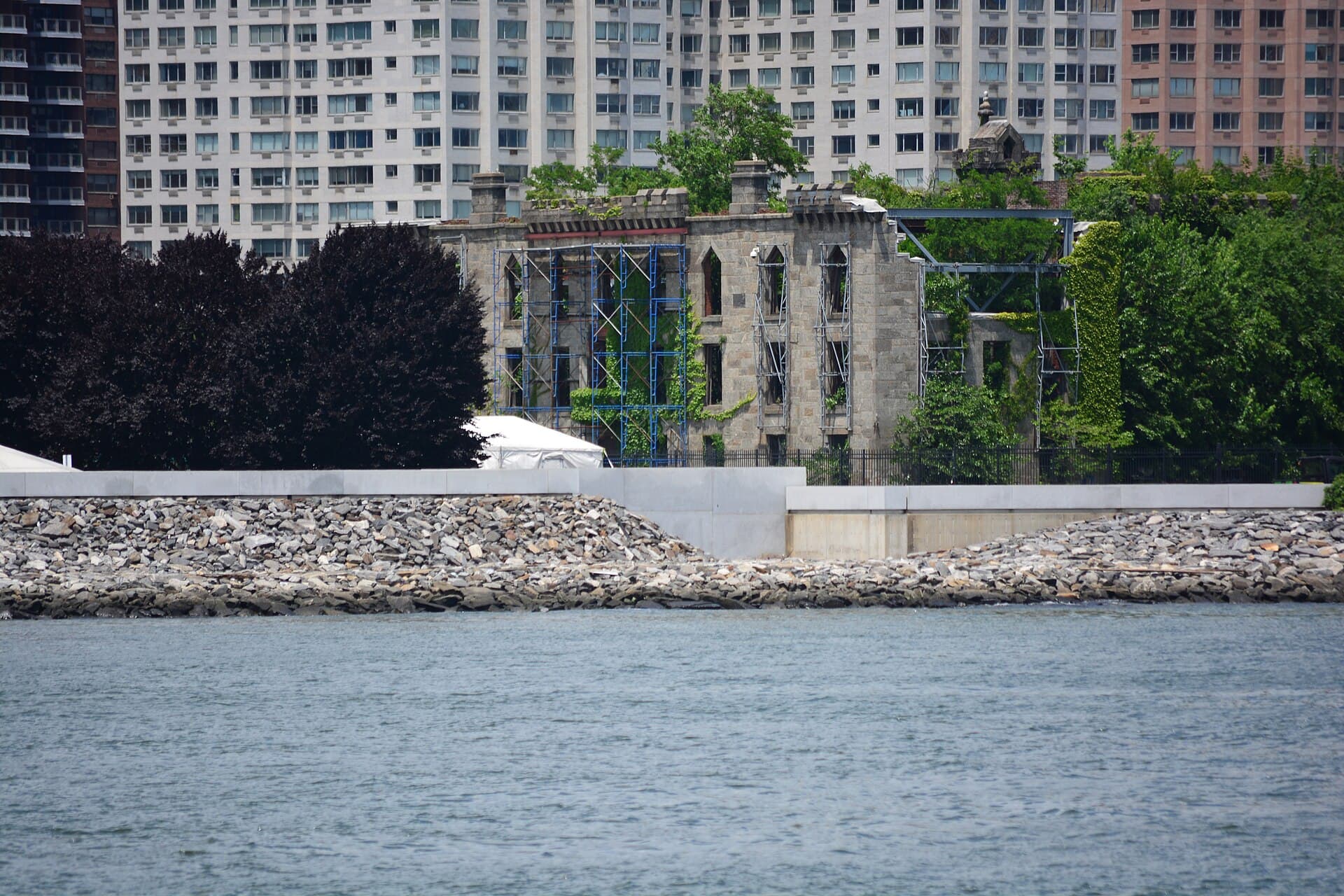
The hospital’s empty windows frame the sky where patients once looked out over the East River.
The Smallpox Hospital Ruins stand near the southern end of Roosevelt Island in New York City. Designed by James Renwick Jr. and opened in 1856, the former hospital later served nursing education before falling out of use. Today, visitors can view the exterior from permitted public areas, but the fragile ruin is not open for casual entry.
Its silhouette looks almost castle-like. That appearance can distract from the building’s real purpose: caring for people with a feared infectious disease in a city that placed many institutions across the water.
Why the Smallpox Hospital Ruins look so grand
Renwick designed the original hospital in the Gothic Revival style, with pointed details, a strong central entrance, and rough stone walls. Construction took place from 1854 to 1856.
The city’s landmark report describes a building intended for about 100 patients. Its arrangement included charity wards and accommodations for paying patients, showing that this isolated institution served people with different financial circumstances. New York City landmark designation report
A photograph can make it look like a medieval ruin transplanted to Manhattan’s edge. The actual story is more local: nineteenth-century civic architecture, disease control, and the city’s use of island land.
An island shaped by institutional labor
Roosevelt Island was known as Blackwell’s Island during the hospital’s early years. Its institutions formed part of a larger municipal landscape of care, confinement, and labor.
The Roosevelt Island Historical Society’s walking-tour material, hosted by the New York Correction History Society, explains that prisoners quarried stone and helped construct the hospital. That detail complicates the romantic appearance of the walls. Their survival also preserves evidence of the labor system behind them. Historical walking-tour account
Later, the building became associated with nursing training and residence. Additional wings expanded the original structure in the early twentieth century. It is therefore misleading to treat every surviving wall as part of Renwick’s initial design.
The hospital did not become a ruin at the moment its original medical role ended. It had another working life before abandonment in the mid-twentieth century.
Reading the building through old photographs
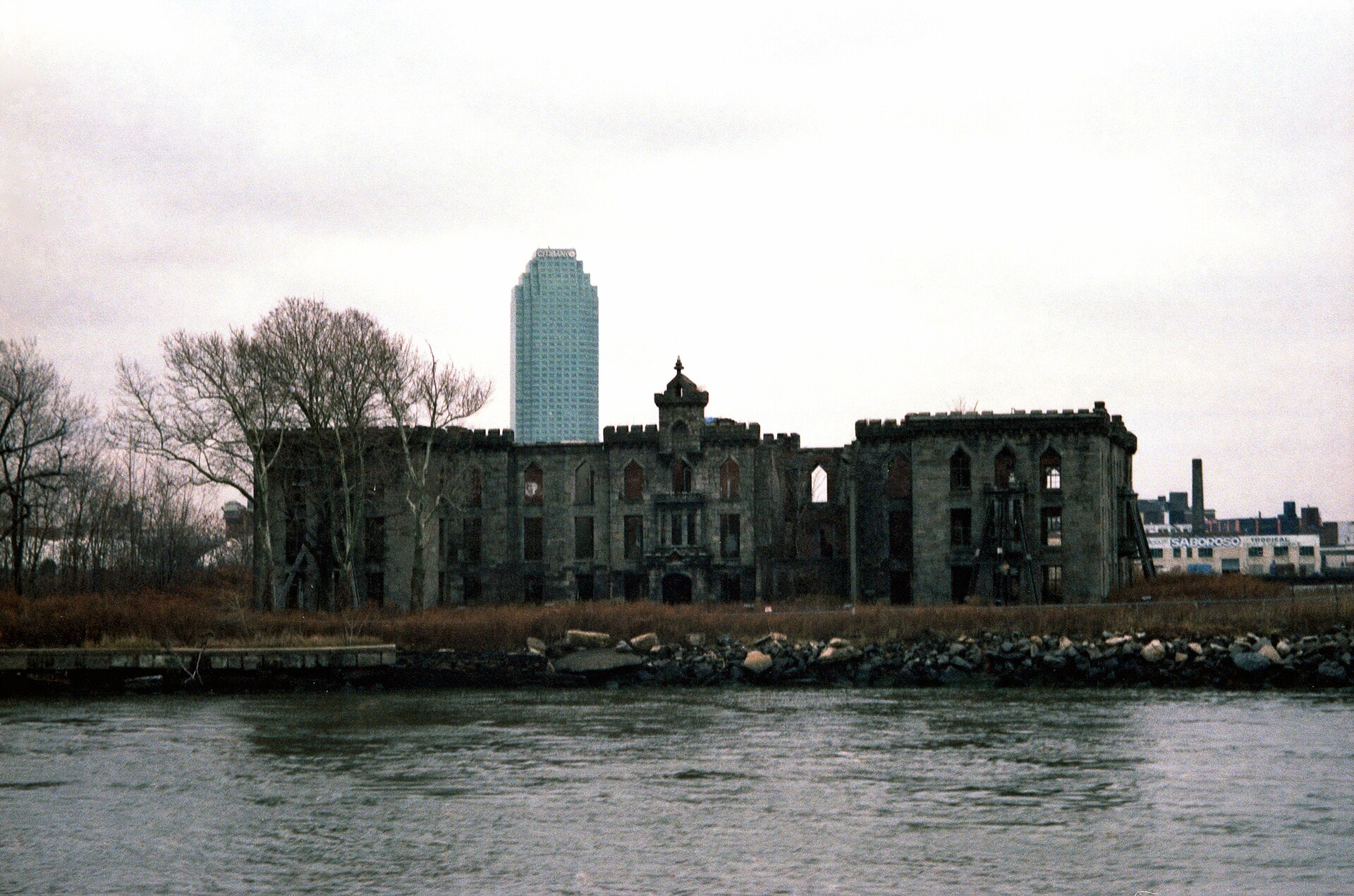
The 1996 photograph above shows the entrance facade long after the roof had disappeared. Compare it with the featured view from 2026: the same Gothic outline remains, but structural supports are now prominent.
Historic photographs are useful precisely because they have dates. A clear opening in an older view does not establish a current entrance, and an image without fencing does not establish public access.
Notice how the repeated windows organize the facade even when there are no rooms behind them in the ordinary sense. A ruin can retain its architectural pattern after losing the floors and roof that made that pattern usable.
That is why preservation here involves more than cleaning stone or clearing plants. The remaining walls require support as exposed structures.
Landmark status did not rebuild the hospital
New York City designated the Smallpox Hospital a landmark on March 23, 1976. The designation recognized its architectural and historical value; it did not turn the shell back into an operating building. Landmarks Preservation Commission report
Preservation studies describe the loss of roofs, floors, and stairs, alongside work to stabilize the remaining masonry. Such documentation explains the steel supports visible in present-day photographs. They are part of the effort to retain the ruin, not evidence that the hospital has reopened. Roosevelt Island preservation study
Ideas for the site have included a public-health memorial. A proposal presented to the Roosevelt Island Operating Corporation should be understood as a proposal, rather than a finished attraction visitors can already enter. RIOC memorial presentation
The distinction is easy to miss online, where an architectural rendering can circulate without the meeting date or planning context.
How to see the ruins responsibly
Plan a Roosevelt Island walk that includes the southern waterfront and permitted paths near the ruin. Check the Roosevelt Island Operating Corporation’s current information and follow on-site closures. The nearby parks and the fenced hospital are different spaces with different access conditions. RIOC visitor information
Stay outside barriers, and use a longer camera view if needed. There is no reason to enter the shell to appreciate its mass, stonework, or position beside the river.
Give the building a few minutes beyond the first photograph. Look at the older central section, the added wings, and the missing roofline. Those differences help separate construction, reuse, and decay.
The most moving feature may be how much of the building remains recognizable. It no longer contains functioning wards, yet its windows still suggest the daily lives once arranged behind them.
Frequently asked questions
Can you go inside the Smallpox Hospital Ruins?
No casual interior access is available. View the building from permitted public areas and respect all fencing and closure notices.
Who designed the hospital?
James Renwick Jr. designed the original Gothic Revival hospital, constructed from 1854 to 1856. Later additions expanded it.
Is it the same hospital as North Brother Island?
No. North Brother Island contains the separate Riverside Hospital complex. The two places have related institutional history but different surviving buildings.
Has the ruin become a public-health memorial?
Memorial plans have been presented, but a proposal is not proof of completion or access. Check RIOC for current project information.
Image credits
Featured image: Joe Mabel, CC BY-SA 4.0.

Body image: Earnest B, CC BY-SA 3.0.
