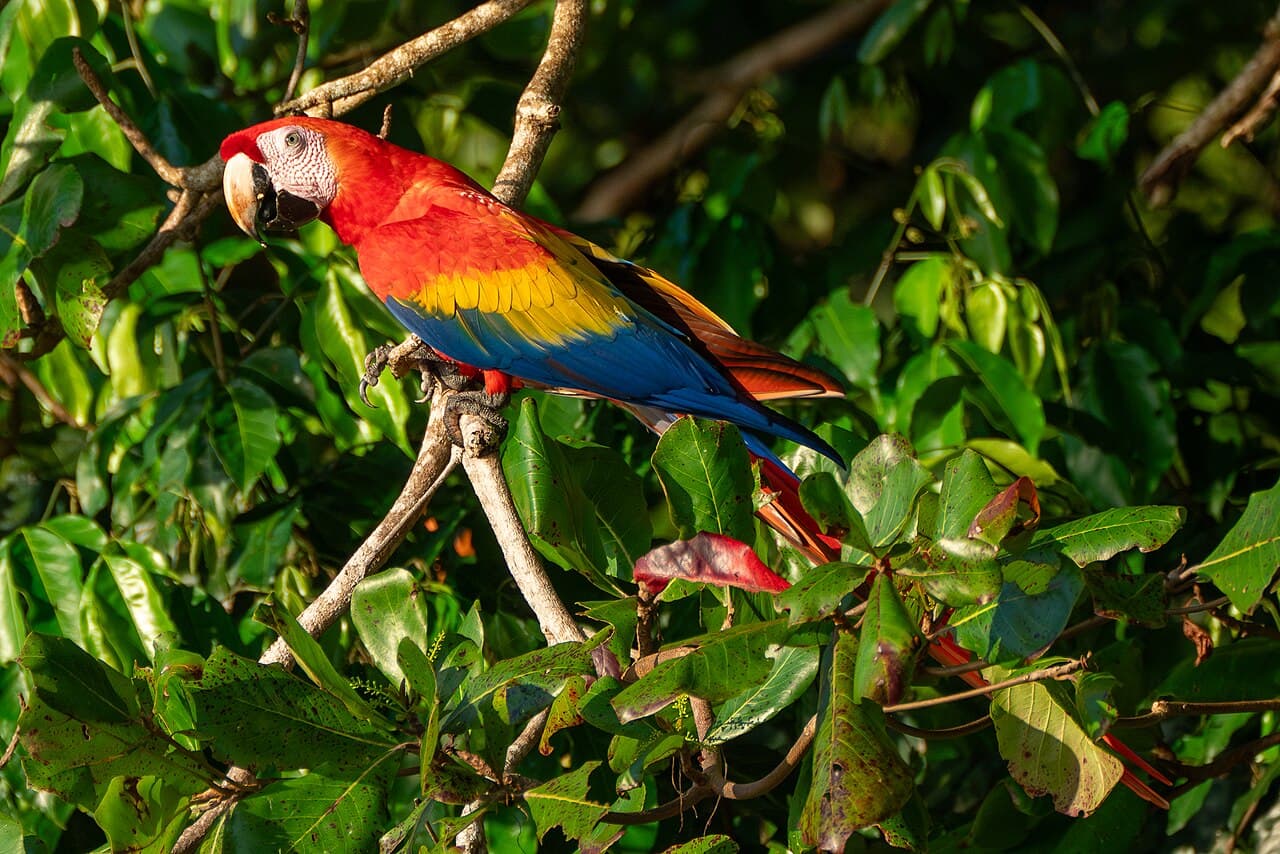
A scarlet macaw's wings unfold like a bright banner: red, yellow, and blue spread above a long tail. Yet the same bird can settle into leafy branches and become much harder to follow.
This large parrot, Ara macao, lives in parts of Mexico, Central America, and tropical South America. A sighting is memorable, but its feeding tools and family life are just as worthy of attention.
More than a brilliant coat
Much of the body is red, with yellow and blue across the wings and a pale, mostly bare face. Adults of both sexes have a similar appearance.
The World Parrot Trust species account gives a total length of about 85 centimeters, including the tail. That tail contributes greatly to the bird's long shape.
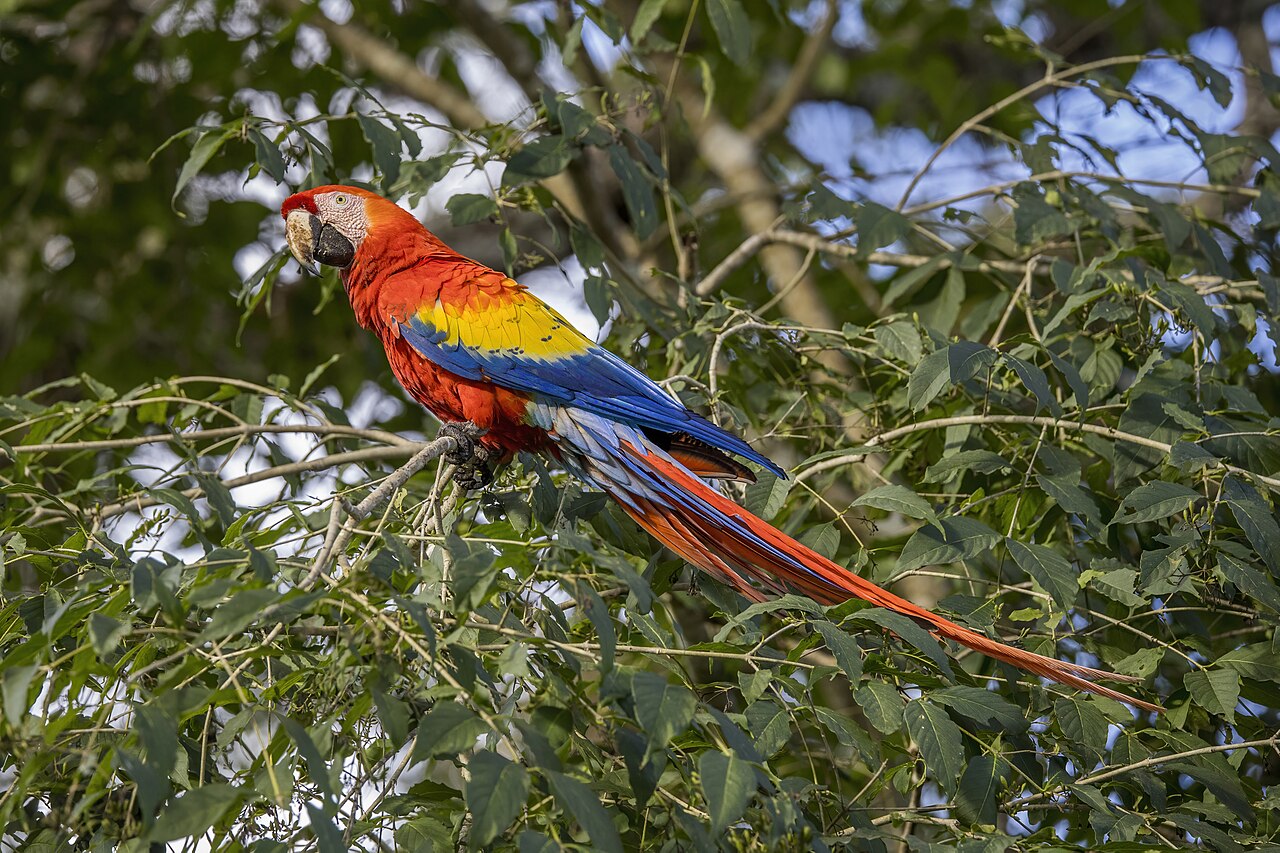
A powerful bill and a varied menu
A hooked bill helps break tough foods. Seeds and nuts are important, alongside fruit and other plant foods.
The Rainforest Alliance highlights the strong beak and a diet including nuts, leaves, berries, and seeds. The bird does not merely collect food; it must grip, open, and process it.
The contrast is striking. Feathers may look delicate, while the mouth below them is a powerful tool for dealing with hard shells.
A social life among tall trees
Scarlet macaws often appear in pairs, family parties, or larger groups. Their loud calls can announce their presence before their colors become visible.
They nest in large natural cavities in tall trees. A standing old tree can therefore offer something a young plantation cannot immediately replace: a suitable hollow for the next generation.
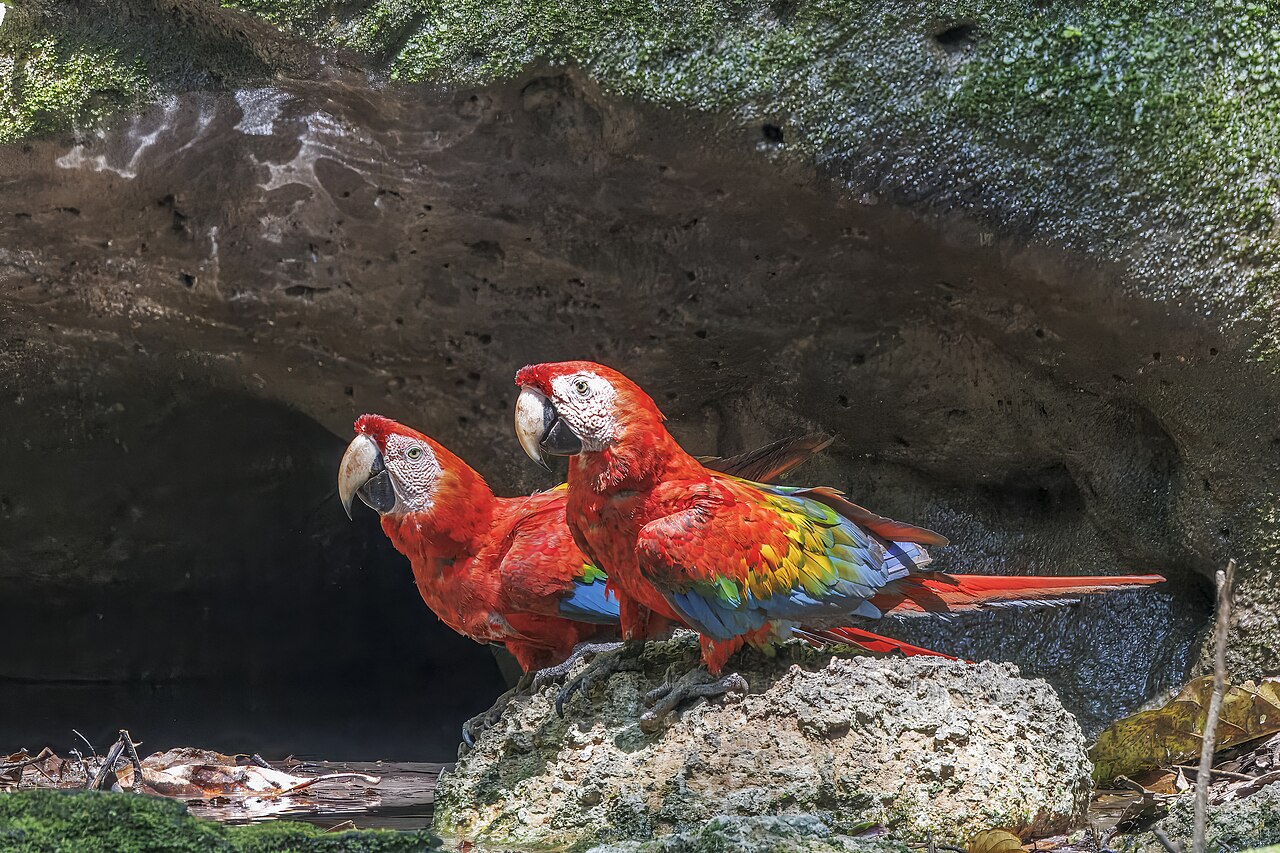
Widespread does not mean secure everywhere
The World Parrot Trust lists the species globally as Least Concern, while documenting declines and local losses caused by habitat destruction and trapping.
Those two facts can both be true. A bird may survive across a wide range while disappearing from places where it once belonged.
Protecting forest and reducing illegal capture keep the focus on wild lives, rather than feathers alone. The most wonderful scarlet macaw portrait is part of a continuing story: a bird with room to feed, nest, call, and fly.
Photo credits
Featured image: Scarlet Macaws at Uvita Beach, Costa Rica 01.jpg — Satdeep Gill, CC BY-SA 4.0.

Body image 1: Scarlet macaw (Ara macao cyanopterus) Copan.jpg — Charles J. Sharp, CC BY-SA 4.0.

Body image 2: Scarlet macaws (Ara macao macao) pair Yasuni.jpg — Charles J. Sharp, CC BY-SA 4.0.

Photographs resized to up to 1,280 pixels wide for web display.