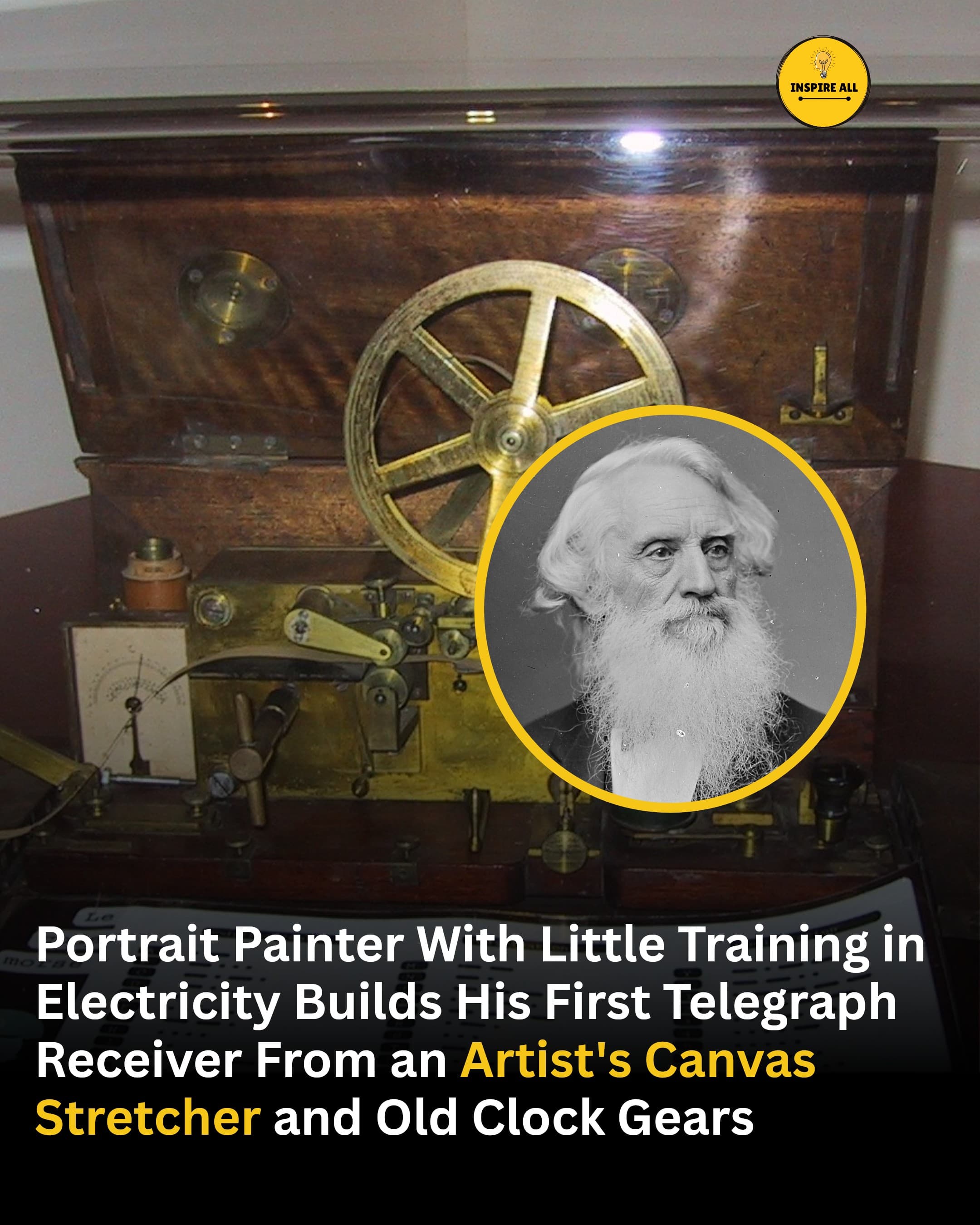
A surviving receiver preserves an unusual link between Samuel Morse’s work as a painter and his later place in electrical communication.
Samuel F. B. Morse’s 1837 telegraph receiver used a wooden artist’s canvas stretcher as part of its frame.
The Smithsonian collection record identifies the apparatus and explains its moving paper, clockwork, electromagnet and recording arm.
Electrical pulses moved the arm while the paper advanced, leaving a trace that represented a coded message.
The frame makes the transition from painter to inventor visible in a single object.
A mechanism needed more than a frame
Morse’s idea concerned sending signals over wire. Making that work over distance required electrical knowledge, suitable mechanisms and collaboration.
The Library of Congress’s history of the telegraph emphasizes contributions from Joseph Henry, Leonard Gale and Alfred Vail.
Gale helped Morse understand weaknesses in his early system and the use of relays to overcome distance limitations. Vail brought technical skill to its development.
Recognizing those contributions gives a clearer account than treating the telegraph as one painter’s entirely solitary invention.
From experiment to demonstration
In a Smithsonian Magazine account featuring museum curator Harold Wallace, the 1838 Speedwell Ironworks demonstration involved more than two miles of wire.
It followed the experimental receiver rather than instantly replacing it with a nationwide network.
Morse, Gale, Vail and others continued refining the system. The story therefore joins a distinctive homemade apparatus to a longer process of making communication practical.
What the object does, and does not, prove
The canvas stretcher is strong evidence of how this prototype was constructed. It is not evidence that electrical telegraphy had no other inventors or earlier experiments.
Likewise, a personal tragedy may be part of Morse’s biography without explaining every decision in his technical work.
The more securely documented human story is a change in vocation made through learning and partnership. Familiar workshop material supported an unfamiliar mechanism, and collaborators helped it work beyond the room where it was built.
The surviving receiver shows the beginning of that transition in wood, wire and moving paper.
This historical account draws on Smithsonian collections, the Library of Congress and a Smithsonian curator’s explanation. Featured graphic supplied by Inspire All.
Related reading: Himaja’s voice-controlled Braille printer and Gargi Agrawalla’s portable alert prototype.