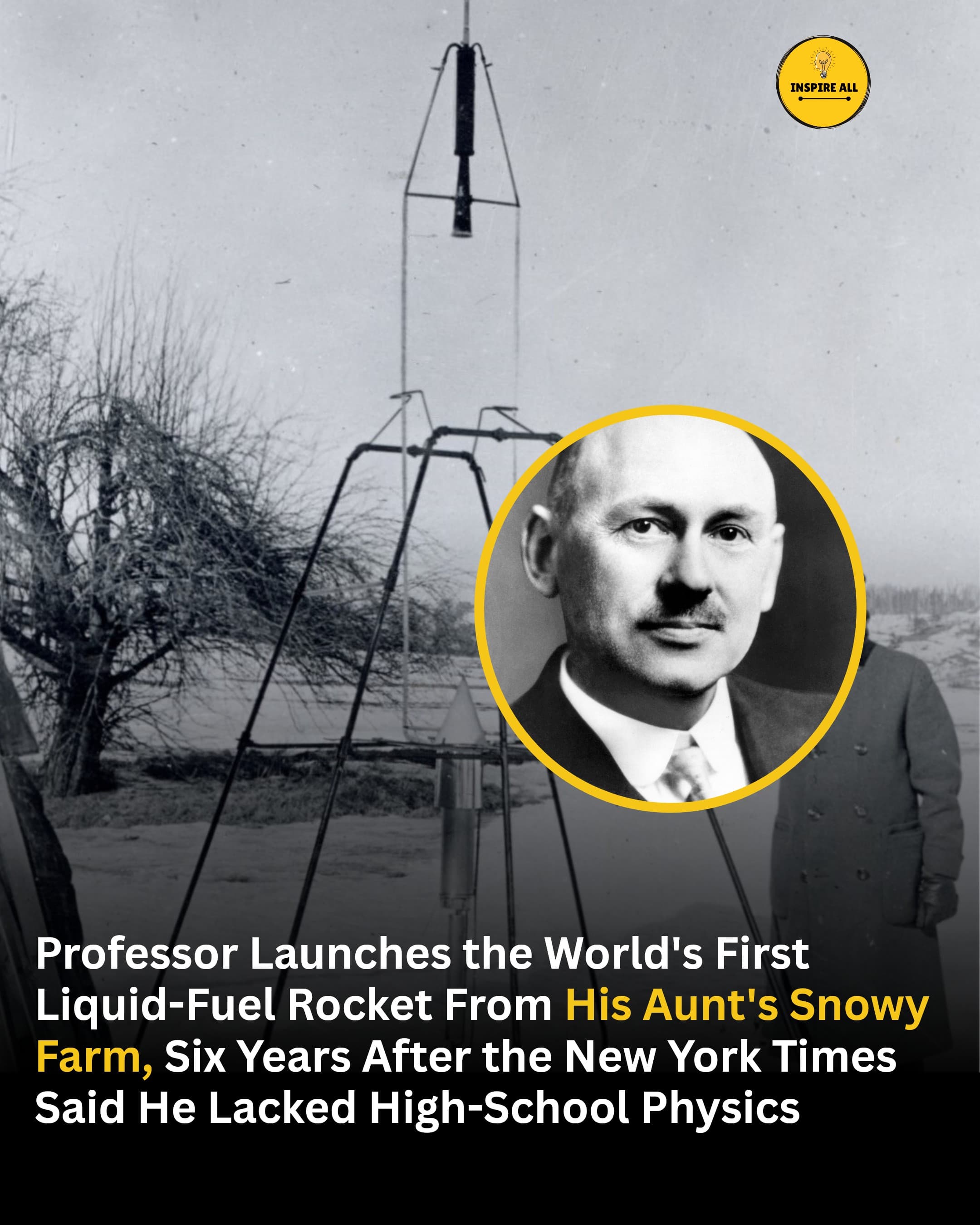
Robert Goddard’s rocket rose only 41 feet in March 1926. The experiment nevertheless demonstrated a method that helped shape modern spaceflight.
On March 16, 1926, Robert H. Goddard launched the world’s first liquid-fueled rocket in Auburn, Massachusetts.
According to NASA’s historical record, it flew for 2.5 seconds, climbed 41 feet and landed 184 feet away.
The flight was brief. Its importance lay in demonstrating that a rocket using liquid propellants could successfully leave the ground.
A farm field as a test site
The launch took place at Ward Farm, associated with a relative Goddard called Aunt Effie.
In its 2026 centennial account, NASA identifies her as a distant relative. It describes the rocket landing in a cabbage patch.
Goddard’s wife Esther, assistant Henry Sachs and fellow Clark University professor Percy Roope were part of the small group associated with the test.
The scene was far removed from a modern launch complex, but it contained a familiar scientific task: assemble an apparatus, conduct a test and record what happened.
Why liquid propellants mattered
The rocket used gasoline and liquid oxygen.
NASA explains that liquid propellants offered possibilities for controlling thrust, alongside challenges such as pressurizing the system and regulating the mixture.
The idea had been considered by other researchers. Goddard’s distinctive milestone was building and successfully launching such a rocket.
The flight did not reach space. It established a practical result on which further work could build.
The newspaper criticism six years earlier
In 1920, The New York Times criticized Goddard’s suggestion that a rocket might reach the Moon.
NASA recounts the editorial’s mistaken objection: how could a rocket work in a vacuum without air to push against?
The underlying principle is that a rocket expels material and receives thrust in the opposite direction. It does not need surrounding air as a surface to push on.
The criticism makes a memorable contrast with later spaceflight. The experimental result remains the stronger foundation for assessing Goddard’s work.
The research continued after 1926
NASA’s older historical account records substantially larger rockets developed from 1930 to 1941, alongside improvements in guidance, control and associated equipment.
The first flight was therefore a beginning within a continuing programme of experiments.
NASA named Goddard Space Flight Center in his honor in 1959, after his death in 1945.
A centennial retrospective can make the farm launch appear like an inevitable first step toward the Moon. At the time, it was a short, measurable test whose value depended on what it demonstrated.
Goddard’s achievement is compelling at that scale: a professor and his collaborators made an apparatus work, documented a 2.5-second flight and continued improving the technology.
Related reading: The Wright brothers’ wind-tunnel experiments and Michael Faraday’s route into electrical science.
Historical reporting based on NASA sources linked above. This article describes a 1926 event, revisited during its 2026 centennial. Featured graphic supplied by Inspire All.