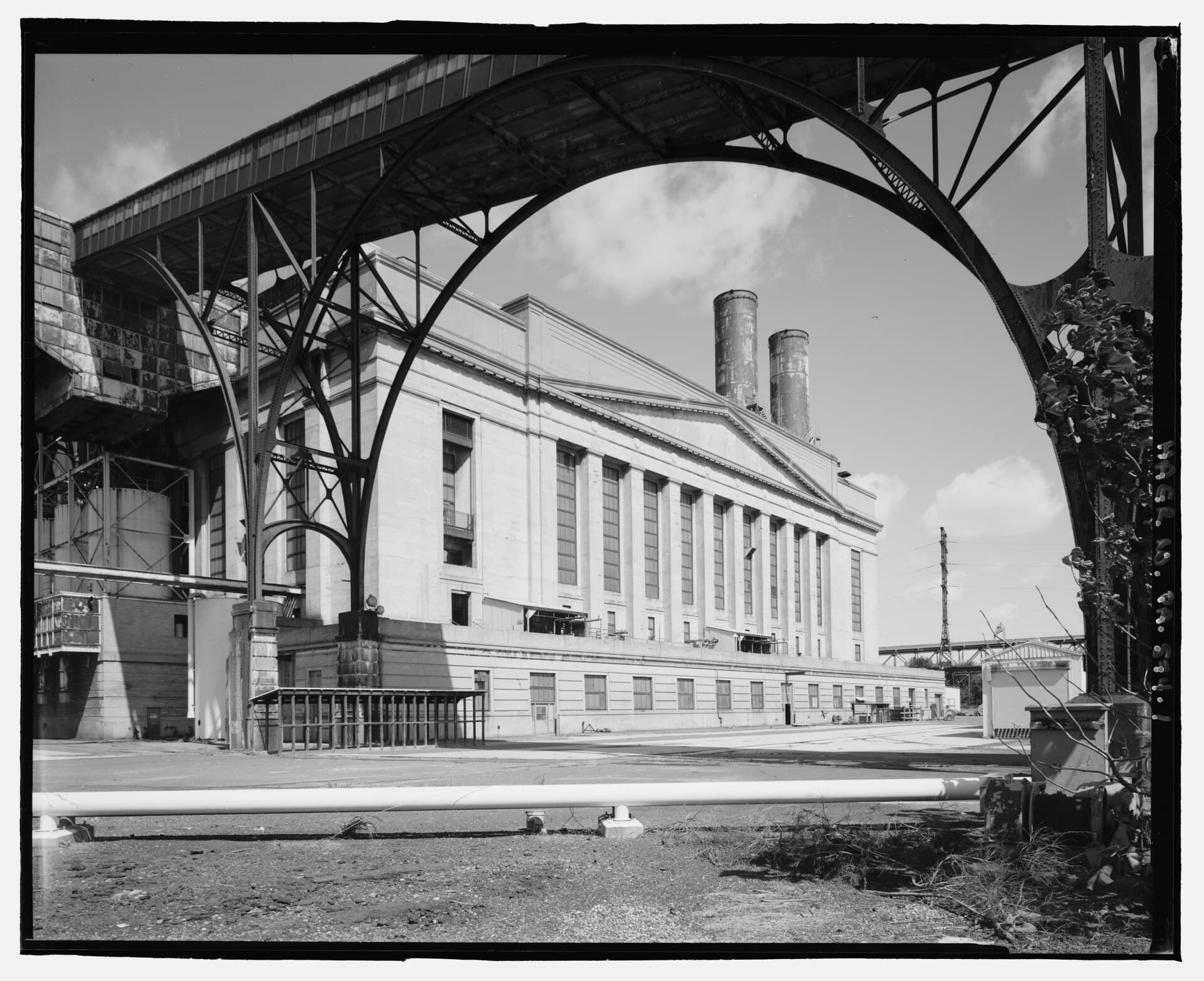
Philadelphia built a power station grand enough to make electricity feel like a civic achievement.
Richmond Power Station, on the Delaware River in Philadelphia, is known for its monumental historic buildings and vast turbine hall. The old steam plant shut down in 1984, but the wider site is not simply abandoned: Constellation still lists an operating Richmond generating facility.
That distinction is essential for understanding both its history and present access. This is an industrial property, not a public museum or an invitation to explore an empty building.
Richmond Power Station and the electric city
The station belonged to Philadelphia Electric Company’s expansion during the early twentieth century. Electricity was becoming central to factories, transportation and daily life, and the buildings supplying it expressed that importance.
Architect John T. Windrim worked with engineer W. C. L. Eglin on Richmond and other major generating stations. WHYY’s architectural history identifies Richmond’s completion in 1925 and describes the extraordinary scale of its turbine hall. WHYY’s industrial history
Its classical appearance was not necessary to generate electricity. It communicated something about the status of the enterprise.
A power station could have been treated as equipment inside a plain shelter. Here, the exterior and interior were designed to make an impression as well as perform a task.
The river was part of the system
Richmond’s position beside the Delaware connected the station with the industrial waterfront. The building was one element in a landscape of fuel handling, transport routes and electrical distribution.
The local industrial survey Workshop of the World describes the station’s different electrical outputs, serving large industrial users, substations, the wider grid and railroad needs. Richmond generating history
Those connections make the station’s scale easier to understand. It was not supplying a single neighborhood light switch. It was part of an interconnected city.
The electricity itself was invisible once it left the machinery. Architecture gave that hidden system a visible presence along the river.
Inside the turbine hall
The archival interior image below shows a great arched window beneath a high roof. Machinery occupies the lower space, while galleries and structural members frame the room above.
The photograph was made by Joseph Elliott for the Historic American Engineering Record in 2000. It is a dated architectural record, not a current visitor photograph.
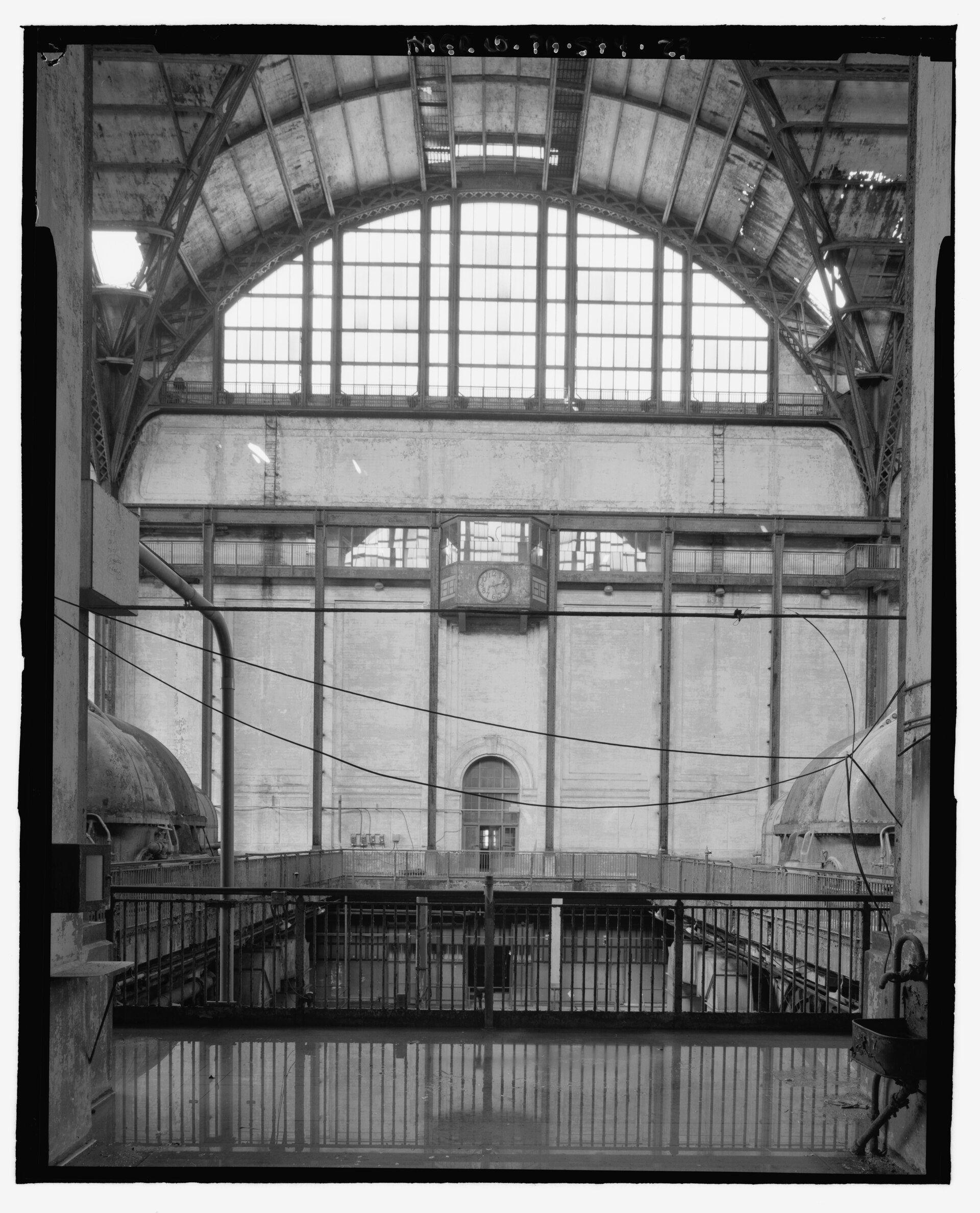
Look at the scale of the window compared with the doorway below it. That contrast helps explain why writers have compared the room with a grand railway station or civic hall.
The featured image shows another part of the complex from outside. Together, the two photographs reveal the combination of monumental architecture and practical industrial connections.
These records preserve details that casual exterior views cannot. They allow the building to be studied without entering restricted property.
What ended in 1984?
The old steam-generating operation closed in 1984. Workshop of the World distinguishes that shutdown from later use of smaller generating units during periods of high demand.
That is why a simple label such as “closed power station” can be incomplete. Industrial sites often contain equipment from different eras, with different operating lives.
A historic turbine hall may be out of service while another part of the property continues supplying electricity. The shutdown of one process does not establish that the entire site is vacant.
Richmond still appears in the energy network
Constellation’s current location page describes Richmond Generating Station as a two-unit, 98-megawatt, oil-fueled facility in its peaking division.
The company explains that these units support periods of high electricity demand and help balance the system. Its listed address is 3901 North Delaware Avenue. Constellation’s Richmond facility page
This does not mean the historic steam machinery has returned to its former role. It means the location’s present status is more complicated than the abandoned-building label suggests.
For an article about forgotten places, that complication is part of the story. The city’s industrial past and current infrastructure can occupy the same landscape.
Avoiding a common Philadelphia mix-up
Richmond is also distinct from the Delaware Generating Station farther down the river. Both share associations with Windrim and Philadelphia’s electrical history, making them easy to confuse.
A story about a new use at one station should not automatically be applied to the other. Check the address, building name and date of any report.
The images here are specifically catalogued as Richmond Power Station records.
Can you visit?
No regular public interior-tour program is established by the sources reviewed for this article as of November 2026.
Use historical archives and lawful public viewpoints to explore the story. Do not cross fences, enter structures or assume that inactivity in one building means permission to approach operating infrastructure.
Richmond’s appeal does not depend on getting inside. Its documented architecture already tells a remarkable story about how a city once gave monumental form to the power that kept it moving.
Frequently asked questions
Where is Richmond Power Station?
It is on Philadelphia’s Delaware River waterfront, with the operating facility listed at 3901 North Delaware Avenue.
When did the old steam plant close?
The historic steam-generating operation shut down in 1984.
Is the entire property abandoned?
No. Constellation lists an operating oil-fueled peaking facility at Richmond.
Are the photographs current?
No. The featured and body photographs are archival engineering records from 2000.
Image credits
Featured image: Joseph Elliott / Historic American Engineering Record / Wikimedia Commons, Public domain. Richmond Power Station’s boiler house in a 2000 Historic American Engineering Record photograph.
Body image: Joseph Elliott / Historic American Engineering Record / Wikimedia Commons, Public domain.