A bank’s broken walls still rise above a desert town that once expected a much bigger future.
Rhyolite ghost town, near Beatty in Nevada, grew from the Bullfrog gold rush and declined within roughly a decade. Its surviving ruins, railroad depot, and bottle house make the speed of that rise and fall unusually easy to picture.
The town is outside Death Valley National Park, despite its close association with the park. It occupies a mix of federal and private land, so public access does not mean every structure is open.
The discovery that set Rhyolite in motion
In 1904, Frank “Shorty” Harris and Ernest Cross found gold-bearing rock in the area. Their discovery helped launch the Bullfrog Mining District’s rush.
According to the National Park Service’s Rhyolite history, mining claims quickly spread across the surrounding country. The promising Montgomery Shoshone Mine helped draw people toward the new townsite.
Rhyolite took its name from a volcanic rock. The name sounds permanent, but the settlement depended on something far less certain: whether the mines could keep delivering profitable ore.
It is tempting to look at the ruins and assume the town was always doomed. Its builders did not have that hindsight. They were making decisions while money, people, and expectations were arriving together.
A city grew where tents had stood
Travel Nevada’s visitor history describes Rhyolite’s transformation from a small camp into the district’s main center. Hotels, restaurants, saloons, shops, and a newspaper served the rush.
Its ambition went well beyond temporary shelters. Substantial commercial buildings announced that this would be a lasting place to live and do business.
That is what makes the Cook Bank ruins so striking. The surviving walls suggest the scale of investment even though the rooms they once enclosed are gone.
Population estimates differ among historical accounts. Thousands lived here at the peak, but the precise total is less secure than a neat number in a travel caption might suggest.
The wider point is unmistakable. People built for a future larger than the one the mining economy could sustain.
The financial shock and the mining problem
Rhyolite’s decline combined weakening mining prospects with the financial panic of 1907. These were connected pressures, not a single mysterious event.
The National Park Service records the decision to close the Montgomery Shoshone Mine and mill in March 1911. Electricity was finally shut off in 1916.
Travel Nevada’s historical feature describes how failing mines and a shrinking population turned the boom into a rapid retreat. As business disappeared, the costly infrastructure no longer had enough activity to support it.
A mining settlement can grow quickly because everyone expects the same opportunity. It can contract just as quickly when those expectations change.
Rhyolite’s empty spaces are a useful reminder that impressive construction does not guarantee economic security. The bank, school, and transport links could not create valuable ore where it was no longer available in sufficient quantities.
Three sights that tell different parts of the story
The Cook Bank ruins
The Bureau of Land Management identifies the Cook Bank Building among the historic area’s signature remains.
Its broken outline is more informative than a generic “haunted” label. Look at the height and footprint, then compare them with the open desert around it. The contrast reveals the town’s confidence.
The bottle house
Tom Kelly’s bottle house offers a different kind of ingenuity. Its walls incorporate glass bottles, turning discarded containers into building material.
Sources disagree on the exact number of bottles, so a precise total is best avoided. What matters is the visible construction and the practical imagination behind it.
The house survived partly because people valued it after the mining town faded. Its preservation belongs to Rhyolite’s later history, not just its brief boom.
The railroad depot
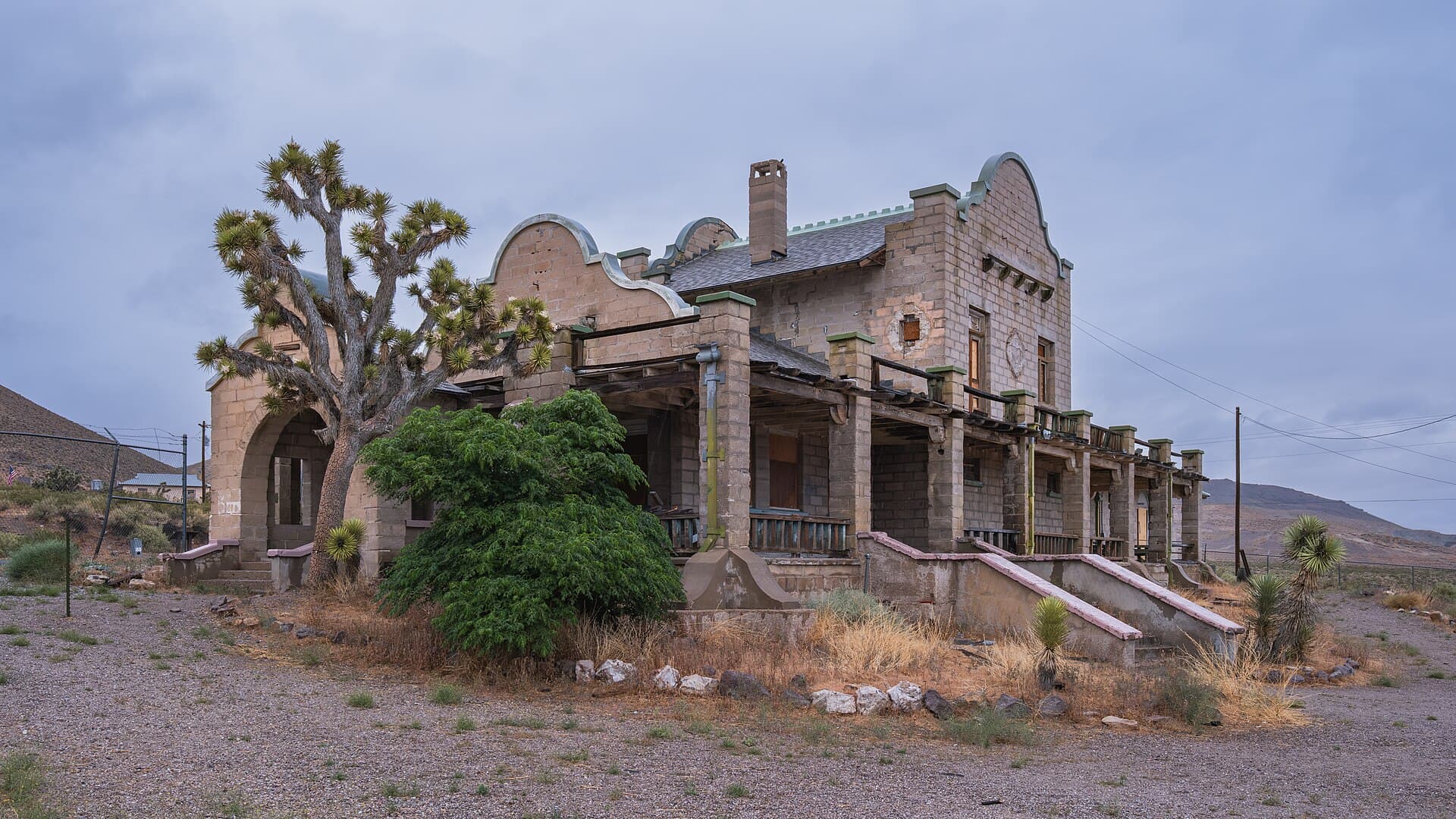
The depot shows how seriously railway companies took the district. Travel Nevada’s railroad history dates the Mission Revival-style station’s opening to 1908.
The building later served other purposes, including use as a casino. That second life helped it outlast the original traffic it was built to serve.
How to visit Rhyolite ghost town
Use the BLM’s current visitor information before traveling, and treat signs and barriers as the authority on where access is allowed.
The town is reached from the Beatty area via State Route 374 and the signed approach. Bring drinking water, sun protection, and appropriate footwear for uneven ground.
Do not enter unstable ruins or assume the depot is open because it looks more complete than nearby buildings. Respect private property throughout the townsite.
Nearby Beatty offers another way to understand the area. Travel Nevada’s Beatty guide highlights its museum and historical collections, which can add context to the ruins.
Give yourself time to compare what remains with historical photographs. The most rewarding visit is not a hunt for the most dramatic broken wall. It is an effort to understand why so much was built so quickly.
Rhyolite’s lasting attraction is the gap between ambition and outcome. A town planned for prosperity now survives as evidence of just how briefly prosperity can last.
Frequently asked questions
Is Rhyolite inside Death Valley National Park?
No. It lies outside the park boundary near Beatty, Nevada, on a mixture of federal and private land.
Why was Rhyolite abandoned?
Declining mining prospects and the financial panic of 1907 undermined its economy. Major mining operations closed in 1911.
What buildings remain?
Notable sights include the Cook Bank ruins, bottle house, depot, and other remnants. Access to individual structures varies.
Can visitors take bottles or other artifacts?
No. Leave historical material in place and follow posted rules. Removing objects damages the evidence that makes the town meaningful.
Featured photograph: Christian David. Original image and details. CC BY-SA 4.0. Photograph predates this article; it is not a real-time view.
