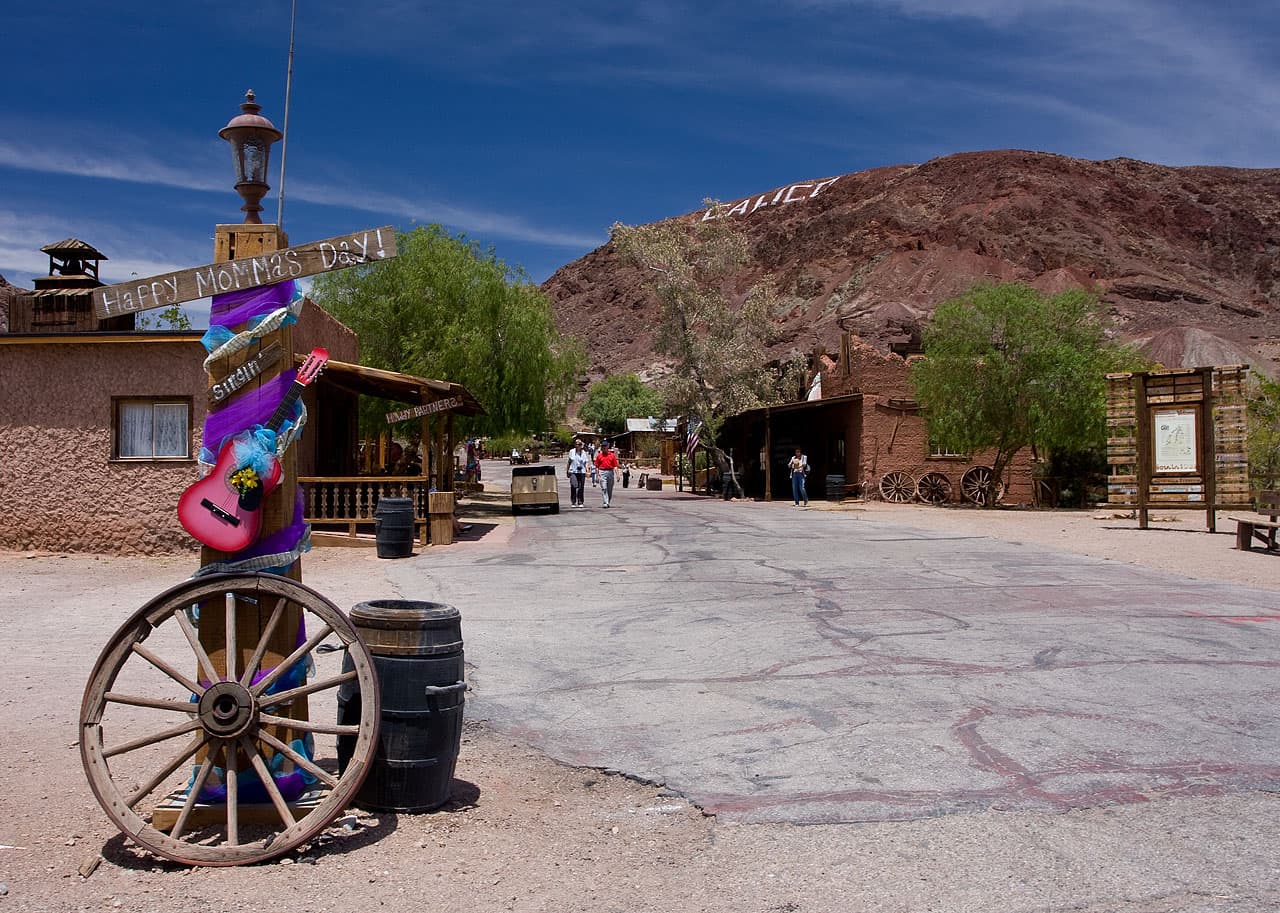
Calico lost its mining crowds, then found a second life by inviting people back to explore its past.
Calico ghost town is a former silver-mining settlement near Yermo, California, now operated as a San Bernardino County regional park. Founded in 1881, it declined as silver lost value and later mining activity faded.
Today, it combines surviving historic structures with extensive restoration and visitor attractions. That distinction is part of the story: Calico is a managed heritage destination whose present appearance reflects both mining history and a twentieth-century effort to revive it.
The silver discovery behind Calico ghost town
San Bernardino County’s historical account dates the local silver discovery to April 6, 1881. The Silver King Mine helped establish the settlement that followed.
The surrounding mineral wealth quickly gave Calico a purpose. People needed places to sleep, buy supplies, conduct business, and spend their earnings.
Its location in the Mojave Desert makes the effort easier to appreciate. A settlement here required more than enthusiasm. Every service represented an investment in the belief that the mines would continue paying.
Borax also became part of the district’s economy. The county’s history notes that mining continued beyond the first silver boom, so Calico’s decline should not be reduced to one moment when every activity stopped.
Why Calico became a ghost town
Silver’s falling value in the 1890s weakened the business that had drawn people to Calico. As mining became less rewarding, the town lost its economic pull.
The county park’s overview places the main abandonment in the mid-1890s. The county’s fuller history also records the end of borax mining in 1907.
Together, those accounts describe a process rather than a single departure date. Different activities and households would have responded to changing conditions at different times.
The buildings are the visible part of that process. The less visible part is the chain of ordinary decisions behind them: whether a shop could stay open, whether work would return, and whether a family should move.
A ghost town often seems frozen because its surviving structures stop changing rapidly. The lives attached to those structures did not stop. They continued elsewhere.
Walter Knott’s connection changed Calico’s future
Calico’s second chapter is linked to Walter Knott, the entrepreneur associated with Knott’s Berry Farm.
He purchased the town in the early 1950s and began restoring it using historical photographs as a guide. The county dates the purchase to 1951 and the donation to San Bernardino County to 1966.
That intervention changed Calico from a declining industrial site into a place designed to receive visitors. It also shaped the familiar streetscape seen in photographs today.
The California State Capitol Museum recognizes Calico as the state’s official Silver Rush Ghost Town, a designation adopted in 2005.
The title links Calico with a larger California story. Gold tends to dominate popular memory of the state’s mining past, but silver supported its own towns, investments, and disappointments.
What is original, and what was restored?
This is the most useful question to bring to Calico.
The county says five original buildings survived, while much of the town was architecturally restored. That means a convincing Old West appearance should not automatically be read as untouched nineteenth-century fabric.
Restoration has value of its own. It can help visitors understand how a street worked and make a difficult landscape easier to interpret. But knowing what was rebuilt makes the experience more honest and more interesting.
The California historical-landmark record identifies the town as Landmark 782. Historic recognition and later restoration are complementary parts of its identity.
Look for interpretive signs and ask which buildings, materials, or features belong to which period. A photograph may show one street, but that street can contain several layers of history.
Start with the museum, then explore the attractions
The Lane House and Museum offers a place to begin exploring the town’s history. It is a useful starting point for separating the historical settlement from the entertainment built around it.
Then choose the attractions that fit your interests. The county park offers shops, dining, camping, and organized activities alongside historical interpretation.
For families, that can make Calico an approachable introduction to mining history. Children can connect buildings and objects with a larger story instead of encountering a remote ruin with little explanation.
For adults, the restoration raises a different question: how do we preserve a place after its original purpose disappears? Calico’s answer is visible in its mix of historical remains and active visitor services.
Planning a visit to Calico
As checked on November 2, 2026, the county lists daily hours of 9 a.m. to 5 p.m., with closure on Christmas Day. Confirm current admission, attraction charges, and event arrangements on the official park page.
Bring water and sun protection. Choose walking shoes for slopes and uneven surfaces. Follow designated routes and use only officially operated mine attractions.
Do not treat nearby mine openings as extensions of the visitor experience. A managed attraction and an abandoned excavation are different places with different access rules.
Calico’s appeal lies in its second chance. The silver economy disappeared, but people found a new reason to maintain the streets and tell the story. Knowing how that happened makes the town more memorable than a simple picture of an abandoned West.
Frequently asked questions
Is Calico a real ghost town?
Yes. It began as a genuine mining settlement. Its current visitor area includes original buildings and substantial later restoration.
What was mined at Calico?
Silver drove the early boom. Borax was also important to the surrounding mining district.
Is Calico open to visitors?
Yes, it operates as a county regional park. Check the official page for current hours, fees, and attraction availability.
Is Calico completely abandoned today?
No. It has staff, businesses, attractions, and visitors. Its ghost-town identity refers to the decline of the original mining community.
Featured photograph: Svein-Magne Tunli. Original image and details. CC BY-SA 3.0. Photograph predates this article; it is not a real-time view.
