An empty hospital photograph can hide the very thing that made a place remarkable: its attempt to change care.
Peoria State Hospital operated in Bartonville, Illinois, from 1902 to 1973. Much of its campus has disappeared, but the Peoria State Hospital Museum preserves its history and offers organized visits to surviving sites. This is a story of reform, daily work and remembrance, not simply an abandoned asylum.
The hospital’s best-known advocate, Dr. George Zeller, wanted an institution that felt less like a prison. That ambition deserves attention alongside the buildings people photograph today.
Why Peoria State Hospital was different
The museum’s historical overview credits the Peoria Women’s League with advocating for better treatment of people with mental illness. The hospital opened in 1902 with Zeller as its first superintendent.
The museum describes his approach as rejecting imprisonment and unnecessary restraint. It presents the institution as an effort to give residents a more humane daily life.
Those were significant goals in an era when people with mental illness were often isolated from their communities. The choice of words mattered: a hospital could be planned as a place to live and receive care, rather than merely a place to be confined.
A local historical study of Zeller and the hospital traces that philosophy through his work. His idea of a state “home” helps explain the importance he attached to surroundings and routine.
Reform ideals, however, are only one part of an institution’s record. They should not be used to assume that every patient’s experience was identical or that care never fell short.
A working community on the hill
Large hospitals depended on much more than doctors. Staff had to prepare meals, maintain buildings, care for grounds and keep a complicated daily schedule moving.
At Peoria, the campus was spread among many buildings rather than contained in one photogenic facade. That makes its history harder to understand from a single abandoned-building image.
Imagine following the practical routes of a working day: between living quarters, workplaces and the spaces used for care. The arrangement of a campus can reveal how separate those activities were.
Peoria Magazine’s account describes the museum’s photographs and artifacts, which cover the institution’s years of operation. Such objects offer a more personal scale than an aerial view.
They also connect the place to families across the region. A hospital employed local residents, received visitors and shaped the surrounding community, even when its patients lived apart from ordinary town life.
The Bowen Building in old photographs
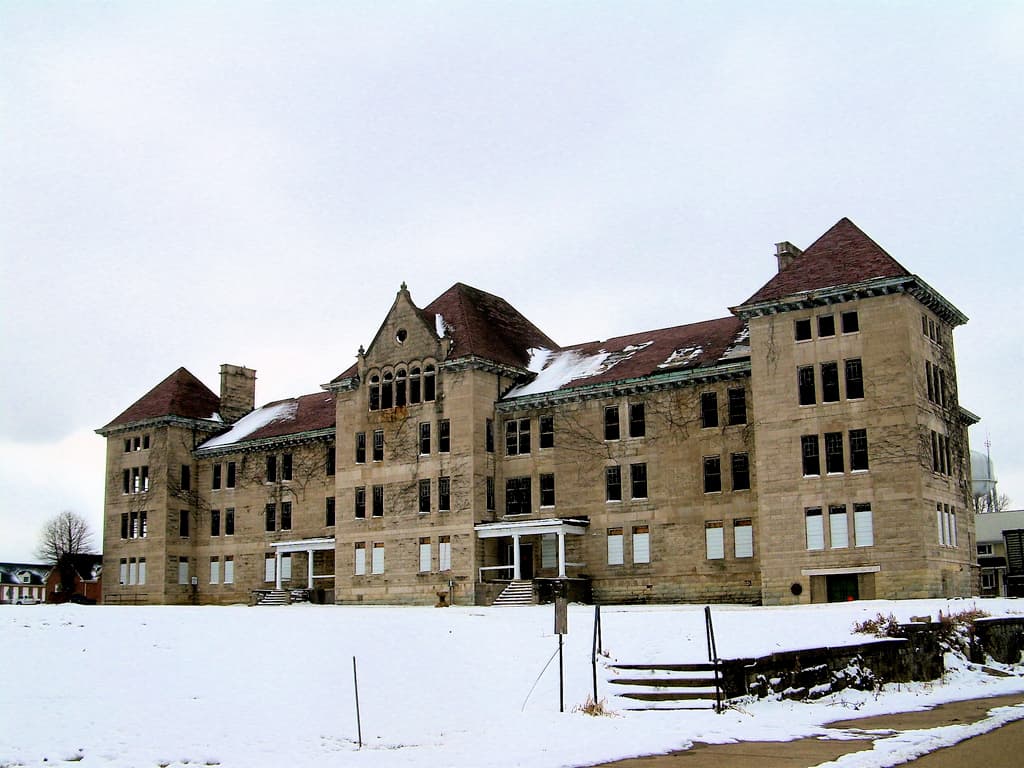
The Bowen Building housed administration and nurses’ accommodations. Its imposing appearance helped make it the most recognizable part of the former hospital.
By 2015, Landmarks Illinois had placed it on its endangered list. The preservation group described a long-vacant centerpiece in need of a viable future.
The effort did not save the building. Later accounts record its demolition, and Atlas Obscura’s updated entry explicitly corrects its earlier description of the Bowen Building as standing.
The featured photograph here dates from 2010. It is a record of the former campus before that loss, not a promise of what a visitor can see now.
That distinction matters at Peoria. Old photographs often circulate without their dates, making demolished buildings seem like available destinations.
Why the hospital closed
The hospital closed in 1973. The museum attributes the decision to funding and staffing problems within a broader move away from large lifelong institutions.
A closure date marks an administrative ending, but the consequences extend further. Patients needed new arrangements, workers faced changes, and the property required another purpose.
Some structures disappeared, while others survived in different uses. The result is a fragmented historic landscape.
That is why an organized visit can be useful. Interpretation helps connect sites that no longer explain themselves clearly from the roadside.
A missing building can still matter historically. Its location, photographs and records may reveal how the rest of the campus once worked.
Visiting through the museum
The museum’s tour page offers private historical tours and separate events that combine history with paranormal activities.
Its historical route includes surviving structures and cemetery visits. The museum identifies Cottage B1 as the remaining patient cottage included in its interpretation.
Check available dates directly before traveling. Winter access may be by appointment, and a published description is not a guarantee that a particular tour will run on your preferred day.
Ask about walking distances, surfaces and building access if anyone in your group has mobility needs. The old campus is not one compact indoor attraction.
Use the museum’s arrangements rather than wandering onto adjoining properties. Buildings with new owners or commercial uses are not automatically part of a tour.
Remember the people behind the stories
Peoria has a place in regional ghost lore, but a paranormal claim is different from a documented event. Choose a history-focused visit if your main interest is the institution and Zeller’s work.
Approach cemeteries as places of remembrance. Leave markers and artifacts undisturbed, and give individual lives more attention than frightening labels.
The strongest reason to visit is the chance to see how a community remembers an institution after its most familiar architecture has gone.
Frequently asked questions
When did Peoria State Hospital operate?
It opened in 1902 and closed in 1973.
Is the Bowen Building still standing?
No. Older images show a building that was later demolished.
Can you take a history tour?
Yes. The museum advertises organized historical visits. Confirm dates and arrangements directly.
Is the whole former campus open to explore?
No. Visit through authorized museum activities and respect separately owned or restricted areas.
Image credits
Featured image: Willjay, CC BY 3.0. Body image: NatFee, CC BY-SA 4.0. Images via Wikimedia Commons.

