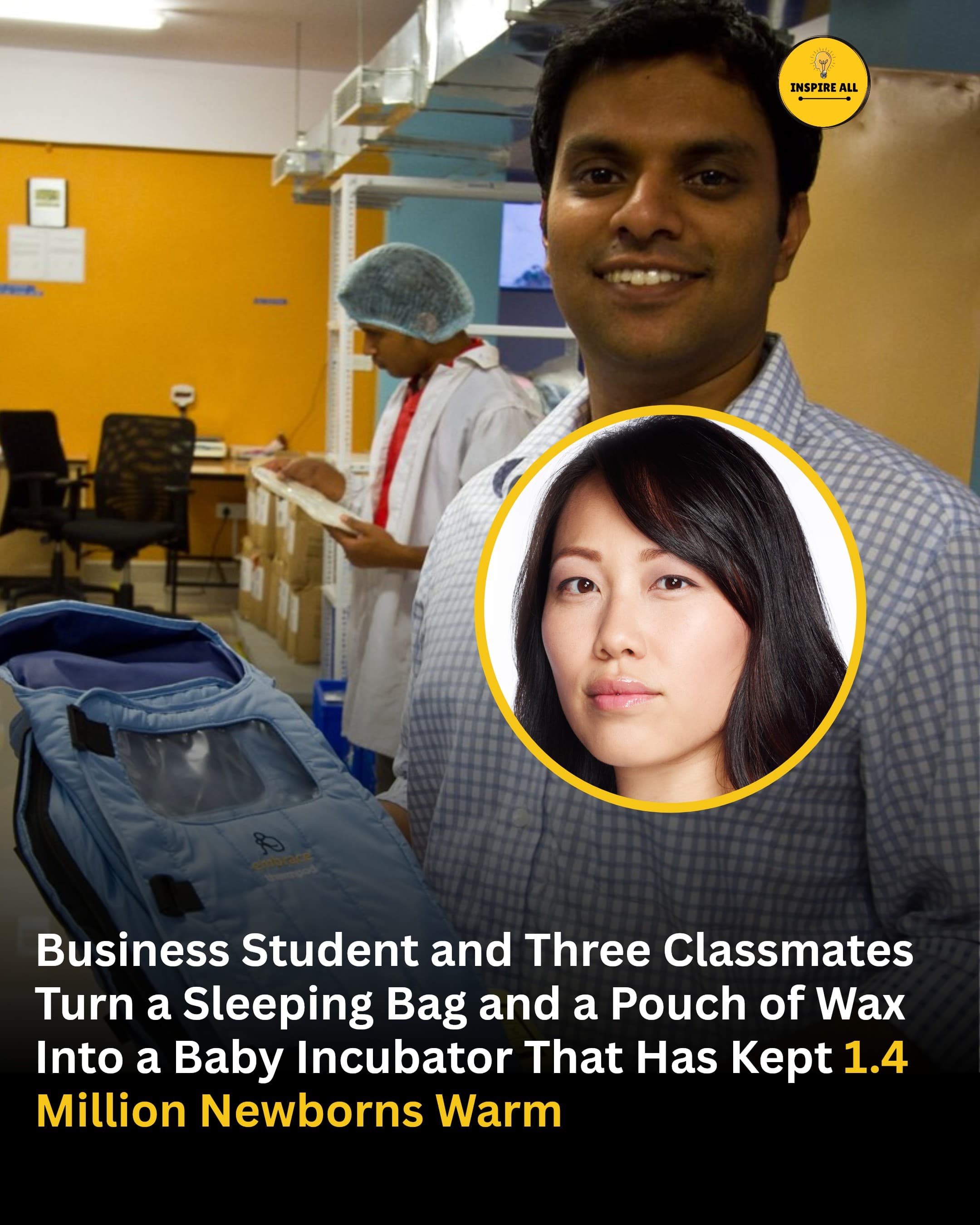
Jane Chen and her classmates approached a newborn-care problem by rethinking the equipment needed to provide warmth. Their class project became a portable infant warmer.
An assignment at Stanford asked Jane Chen’s team to develop a baby incubator at a fraction of the cost of conventional equipment.
The response looked more like a small sleeping bag than a hospital machine. It paired an insulated wrap with a pouch of phase-change material designed to release warmth over several hours.
Embrace Global now reports that its work has kept more than 1.4 million newborns warm across over 30 countries since 2011. That is the organization’s reported reach, rather than an independently verified count of lives saved.
A business student within an interdisciplinary team
In a 2010 TED interview, Chen named co-founders Naganand Murty, Linus Liang and Rahul Panicker.
She described Stanford’s Design for Extreme Affordability course as bringing together business and engineering students. The assignment targeted a device costing less than one percent of a conventional incubator’s price.
The team researched needs in Nepal and India. Portability, ease of use and unreliable electricity shaped the problem.
This was therefore a collaborative design effort. Chen’s business background was one contribution within a team, rather than evidence that medical-device development required no engineering or clinical input.
How a wax-like pouch provides warmth
The device’s core is a packet of phase-change material, not ordinary household wax.
On its current technology page, Embrace calls this component the WarmPak and describes a transition temperature of about 98°F, roughly 37°C.
After preparation in its dedicated heater, the packet releases heat as it re-solidifies. The organization says it can provide warmth for up to four to six hours and can be reheated for reuse.
The packet sits in a pocket in the BabyWrap.
Those details explain the design without providing a home-use recipe. Preparation, suitability and monitoring belong within the device’s instructions and clinical care.
What “without electricity” needs to mean
A device that retains and releases heat after preparation is different from one that needs no energy source at any stage.
Chen’s earlier interview discussed different versions and intended settings. The current Embrace description specifies a dedicated heater to prepare the WarmPak.
It is more accurate to say the warmer does not require a continuous power connection while releasing its stored heat than to imply that every version can be prepared anywhere with warm water.
The same care applies to the word incubator. Embrace provides thermal support; that does not mean it replaces every function of a hospital incubator or all the care a premature infant may need.
Equipment was only part of the work
Embrace’s current model emphasizes partnerships with governments, hospitals and humanitarian organizations.
Its technology page also describes input from doctors, healthcare workers and parents. Training and feedback are part of making a device usable in the setting for which it is intended.
That adds an important dimension to the original student-invention story. A compact design can address a practical constraint, but distribution, preparation and appropriate use still matter.
The reported reach is substantial. The more immediate lesson is how the team narrowed a large challenge to a specific need: providing warmth through equipment designed around local conditions.
The resulting pouch and wrap were the visible product. The work also required listening to the people who would use them.
Related reading: Gargi Agrawalla’s portable alert system and Himaja’s voice-controlled Braille printer.
Based on Jane Chen’s published interview and Embrace Global’s current device and programme descriptions. Reach figures are organization-reported. Featured graphic supplied by Inspire All.