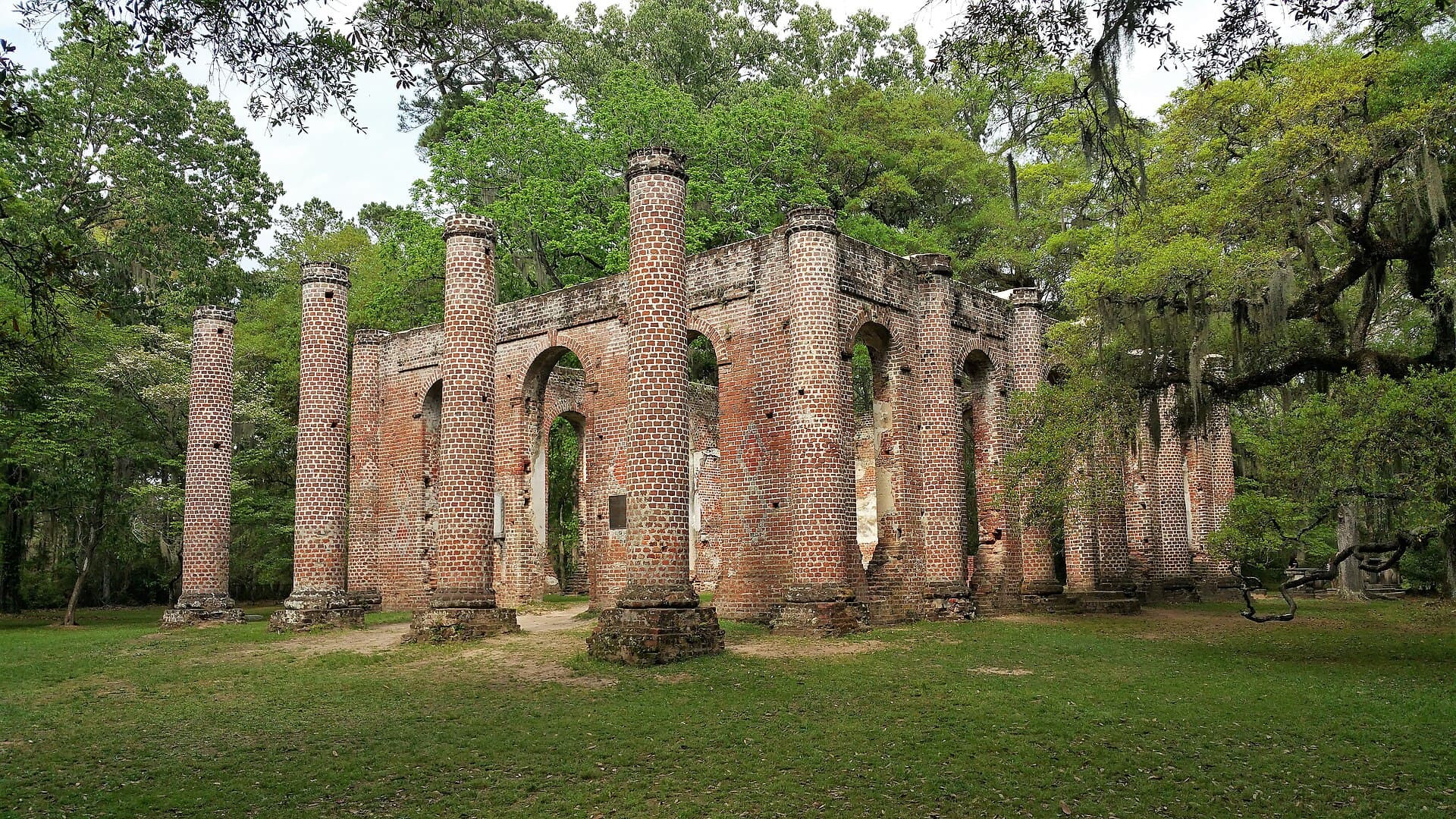
The roof is gone, but the brick columns still make the clearing feel like a room.
Old Sheldon Church Ruins, near Yemassee in South Carolina, preserves the shell of an 18th-century church. Its history includes Revolutionary War destruction, rebuilding, and later dismantling. The familiar claim that Sherman's troops burned it during the Civil War is disputed by documentary evidence and a revised historical marker.
That correction does not make the place less compelling. It makes the surviving walls a starting point for a better question: how do we know what happened to a ruin?
A church built to make an impression
Originally known as Prince William's Parish Church, Sheldon rose during the middle of the 18th century. The substantial brick walls and classical columns conveyed the ambitions of its colonial congregation. William Bull was closely associated with its development.
The South Carolina Picture Project's account explains the building's origins and its continuing connection to St. Helena's parish. The church was a place of worship within colonial society, not a decorative folly placed among the trees.
Look at the columns and arched openings in photographs. The repetition gives the shell a sense of order even without timber, glass, or furnishings. A visitor can recognize where light entered and how the exterior presented itself, although much of the original experience has disappeared.
Burials around the church add another layer of meaning. This is a religious and commemorative landscape, not simply an attractive backdrop for a roadside photograph.
Fire, rebuilding, and a disputed second destruction
The revised marker records that Loyalist forces burned the church in 1779 during the Revolutionary War. Its roof and interior were rebuilt in the 1820s. The surviving shell therefore belongs to more than one period of use and repair.
For years, many accounts told a neat story of two wartime burnings. The first involved the British; the second supposedly involved General William T. Sherman. The symmetry made the story memorable, but repetition is not the same as proof.
A transcription and photograph of the newer marker instead describes dismantling between 1865 and 1867. That wording changes both the timing and the explanation for the building's final loss of use.
What the letters changed
Historian Jennifer Whitmer Taylor examined postwar correspondence from the Leverett family. In her discussion of the letters, an 1866 account describes a church that had not burned but had been stripped internally.
That is important evidence because it comes from close to the event. It challenges the later picture of a complete church destroyed by an invading army. Materials from buildings were valuable in a devastated region, and dismantling leaves a different historical trail from a fire.
The National Trust for Historic Preservation added an editorial correction to its own story, explaining the revised interpretation. The old headline remains a reminder of how widely the earlier version circulated.
The responsible conclusion is specific: do not present a second burning by Sherman's troops as settled fact. The revised marker and the surviving correspondence support a more complicated account.
A ruin that still needs care
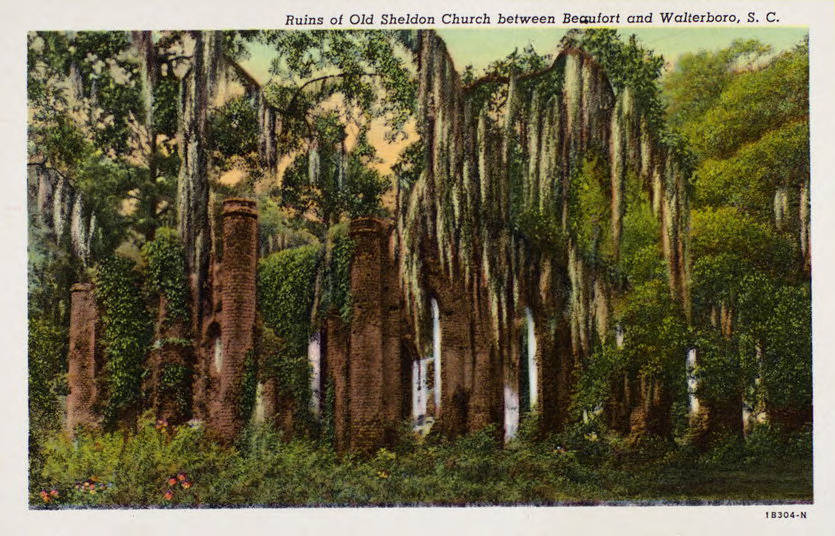
The postcard above shows that the roofless church has attracted attention for generations. Comparing it with a later photograph reveals the same strong outline of columns, walls, and open sky. The trees and views may change, but the masonry carries the story.
Popularity creates pressure. In 2019, the Island Packet reported on a protective fence after damage and theft of bricks. A ruin can lose small pieces gradually until the loss becomes structural.
Documentation also matters. The National Trust described work by preservation students and specialists to record Sheldon in three dimensions. Recording a building cannot stop weathering, but it helps preserve information about its form and condition.
Do not remove loose material, touch fragile surfaces, or climb walls to improve a view. A brick lying on the ground is still part of the site's historical fabric.
Visiting Old Sheldon Church Ruins respectfully
Old Sheldon remains private church property. Follow current signs and any fencing, and check with St. Helena's parish before planning an event or expecting special access. Published photographs are not proof that every area is open today.
The parish continues to recognize Sheldon through worship, including an annual service tradition. Check its announcements for a particular year's arrangements rather than assuming an old event listing still applies.
Allow time to look quietly. The most rewarding visit may be the moment the familiar image becomes a real historical question: which parts survived, which were rebuilt, and which stories were added afterward?
Sheldon deserves admiration for its beauty. It also deserves a history that can change when better evidence appears.
Frequently asked questions
Where are Old Sheldon Church Ruins?
They are in the Yemassee area of South Carolina's Lowcountry, inland from Beaufort.
Did Sherman burn Old Sheldon Church?
That traditional account is disputed. The revised marker describes postwar dismantling, supported by contemporary correspondence.
Is Old Sheldon completely abandoned?
It no longer functions as a roofed parish church, but it remains church property with an ongoing worship tradition.
Can visitors enter the ruins or hold events there?
Access depends on current property rules. Respect barriers and contact the parish about events or special arrangements.
Image credits
Body image: Unknown creator, Public domain.

Featured image: Brykoon, CC BY-SA 4.0.
